Bone Conduction: How Your Skull Became a Speaker
Wireless Earbuds
The Audio That Refuses to Drown
You push off the pool wall, water closing over your ears, and the music stops. Not a battery issue. Not a broken headphone. The 2.4 GHz Bluetooth signal carrying your playlist dissolves within two inches of water. Electromagnetic waves at this frequency interact strongly with water molecules—the same physics that makes your microwave heat leftovers. The signal simply cannot reach you.
This is the central problem that bone conduction headphones were designed to solve. But understanding why they work—and why they sometimes disappoint—requires looking past the marketing and into the physics of how sound travels through the human head.
How Sound Normally Reaches Your Brain
Airborne sound travels as pressure waves at roughly 340 meters per second. These waves hit the outer ear, travel down the ear canal, and vibrate the tympanic membrane—the eardrum. That vibration gets amplified by three tiny bones called ossicles (the malleus, incus, and stapes), which pass the mechanical energy to the oval window of the cochlea. Inside the cochlea, fluid waves bend hair cells, converting mechanical motion into electrical signals for the auditory nerve.
This is air conduction, and it accounts for the vast majority of how humans experience sound. The entire pathway—from ear canal to cochlea—is optimized for airborne pressure waves.
Bone conduction bypasses most of this chain.
The Physics of Sound Through Bone
When a transducer presses against your skull and vibrates, sound energy travels through bone and tissue directly to the cochlea, skipping the ear canal and eardrum entirely. Sound moves through bone at 800 to 3,000 meters per second—substantially faster than through air.
But "faster" does not mean "better." Bone is a far denser medium than air, and the transition from one medium to another creates an acoustic impedance mismatch. When a vibrating transducer sits on skin, the soft tissue and fat layers between the device and the skull absorb 10 to 20 dB of energy if the contact is not firm. This is impedance matching in action: the energy literally gets stuck at the boundary between materials with different acoustic properties.
Think of it like shining a flashlight into a pool of water. Some light enters the water, but a portion reflects off the surface. Sound faces the same problem when transitioning from a transducer, through skin, into bone. The acoustic impedance of skin differs from that of cortical bone, which differs from the cerebrospinal fluid surrounding the brain.
Five Pathways, One Destination
In their 2005 analysis of bone conduction hearing mechanisms, Stenfelt and Goode identified five distinct pathways through which bone-conducted sound reaches the cochlea.
Ear Canal Radiation
Vibrations in the skull can radiate sound back into the ear canal, which then travels through the normal air conduction path. The skull essentially acts as a speaker that happens to face inward.
Ossicle Inertia
The ossicles—the three small bones in the middle ear—have mass. When the skull vibrates, these bones resist movement due to inertia. This relative motion between the skull and the ossicles creates a signal at the cochlea, similar to how a seismometer detects ground movement.
Cochlear Fluid Inertia
The fluid inside the cochlea (perilymph and endolymph) also has inertia. When the skull moves, the fluid lags behind, creating relative motion that stimulates the hair cells directly.
Cochlear Wall Compression
Vibrations can compress the bony walls of the cochlea itself. This compression squeezes the fluid inside, creating pressure waves that stimulate hair cells—similar to squeezing a partially filled water bottle.
Cerebrospinal Fluid Pressure
Pressure changes in the cerebrospinal fluid surrounding the brain can propagate to the cochlea through connecting fluid pathways.
These five pathways operate simultaneously, and their relative contributions shift depending on frequency, transducer placement, and individual anatomy. At frequencies below 500 Hz, ossicle inertia and cochlear fluid inertia dominate. Above 2000 Hz, ear canal radiation and cochlear wall compression become more substantial.
Why Bone Conduction Sounds Different
If you have used bone conduction headphones, you probably noticed the audio sounds different. Not worse, necessarily, but distinctly not what you hear from conventional headphones. This comes down to frequency response.
Bone conduction transmits low frequencies more efficiently than air conduction, but mid and high frequencies suffer. The skull acts as a low-pass filter of sorts. Additionally, the sound has a distinct tactile quality—you feel the bass as much as you hear it. This is because the same vibrations that stimulate the cochlea also activate somatosensory receptors in the skin and bone.
Transducer placement matters here. Mastoid placement (behind the ear) provides the best power efficiency because the mastoid bone sits close to the cochlea with relatively thin soft tissue coverage. Forehead placement yields better speech intelligibility at the cost of requiring more power, likely due to differences in how vibrations propagate through the frontal bone versus the temporal bone.
A Biting Workaround: Beethoven and Bone Conduction
Ludwig van Beethoven began losing his hearing in his late twenties. By 1814, he was almost entirely deaf. Unable to hear his own compositions through air conduction, Beethoven devised a method that physicists would later recognize as bone conduction: he clamped one end of a wooden rod between his teeth and pressed the other end against his piano.
The vibrations from the piano strings traveled through the rod, into his teeth, through his jawbone, and directly to his cochlea—bypassing his damaged middle ear entirely. Teeth, being rigid bone, transmit vibrations with less impedance loss than softer tissue.
This was not a sophisticated device. It was a wooden stick. But it demonstrated a principle that audiologists would formalize a century later: the skull can serve as a conduit for sound when the conventional pathway fails.
The leap from Beethoven's rod to modern bone conduction headphones took roughly 170 years. The first bone-anchored hearing aid (BAHA) was implanted in 1977 in Sweden. Consumer bone conduction headphones emerged in the early 2010s, initially targeting runners who wanted environmental awareness while listening to audio. The swimming application came later, driven by that Bluetooth-in-water problem.
Your Skull Is Not Uniform
Here is something most explanations of bone conduction skip: the human skull is not a homogeneous shell. It consists of three distinct layers, and they conduct sound differently.
The outer and inner tables are cortical bone—dense, hard, and relatively effective at transmitting vibrations. The middle layer, called diplo, is cancellous or spongy bone filled with marrow and blood vessels. This spongy middle layer absorbs and scatters vibrations rather than transmitting them cleanly.
Sound transmission efficiency varies depending on which part of the skull the transducer contacts. The temple and mastoid regions, where cortical bone is relatively close to the surface, offer the most consistent transmission. Areas with thicker soft tissue or more diplo introduce greater impedance mismatch and energy loss.
Age compounds this variation. Bone density decreases over time—osteoporosis being the most visible manifestation—and the skull is not exempt. A study on mechanical impedance of the human skull found that older subjects showed reduced bone conduction efficiency, particularly at higher frequencies. The bone becomes less rigid, more porous, and less effective as a vibration conduit.
This is why two people can wear the same bone conduction device and have vastly different listening experiences. It is not about the device. It is about the skull wearing it.
The Water Problem, Explained
Water is notably effective at blocking 2.4 GHz radio waves. Bluetooth operates in this frequency range, and even a thin layer of water attenuates the signal severely. This is physics, not a design flaw—you cannot firmware-update your way around electromagnetic absorption.
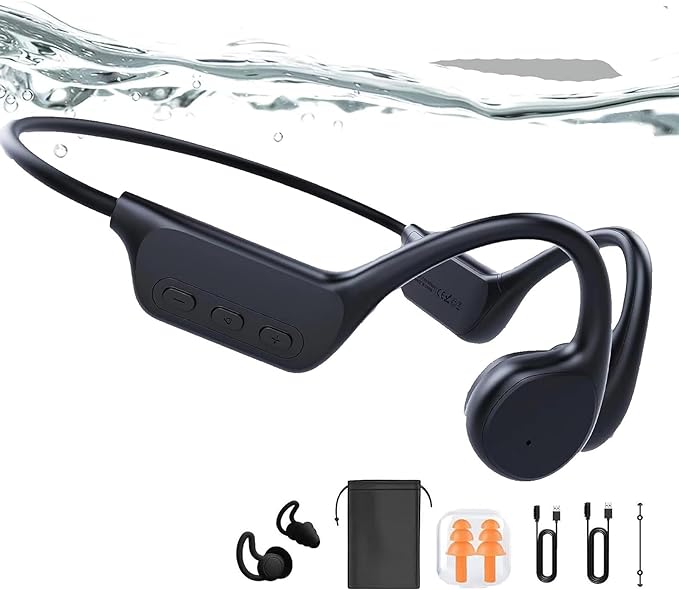
Bone conduction headphones designed for swimming solve this by including internal storage. You load MP3 files directly onto the device, eliminating the need for a wireless signal underwater. The transducer vibrates against your cheekbones, transmitting sound through bone regardless of the water surrounding you.
The engineering requirement here is twofold: the transducer must maintain firm contact with bone despite water pressure changes at depth, and the device must carry an IP68 waterproof rating—defined as continuous submersion at 2 meters for 2 hours or more. Water pressure at the bottom of a typical swimming pool (roughly 1.3 atmospheres) can shift a loosely fitted device, degrading the bone-to-transducer contact and increasing impedance loss.
Who Benefits, Who Does Not
Bone conduction is most effective for people with conductive hearing loss—damage to the eardrum or ossicles—because it bypasses those structures entirely. For people with sensorineural hearing loss (cochlear or nerve damage), bone conduction offers no advantage because the signal still arrives at the same damaged cochlea.
For athletes and swimmers, the value is practical rather than audiophilic. Bone conduction keeps ear canals open, allowing environmental awareness during outdoor runs and providing a way to listen to audio underwater where Bluetooth simply fails.
People with particularly thick soft tissue at the contact points, or reduced skull bone density, may find bone conduction underwhelming regardless of the device quality. The limiting factor is biological, not technological.
The Unresolved Question of Fidelity
Bone conduction technology has improved substantially over the past decade, but a fundamental constraint remains: the human skull is not a neutral conductor. It is a living, variable, complex structure with its own acoustic properties that color every signal passing through it.
Engineers designing bone conduction devices face a problem that conventional headphone designers do not. A speaker designer can control the driver, the enclosure, and the tuning. A bone conduction designer controls only the transducer. The rest of the signal path—skin, tissue, bone, fluid—is biological infrastructure that varies from person to person and changes over a lifetime.
This is not a limitation to be solved. It is a characteristic to be understood. Bone conduction does not aim to replicate the experience of high-fidelity air conduction. It delivers sound through a different channel, with different trade-offs, for situations where air conduction is impractical or impossible.
The physics have not changed since Beethoven bit down on his wooden rod. We just have better rods now.
Wireless Earbuds
Related Essays

The Impossible Sound: How MIT Research Bent the Rules of...

The Science of Wireless Audio: How Your Earbuds Create Immersive Sound

The Invisible Force: How Personal Audio Devices Create Sound from Silence
Joysico YS3: Your Ultimate Workout Companion for Uninterrupted Audio Bliss

Mood Pie C9 True Wireless Earbuds: Your Daily Jamming Companion

TECKNET TK-HS008 Wireless Headphones: Your Ideal Choice for Music on the Go

H2O Audio Stream 3 and Surge S+ Earbuds – Waterproof MP3 Player for Swimming

Aftershokz New Xtrainerz Bone Conduction Wireless MP3 Swimming Headphones – Innovative Audio Solution for Swimming

IKXO Waterproof Bone Conduction Headphones - A Unique Listening Experience
