The Physics of Through-Wall Audio: Why RF Technology Outperforms Bluetooth for Home Theater


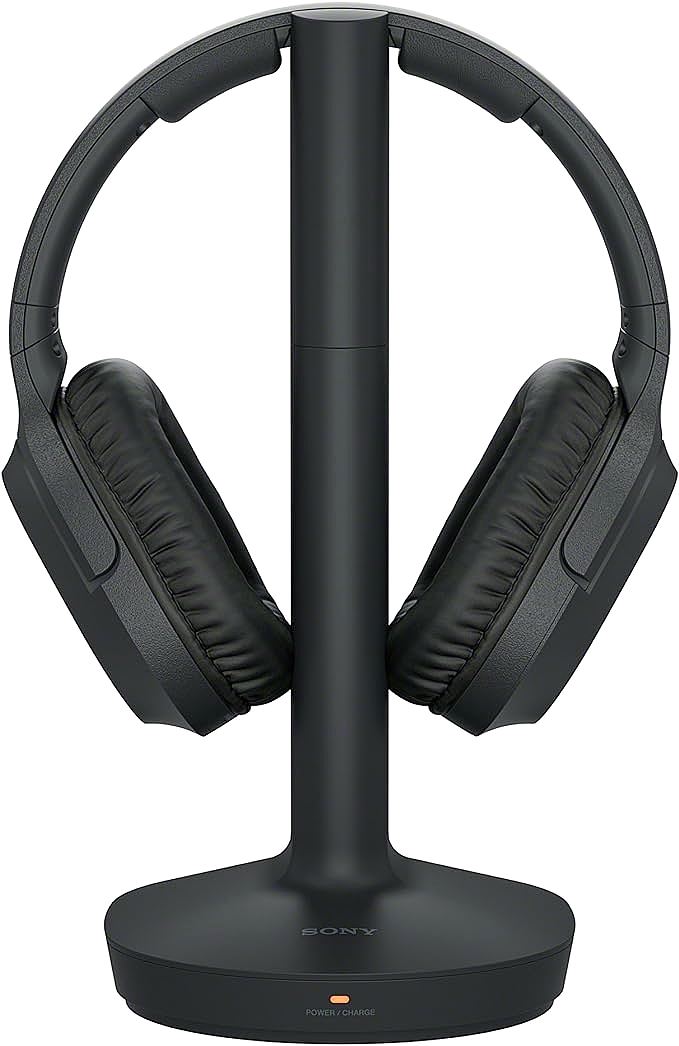
Sony RF995RK Wireless RF Headphones
In the modern smart home, "Wireless" usually means Bluetooth or Wi-Fi. These technologies operating in the 2.4GHz and 5GHz bands have revolutionized how we connect. Yet, for a specific application—watching television wirelessly throughout a house—they often fail. The signal drops when you walk into the kitchen; the audio lags behind the video, ruining the lip-sync; pairing glitches interrupt the movie.
It seems counterintuitive that an older technology, Radio Frequency (RF) modulation, would offer a superior solution. But physics does not care about "newness." The Sony RF995RK Wireless RF Headphones rely on fundamental laws of electromagnetic propagation that give them a distinct edge over modern digital protocols for this specific use case.
This article dissects the "Physics of Through-Wall Audio." We will explore the relationship between frequency and wavelength, the mechanics of Analog FM Modulation, and why, when it comes to range and latency, the old ways are sometimes the best ways.
The Electromagnetic Spectrum: The Battle of Bands
To understand why your fancy Bluetooth earbuds cut out when you walk behind a fridge, but the Sony RF995RK keeps playing, we must look at the Electromagnetic Spectrum.
Bluetooth operates at 2.4 GHz (Gigahertz). RF headphones typically operate in the 900 MHz (Megahertz) band (specifically 915 MHz ISM band in the US).
Wavelength and Penetration
The relationship between frequency ($f$) and wavelength ($\lambda$) is inverse:
$$\lambda = c / f$$
(where $c$ is the speed of light)
- 2.4 GHz (Bluetooth): Wavelength is approx. 12.5 cm.
- 900 MHz (RF): Wavelength is approx. 33 cm.
Why does this matter? Diffraction and Penetration.
Longer wavelengths (RF) are better at bending around obstacles and passing through solid objects like drywall and furniture. A 33cm wave can "ignore" small obstructions that would scatter or block a 12cm wave. This gives RF headphones a "through-wall" capability that Bluetooth struggles to match. While Bluetooth creates a "Personal Area Network" (PAN) of ~30 feet, RF creates a "Home Area Network" of 150 feet.
Zero Latency: The Speed of Analog
The bane of wireless TV audio is Latency (lip-sync error). When the actor moves their lips, and the sound arrives 200ms later, the immersion is broken.
* Digital (Bluetooth): Signal must be Digitized (ADC) -> Compressed (Codec) -> Packetized -> Transmitted -> Buffered -> Depacketized -> Decompressed -> Converted to Analog (DAC). This processing chain takes time. Even "Low Latency" aptX is ~40ms. Standard Bluetooth is 150ms+.
* Analog (RF): The Sony RF995RK uses Frequency Modulation (FM). The audio signal from the TV directly modulates the carrier wave.
* Signal enters base -> Modulator varies the 900MHz wave -> Antenna transmits -> Headphone receives -> Demodulator extracts audio.
* There is no buffering. No compression. No packets.
* The signal travels at the speed of light. The processing time is virtually instantaneous.
Result: Perfect lip-sync, every time. For gaming or action movies, this analog immediacy is perceptually superior to digital transmission.
Signal Integrity: The Base Station Advantage
Unlike Bluetooth headphones which cram the antenna, battery, and receiver into the earbud, RF headphones use a dedicated Base Station (Transmitter). * Power Output: The base station plugs into the wall. It can transmit at a higher power level (within FCC limits) than a battery-powered smartphone. This higher signal strength improves the Signal-to-Noise Ratio (SNR) at distance. * Antenna Geometry: The base station allows for a larger, more efficient antenna design compared to the microscopic ceramic antennas in earbuds. This improves transmission efficiency and reduces "dead spots" caused by multipath interference.
The Trade-off: Noise Floor and Interference
Physics is a zero-sum game. The advantages of Analog RF come with a disadvantage: The Noise Floor.
In digital systems, you either get the signal (perfect silence) or you don't (drop out). In analog FM, as the signal gets weaker (distance), the background static (hiss) gets louder.
* Interference: The 900MHz band is shared with other devices (older cordless phones, baby monitors). The Sony RF995RK includes a Noise Reduction System (likely a compander circuit: compress at source, expand at receiver) to mitigate this hiss, but it can never be as "black" as digital silence.
* Tuning: Unlike digital pairing, analog RF requires "Tuning" to lock onto the carrier frequency. The RF995RK handles this automatically, but users may occasionally hear static drift, a reminder of the analog nature of the tech.
Battery Life: The Chemistry of Longevity
The RF995RK uses Ni-MH (Nickel-Metal Hydride) rechargeable batteries. Crucially, these are standard AAA form factor. * Sustainability: Most modern headphones seal a Lithium-Ion pouch inside. When that battery dies (3-5 years), the headphone is trash. With the Sony, you can simply buy new rechargeable AAA batteries. This design choice effectively makes the headphones immortal. * Runtime: The lower power consumption of analog reception allows for up to 20 hours of playback. Since there is no complex digital processor to feed, the energy goes efficiently into the driver and the receiver.
Conclusion: The Right Tool for the Job
The Sony RF995RK is not designed to replace your AirPods on the subway. It is a specialized tool for the home. It leverages the physics of Longer Wavelengths for range and Analog Modulation for zero latency.
In a world obsessed with "Smart" everything, this "Dumb" analog technology offers a reliability that digital protocols often miss. It connects you to your content instantly, through walls, and without lag. It proves that sometimes, the best way to move forward is to respect the physics of the past.
Sony RF995RK Wireless RF Headphones
Related Essays

The Wireless Handshake: Bluetooth 5.3, Frequency Hopping, and the Quest for Stability

Size Matters: The Acoustics of 10mm Drivers and the Efficiency of Bluetooth 5.3

