Engineering for the Human Variable: Ergonomics, Durability, and Energy Density in Wearables


KENKUO TG911 Wireless EarBuds
Designing electronic devices that interface directly with the human body presents a unique set of engineering challenges. Unlike a smartphone that sits in a hand or a laptop that rests on a desk, an earbud must reside within a sensitive, geometrically complex, and humid biological cavity—the ear canal. Success in this domain is not measured solely by electronic specifications but by how well the hardware accommodates the "human variable."
The functionality of a device like the KENKUO TG911 depends heavily on three physical interaction points: the mechanical fit within the ear (ergonomics), the resistance to environmental factors (durability), and the management of energy constraints (battery density). Analyzing these aspects reveals the complex interplay between material science and user experience.

Anthropometry and Passive Isolation Mechanics
The human ear canal is not a uniform cylinder; it is an S-shaped tube with varying diameters and cartilaginous flexibility. A "one size fits all" approach is mechanically impossible in this context. To solve this, manufacturers utilize a nozzle-and-tip system. The nozzle houses the driver and directs sound, while the interchangeable silicone tip acts as the mechanical interface.
The TG911 addresses anthropometric variance by providing three sizes of ear tips. The engineering goal here is two-fold: retention and isolation.
1. Retention: The silicone tip relies on friction against the skin of the ear canal to counteract the gravitational pull on the 3.5g mass of the earbud. The coefficient of friction of the silicone, combined with the radial pressure exerted by the compressed tip, secures the device during head movement.
2. Passive Noise Isolation: This is the acoustic equivalent of a hermetic seal. When the tip expands to fill the canal cross-section, it creates a physical barrier that attenuates high-frequency environmental noise (wavelengths shorter than the obstruction). This "occlusion effect" is critical for bass performance. If the seal is broken, low-frequency pressure waves escape the canal rather than vibrating the eardrum, resulting in a thin, tinny sound regardless of the driver's capability.
The Physics of Environmental Hardening (IPX5)
Wearable electronics exist in a hostile environment characterized by moisture, salt (from sweat), and dust. The IP (Ingress Protection) code, defined by IEC standard 60529, quantifies a device's resistance to these elements. The KENKUO TG911 carries an IPX5 rating.
- The "X": Indicates that the device has not been formally rated for dust protection, though the seals required for water generally offer significant dust resistance.
- The "5": Specifies protection against water jets. Technically, this means the device can withstand water projected by a 6.3mm nozzle at 12.5 liters per minute from any direction for at least 3 minutes.
Achieving this requires specific manufacturing techniques. The casing seams are typically bonded with ultrasonic welding or water-resistant adhesives. The microphone ports and pressure relief vents are covered with hydrophobic meshes—materials treated at the nano-scale to repel water molecules while allowing air (sound) to pass through. Internally, the circuit boards (PCBs) are often coated with a conformal coating (like parylene) that prevents corrosion even if microscopic amounts of moisture penetrate the outer shell. This engineering ensures reliability during exercise or precipitation, preventing the short-circuits that kill unprotected electronics.
Energy Density and Power Management
The spatial constraints of an earbud dictate the size of the power source. The TG911 incorporates a 40mAh battery in each earbud and a 500mAh battery in the charging case. These are typically Lithium-Ion (Li-ion) or Lithium-Polymer (Li-Po) cells, chosen for their high energy density.
The power management architecture operates on a micro-cycle logic. The earbuds, operating on a 3.7V nominal voltage, consume power in the milli-watt range. The Bluetooth 5.2 chipset plays a vital role here, dynamically adjusting transmission power based on signal strength to conserve energy. * The Charging Handshake: When the earbuds are placed in the case, pogo pins make contact with the charging pads. The case's internal Battery Management System (BMS) detects the load and initiates charging, stepping down the voltage to safely charge the small 40mAh cells. * Total Autonomy: The mathematical relationship between the case capacity and earbud capacity (500mAh / 40mAh * 2) suggests a theoretical recharge capability of roughly 6 full cycles, accounting for conversion losses. This extends the "off-grid" time to approximately 30-35 hours, a critical specification for users who may not have access to a USB-C outlet for days.
Human-Computer Interaction: Capacitive Sensing
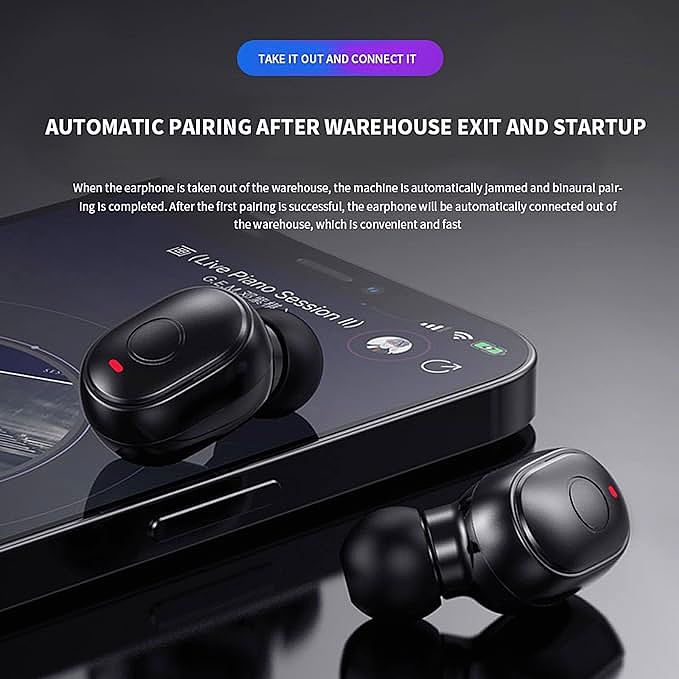
Eliminating physical buttons on earbuds is an engineering decision driven by comfort and sealing. Physical buttons require actuation force, which pushes the earbud deeper into the canal, causing discomfort. The TG911 utilizes capacitive touch sensors.
These sensors work by generating an electrostatic field. The human body is conductive and has dielectric properties. When a finger approaches the sensor area, it acts as a capacitor plate coupled to the ground, altering the capacitance of the sensor's electrode. The controller chip detects this change and registers it as a "touch." The challenge in firmware engineering is tuning the sensitivity to distinguish between a deliberate tap and an accidental brush against hair or a hoodie. Smart Touch Control algorithms implement timing windows (e.g., distinguishing a double-tap from two single taps) to ensure user intent is interpreted correctly.
Industry Implications
The engineering choices found in devices like the TG911 reflect a mature supply chain where advanced materials (hydrophobic meshes, high-density batteries) and protocols (Bluetooth 5.2) have become accessible. For the end-user, this means that durability and ergonomic stability are no longer premium features but expected standards. As battery technology improves, future iterations will likely focus on even smaller form factors or the integration of health-monitoring sensors without compromising the acoustic or ergonomic baseline established by current designs.
KENKUO TG911 Wireless EarBuds
Related Essays

Passive Noise Isolation: How a Silicone Seal Outsmarts...

The Analog Advantage: Why the LORELEI X6's Wired Tech Beats Wireless on a Budget

The Physics of Your Wired Earbuds, Explained

The Physics of Foam: Why the Koss 'The Plug' Wireless...

The Physics of Silence: Decoding 30dB Reduction and...

The Anatomy of Audio: Physics of Dynamic Drivers and Passive Isolation

Wood Acoustics and Analog Signal Paths: The Physics Behind Natural Sound

Passive Noise Isolation and 38-Hour Battery Life: How Physical Sealing Outperforms Active Circuitry

Why Your Earbuds Don't Need Active Noise Cancellation: The Physics of Silence

