Decoding Sport Earbud Tech: Bluetooth 5.4, IP7 & ENC

Rolosar Q76 Wireless Earbuds
If you have ever stared at a sport earbud spec sheet and felt your eyes glaze over, you are not alone. "Bluetooth 5.4." "IP7 waterproof." "ENC noise canceling." "14.2mm double-layer diaphragm." Each term is a small black box, and none of them tell you whether the buds will survive a sweaty run, stay planted during box jumps, or keep your podcast intelligible on a busy street.
This guide decodes them the way an engineer would, using one concrete, widely sold pair as the running example: the Rolosar Q76 Wireless Earbuds, ASIN B0DNZB2WJ4. Every number we unpack is a number this product ships with, and every principle transfers to whatever you end up buying. Our reference point is the Bluetooth 5.4 IP7 sport earbuds that dominate most gym-floor shelves right now.
Fit Is the Foundation: Why Ear Hooks Beat In-Ear Friction
Before sound, before battery, before any number on the box, there is a single question that decides whether a sport earbud works at all: will it stay in your ear when you move? A conventional in-ear bud stays through friction alone, and that grip is the only thing holding it in place until your stride or a deadlift sends vibrations through the whole head.
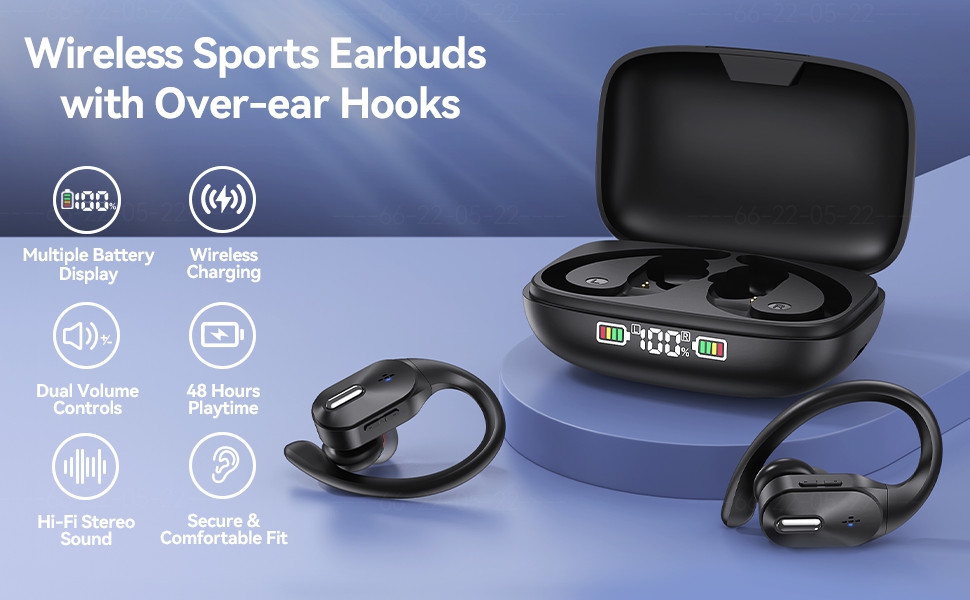
The Rolosar Q76 solves this with a flexible ear hook that loops over the cartilage of your outer ear. That structure is the most stable real estate on the side of your head, so the hook carries the mechanical load and the silicone tip no longer has to grip hard enough to do everything on its own. The result is a two-point contact system: hook on top, tip seal in the canal, and the bud rides on both at once.
Fit is also where sizing matters, and the pair ships with three ear-tip sizes, labeled S, M and L, so you can match the seal to your own canal diameter. A tip that is too small leaks bass and the driver performance collapses; a tip that is too large fatigues the canal within 20 minutes. The correct tip size, combined with the hook, is what lets a sport bud hold through explosive movement. The JLab Go Sport+ and the TRAUSI open-ear models use the same hook-plus-tips approach, which is why every serious workout pair on the shelf converges on this one design.

What to look for: a flexible ear hook made of a soft-touch material, plus at least three ear-tip sizes in the box. If a sport earbud ships with neither, it was designed for the commute, not the workout.
Sweat, Rain, and the Truth About IP7 Waterproofing
Waterproofing is the most abused word in consumer audio. Every box claims it; almost none of them mean the same thing. The honest number is the IP Code, an international standard (IEC 60529) that defines exactly how resistant a device is to solids and liquids.
The Q76 carries an IP7 rating, and read the standard carefully and it says something very specific: the device survives submersion in up to 1 meter of fresh water for up to 30 minutes, measured under controlled laboratory conditions. Two details are worth drawing out. First, the rating is written informally as IP7, but the first digit is technically an X because the product has not been formally rated against dust. Second, 1 meter of static submersion is a far more violent test than sweat or rain will ever produce on your body.
That is the real reason IP7 matters for an athlete: it is not that you will swim laps with them, it is that the seal protecting the driver and the Bluetooth chip is robust enough to shrug off the corrosive, repeated moisture that kills cheaper sport earbuds within a single season. A downpour on a long run, a grueling HIIT session, even an accidental drop into a sink, all sit comfortably inside the IP7 budget.
What to look for: an explicit IP rating, not the word "waterproof." IPX7 or better is the sweet spot for sport. If a brand only says "sweat resistant" with no number behind it, treat it as untested.
The Wireless Lifeline: What Bluetooth 5.4 Changes
This connection is the invisible backbone of a good workout, because dropouts and stutters ruin a motivating playlist faster than almost anything else. The Q76 pairs over Bluetooth 5.4, the most recent mainstream version of the standard, and the number is doing real work rather than just being a bigger digit.
To understand why, think of Bluetooth as a highway for your audio data. Bluetooth 4.x was a two-lane road that congested the moment your phone left the room or your body got in the way. Bluetooth 5.x is a multi-lane highway, and each revision adds smarter traffic management. The jump from 5.3 to 5.4 brought three concrete gains: a more robust and stable signal, lower power consumption on both the buds and the phone, and the groundwork for ultra-low latency listening, with about 2 times the transfer speed of 5.3.
Those three gains map directly onto real use. The more robust signal means fewer dropouts when your phone sits in a gym bag across the room, with a workable range of roughly 30 feet. The lower power draw is a direct ingredient in the long battery life covered in the next section. The low-latency behavior keeps the audio you hear in sync with the video you watch, which matters when you follow a form-check clip between sets.
Bluetooth 5.4 also underpins the small quality-of-life feature buyers love: open the charging case and the buds reconnect automatically to the last paired device. That auto-pairing feels trivial until the day it does not work and you are manually re-pairing before a run.
What to look for: Bluetooth 5.3 or 5.4. The difference between 5.2 and 5.4 in daily use is real but modest, so treat 5.3 as the floor and 5.4 as the current sweet spot.
Sound You Can Feel: Decoding the 14.2mm Driver
The sound is the third pillar to decode, and it starts inside the earbud. Inside every earbud is a driver, a tiny speaker whose diaphragm vibrates to produce the sound waves you hear. The Q76 uses a 14.2mm driver, which is large for an in-ear bud, and pairs it with a double-layer diaphragm. In this price band most sport buds cluster between 12-14mm, and the Q76 sits at the top of that range.
Driver size matters because of air. A larger diaphragm moves more air, and moving more air is what produces deep, impactful bass. This is the same reason a full-size headphone can reproduce sub-bass that a tiny bud physically cannot. The 14.2mm size gives the Q76 a real advantage on low-frequency energy, so kick drums and bass lines carry weight instead of sounding thin. A 12mm driver is the healthy floor for sport; anything smaller starts to run out of bass.
The double-layer diaphragm is the more subtle part of the story. A driver diaphragm has an impossible engineering brief: it must be stiff enough to reproduce sound accurately without distortion, and light enough to respond instantly to the signal. Those two goals fight each other, which is why manufacturers build a diaphragm out of more than one layer of material, balancing stiffness and responsiveness. The result the Q76 aims for is a Hi-Fi signature: strong bass, clear vocals in the midrange, and crisp highs.
What to look for: driver size in millimeters, ideally 12mm or larger, and a named diaphragm construction when the brand shares it. Bigger is not automatically better, but a larger driver with a tuned diaphragm is what gives you the low end you can feel during a heavy set.
Being Heard: Why ENC Is Not the Same as ANC
This is the single most confusing label for buyers, and getting it wrong leads to real disappointment. The Q76 lists an ENC noise-canceling microphone, and it is important to understand that this is a different technology from the active noise cancellation most people picture.
Active noise cancellation, or ANC, is for your listening experience. It uses outward-facing microphones to sample the hum of an airplane cabin or a subway car and generates an anti-noise wave to cancel it before it reaches your ear. It changes what you hear. ANC is wonderful on a flight and largely irrelevant on a trail run.
Environmental noise cancellation, or ENC, is for your call quality. It is a smart filter applied to your microphone: the algorithm listens to everything around you, identifies your voice, and suppresses the background chaos, the clang of weights at the gym, the wind on a bike path, the chatter of a cafe. It does not change what you hear; it changes what the person on the other end of the call hears. That is why it is the more practical of the two for a sport earbud, because the moment you are most likely to take a call is exactly the moment you are in a noisy environment.
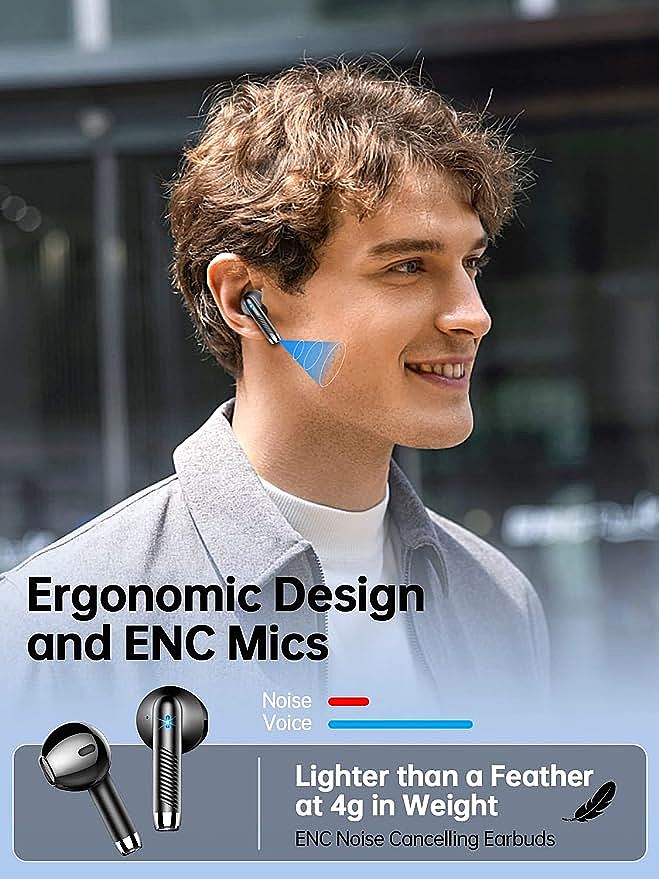
What to look for: ENC if you take calls while training. ANC only if you also want to block out the world while resting, and understand that it usually adds cost and can slightly color the sound signature.
The Marathon Mentality: Battery, Charging, and the Dual LED Display
Battery life is where sport earbuds win or lose, and the Q76 leans into it. It quotes roughly 10 hours of playback on a single charge of the buds, with the charging case adding enough capacity to bring the total to about 50 hours. For a workout pair that is a 10-50 hour range, far ahead of the 4 to 5 hours a typical commuting earbud ships with.
Put that in training terms. If you work out for 1 to 2 hours a day, five days a week, 10 hours of bud life means a single charge carries you through the entire week. The case, refilled only every 3 to 4 weeks, turns battery anxiety into a non-issue.
The physical charging details matter too. Each bud weighs about 4 g, light enough that you stop noticing them mid-workout. The Q76 charges over USB-C, the universal reversible standard, so you can share a cable with your phone instead of hunting for a different lead. And the case includes a dual LED display that shows the remaining charge of both the case and each individual bud. At a glance you can see whether the buds you are about to put in really have power, a readout you only appreciate after trying a pair without one.

Modern convenience extends to controls. The buds use smart touch surfaces to play and pause music, skip tracks, adjust volume, answer calls, and summon your voice assistant. During a workout, reaching for your phone is not an option; being able to tap the bud and keep moving is what keeps your flow intact.
From Numbers to a Real Decision
You started with a wall of acronyms, and you should now hold a working mental model of what each one does for your body. Fit, anchored by an ear hook and the right tip size, is the make-or-break feature. IP7 waterproofing means the electronics will survive sweat and rain for years. Bluetooth 5.4 gives you a stable, efficient, low-latency connection that sips power. The 14.2mm double-layer driver delivers the bass that makes a workout feel powerful. ENC keeps your voice clear on calls in loud places. And a 10-hour, 50-hour-total battery with a dual LED display means you think about charging once a month instead of once a day.
None of these features exist in isolation, and that is the real lesson. A great sport earbud is a system in which the fit keeps the driver stable, the Bluetooth keeps the signal clean, and the battery keeps the whole thing alive long enough to matter. The Rolosar Q76 is one product where all of those pieces line up at a reachable price, and the market around it is full of close cousins: the JLab Go Sport+ and the CASCHO pair with LED displays both ride on the same hook-plus-display template.
The next time you pick up a box, you will not be reading the marketing. You will be reading the numbers, and you will know exactly which ones deserve your attention and which are there only to fill space.
Rolosar Q76 Wireless Earbuds
Related Essays

How Sport Earbuds Stay Sealed and Stable While You Run

Why Your Sport Earbuds Seem Broken: 4 Fixes That Work

Hadbleng Q28S Discontinued: The Q22 Steps In

What IP7, Bluetooth 5.3, and 140H Battery Actually Mean for...

How Wireless Earbuds Work: The Tech That Powers Your Sound

What Bluetooth 5.3, IPX7, and ENC Do for Your Earbuds

Nerunsa D60 Pro Earbuds: Bluetooth 5.4 and ENC Explained
Why Earbuds Fall Out on Your Run: The Engineering Fix

DOBOPO A20-1 Wireless Earphones: A Sweat-Proof Battery Beast for Workouts
