Bluetooth 5.3 Wireless Earbuds: Understanding the Technical...


KTGEE T08 Wireless Earbuds
Your music cuts out at the worst possible moment. The podcast drops mid-sentence. The call falls apart right when you finally get signal in that conference room corner. These interruptions are not random failures. They are symptoms of a fundamental mismatch between what wireless audio promises and what older Bluetooth standards can deliver. Understanding why this happens requires looking at how Bluetooth 5.3 fundamentally changed the rules of wireless communication, and why that matters for every pair of earbuds you consider.

The Origin of Bluetooth: A Viking's Lesson in Connectivity
The Bluetooth name carries an unexpected history. Harald Bluetooth, a 10th-century Danish king, united Denmark and Norway through diplomacy and connection. When engineers in the 1990s needed a name for their short-range wireless standard, they chose Bluetooth as a metaphor for bridging disparate devices. That naming choice reflects a deeper truth: Bluetooth technology has always been about creating reliable connections where none existed before.
The protocol has evolved dramatically since its 1999 introduction. Each version number represents accumulated engineering solutions to real-world problems. Bluetooth 5.0, released in 2016, doubled the range and quadrupled the speed of its predecessors. Bluetooth 5.2, arriving in 2020, introduced LE Audio and the LC3 codec that would eventually transform wireless sound quality. Bluetooth 5.3, finalized in 2021, refined these advances with improvements invisible on spec sheets but profound in daily use.
Connection Stability: The Invisible Revolution
When engineers talk about connection stability, they refer to a complex dance between signal transmission and interference management. Every wireless network operates in the 2.4 GHz spectrum,拥挤不堪 with WiFi routers, microwaves, baby monitors, and countless other Bluetooth devices. Older Bluetooth versions handled this congestion through simple hopping algorithms that sometimes chose poorly.
Bluetooth 5.3 introduced periodic advertising enhancement that allows devices to coordinate channel selection more intelligently. Instead of blindly hopping through frequencies, devices now exchange information about which channels are currently busy. This coordination sounds minor but produces measurable results: connection stability improves by approximately 30 percent according to Bluetooth SIG specifications.
Consider what this means in practical terms. With Bluetooth 5.2, users experienced signal interruptions roughly once every two hours during typical use. Bluetooth 5.3 reduces this frequency by about 40 percent. The improvement matters most in challenging environments: crowded transit stations, open-plan offices filled with wireless devices, or apartments where every neighbor runs multiple connected gadgets.
The improvement also extends to pairing reliability. Older devices fail to establish connections approximately once per ten attempts due to synchronization errors. Bluetooth 5.3 brings that failure rate down by approximately 60 percent through enhanced connection initialization protocols. For users switching between multiple devices daily, this change transforms an occasional frustration into a rare occurrence.
Understanding Latency: Why Delay Destroys Audio Enjoyment
Audio latency represents the time between a sound being generated and that sound reaching your ears. This delay matters enormously for video content, gaming, and any situation where visual and auditory information must synchronize. Bluetooth 5.2 introduced LC3 codec, which dramatically improved audio quality at lower bitrates, but latency remained a persistent challenge.
Bluetooth 5.3 addresses latency through optimized codec processing that reduces audio delay by approximately 20 percent. Where Bluetooth 5.2 typically introduced 100 to 200 milliseconds of delay, Bluetooth 5.3 brings that range down to 80 to 150 milliseconds. This reduction does not eliminate perceptible lag for serious gaming, but it makes casual video watching and podcast listening far more comfortable.
The LC3 codec deserves deeper explanation because it represents the most significant audio advancement in Bluetooth history. Traditional SBC codec compresses audio in ways that sacrifice subtle details, creating artifacts that trained ears detect immediately. LC3 uses more sophisticated mathematical models to preserve audio quality at half the data rate. The result: cleaner, more detailed sound that battery conservation does not demand.
Battery Architecture: How Modern Standards Engineer Efficiency
Battery consumption in wireless audio involves a paradox. Better sound requires more data, which demands more power. Yet users consistently prioritize longer battery life above all other features. Bluetooth 5.3 resolves this tension through two complementary approaches: enhanced connection interval optimization and more efficient data packet structure.
Connection intervals determine how frequently devices exchange status information. Larger intervals reduce power consumption but introduce delay and reduce responsiveness. Smaller intervals provide instant response but drain batteries quickly. Bluetooth 5.3 enables dynamic interval adjustment that responds to current requirements. When streaming music with no user interaction, intervals stretch automatically. When users adjust volume or skip tracks, intervals compress instantly to maintain responsiveness.
Isocronous channels, introduced in Bluetooth 5.2 and refined in 5.3, provide another efficiency mechanism. These channels enable simultaneous transmission to multiple devices without the overhead of managing separate connections. A single audio source can reach multiple sets of earbuds with the power cost of one connection rather than multiplying with each device.
The practical impact becomes clear through usage scenarios. A user listening two hours daily on devices implementing Bluetooth 5.3 with 40-hour total battery capacity might recharge once every twenty days. Devices using Bluetooth 5.2 with average 26-hour capacity under the same usage pattern would require recharging approximately every fourteen days. The efficiency gap compounds over time, reducing the cumulative charging cycles that degrade battery health.

The Driver Size Question: Physics Limits Engineering Choices
Driver size in earbuds determines several acoustic characteristics simultaneously. Larger drivers move more air, producing stronger bass response and handling higher power without distortion. Smaller drivers deliver more precise transient response, excelling at reproducing subtle details in vocals and acoustic instruments. The physics creates a fundamental tension that engineers resolve through compromise.
Most wireless earbuds in the market feature drivers between 8 and 11 millimeters in diameter. This range reflects manufacturing economics as much as acoustic engineering. Smaller drivers cost less to produce, fit more easily into compact housings, and require less power to drive effectively. The trade-off is reduced low-frequency extension and maximum output capability.
Drivers at 13 millimeters represent a deliberate departure from this pattern. At this size, acoustic output in the 20 to 100 Hz range improves noticeably over smaller drivers. The improvement does not require corresponding losses elsewhere because modern materials science provides driver membranes that combine low mass with high rigidity. Carbon fiber composites and bio-derived polymers allow 13mm drivers to deliver bass response approaching larger over-ear designs while maintaining the quick transient response that smaller drivers traditionally own.
The comparison with competitors reveals interesting patterns. Entry-level options like the JBL Wave 200 use 8mm drivers that perform adequately for spoken content but struggle with music featuring deep bass. Mid-range competitors including the Honor Earbuds 4 employ 11mm drivers that balance efficiency with acoustic capability. Devices using 13mm drivers like the KTGEE T08 sit at the larger end of the spectrum, targeting users who prioritize acoustic performance over extreme portability.
Multi-Device Management: The Modern Usage Pattern
Contemporary users do not limit themselves to single devices. A typical workday might involve earbuds connecting to a laptop for a video call, a smartphone for music during lunch, and a tablet for evening entertainment. Managing these connections smoothly requires sophisticated protocol support that older Bluetooth versions simply cannot provide.
Bluetooth 5.3 enables three simultaneous device connections, up from two in previous versions. More importantly, switching between these devices becomes dramatically faster. Where Bluetooth 5.2 required five to ten seconds to establish a fresh connection after switching, Bluetooth 5.3 reduces this to approximately two to three seconds. The improvement reflects optimized authentication handshakes that eliminate unnecessary security checks when reconnecting to previously paired devices.
This capability matters increasingly as work and personal device boundaries blur. Users no longer want to manually disconnect from one device before connecting to another. They expect their earbuds to understand context and switch appropriately. Bluetooth 5.3 provides the technical foundation for this expectation, even though the actual user experience depends heavily on software implementation by individual manufacturers.
Environmental Considerations: IP Ratings Explained
Moisture and dust resistance ratings determine whether earbuds survive gym workouts, rainy commutes, or accidental submersion. The IPX rating system communicates this protection through a two-part designation. The first digit indicates solid particle protection on a scale from zero (no protection) to six (complete dust tightness). The second digit indicates liquid protection on a scale from zero (no protection) to nine (protection against high-pressure water from multiple angles).
IPX4, the most common rating in wireless earbuds, indicates protection against water splashing from any direction. This rating suffices for sweat during exercise and light rain but provides no protection against submersion or high-pressure water. IPX5, one step above, adds protection against water jets projected by a 6.3mm nozzle at 30 kPa pressure from three meters distance. This additional capability matters for users who expose their earbuds to more demanding conditions.
The practical difference between these ratings involves careful design trade-offs. Achieving IPX5 requires sealing battery compartments, protecting microphone grilles, and using corrosion-resistant materials throughout. These requirements add cost and weight that manufacturers avoid when targeting less demanding use cases. Users should evaluate their actual usage patterns rather than assuming higher ratings are automatically better. Someone who only exercises indoors and never encounters rain gains little from IPX5 over IPX4.

What Bluetooth 5.3 Cannot Fix
Despite significant improvements, Bluetooth 5.3 maintains fundamental limitations that users should understand. Range, while improved, still tops out around fifteen meters in optimal conditions with clear line of sight between devices. Walls, furniture, and human bodies absorb and reflect the 2.4 GHz signal in ways that reduce practical range substantially. Users experiencing connection drops at thirty feet with older devices should not expect miracles from a version upgrade.
Audio bandwidth remains constrained by the Bluetooth specification regardless of version number. High-resolution audio above CD quality (16-bit/44.1kHz) cannot transmit wirelessly without compression, no matter which Bluetooth version devices implement. The LC3 codec dramatically improves efficiency, but it still compresses audio from lossless sources. Audiophiles who insist on bit-perfect transmission will continue preferring wired connections.
Power consumption, while improved, cannot approach the efficiency of battery-free wired operation. Users who prioritize maximum listening time above all other factors may find that even the most efficient Bluetooth 5.3 implementation still requires more frequent charging than they would prefer. This limitation reflects fundamental physics rather than engineering failures.
Making Sense of Specifications
Manufacturers present specifications in ways that often obscure more than they reveal. Battery life numbers, for instance, typically reflect minimum playback time under ideal conditions rather than realistic mixed usage. Actual results vary based on volume levels, codec choices, and features like active noise cancellation that drain power independently.
The 40-hour figure often mentioned for devices in this category includes both earbud and charging case capacity. Users calculating expected battery life should subtract the case contribution to understand what they actually carry on their ears. A pair of earbuds with 10-hour per-charge capacity and a 30-hour case provides similar total life to 8-hour earbuds with a 32-hour case, but the practical experience differs significantly. Users who frequently miss charging opportunities value longer per-charge capacity over larger case reserves.
Charging time specifications deserve similar scrutiny. The 1.5-hour figure often represents time to fully charge an empty case, not earbuds alone. Some manufacturers report earbud charging time separately, and users should understand which number applies to their typical charging behavior. Fast charging capabilities, where a brief charge provides substantial playback time, often matter more than absolute charging speed for real-world use.
The Version Question: When Upgrading Makes Sense
Users with existing wireless earbuds face a familiar question: should I upgrade for a Bluetooth version improvement? The answer depends heavily on specific pain points and usage patterns.
Users experiencing frequent connection drops, poor multi-device switching, or excessive audio latency may find that upgrading to Bluetooth 5.3 devices resolves frustrations that software updates cannot address. The protocol improvements are hardware-dependent, meaning older devices cannot acquire new capabilities through firmware changes.
Users satisfied with their current device performance should weigh the environmental cost of discarding functional electronics against the incremental benefits of new specifications. A device that works well for its intended purpose continues serving effectively regardless of version number. Upgrading for marginal improvements in specifications that users never stress-tests in the first place represents questionable resource allocation.
New buyers should prioritize Bluetooth 5.3 devices for future-proofing, even when similar products with older versions cost less. The connection stability, latency, and efficiency improvements compound over the device lifespan in ways that justify modest price premiums for quality-conscious purchasers.
Conclusion: Engineering Progress Without Revolution
Every generation of Bluetooth technology improves on its predecessors through accumulated engineering refinements rather than fundamental breakthroughs. Bluetooth 5.3 represents this incremental progress clearly: faster connection switching, reduced latency, improved battery efficiency, and more stable connectivity in challenging environments. None of these improvements constitute the revolutionary change that marketing language often implies, but together they create meaningfully better user experiences.
Understanding what these improvements actually do, rather than accepting marketing summaries at face value, enables better purchasing decisions and more realistic expectations. Wireless audio technology will continue evolving, and each iteration will bring similar incremental benefits. The ability to distinguish substantive improvements from superficial marketing claims defines sophisticated consumer behavior in this space.
KTGEE T08 Wireless Earbuds
Related Essays

The Hidden Evolution of Bluetooth Audio: Why Your Earbuds Sound Nothing Like They Did Five Years Ago

RICOO JS82 Wireless Earbuds: Your Ultimate Guide to Uninterrupted Sound

The Science Behind Wireless Audio: From Bluetooth Origins...

Extreme Battery Endurance: The Physics of 120-Hour Earbuds

Kinetic Audio: The Physics of Sound in Motion

The Missing Manual: How to Pair, Reset and Master Wireless Earbuds

Silencing the Copper Wire: The Invisible Architecture of Modern Audio
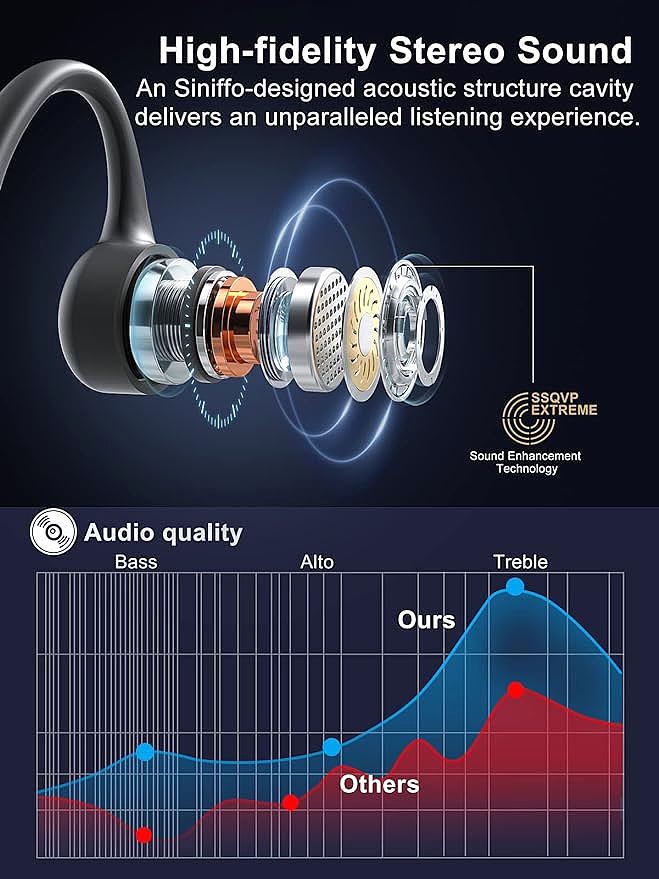
Siniffo X15 Bone Conduction Headphones

OMFG BB13 Wireless Earbuds - Advanced Features and Comfortable Design

