Why Your Earbuds Sound the Way They Do: The Physics Inside a 10-Millimeter Driver

AIHOOR A2 Wireless Earbuds
You bought wireless earbuds with "13mm drivers" expecting thunderous bass. The sound that came out was thin. Hollow. A week later, you tried a friend's pair with smaller drivers, and the bass hit harder, the vocals cut cleaner, the whole presentation felt sharper. Size, it turns out, was never the whole story. The real difference was hiding in a layer of material thinner than a human hair.

The Myth of Millimeter Supremacy
Speaker marketing has a numbers problem. For decades, the audio industry has sold consumers on a simple equation: bigger driver equals better sound. It works on paper. A larger cone moves more air, and more air movement should mean more bass. That logic holds for the 12-inch woofer in your living room, where the listening room has hundreds of cubic feet of air to pressurize. But shrink the listening environment down to the two cubic centimeters between an earbud tip and your eardrum, and the physics flip entirely.
In a pressure chamber that small, the limiting factor is not how much air the driver can shove. It is how precisely the driver can start and stop moving. Mass becomes the enemy. A heavy diaphragm, once set in motion by the voice coil, carries inertia. It wants to keep going after the electrical signal tells it to stop. That overshoot smears one note into the next, turning a crisp kick drum into a muddy thud and blurring the attack of a guitar pick into a wash of harmonic soup. A smaller, lighter, stiffer diaphragm can follow the electrical signal with the fidelity of a tuning fork, striking with physical impact and vanishing the instant the signal ends. This is why a well-engineered 10mm driver with the right materials can outperform a poorly engineered 13mm one.
What Happens When Electricity Meets a Coil
To understand why material matters more than size, you need to understand the mechanism inside every moving-coil driver. At its core, the design has not changed since 1925, when Edward W. Kellogg and Chester W. Rice patented the moving-coil loudspeaker. A voice coil, made of fine copper or aluminum wire wound on a lightweight cylindrical former, sits inside the gap of a permanent magnet. When an audio amplifier sends alternating current through that coil, the electromagnetic field generated by the current interacts with the permanent magnet's field. The coil is pushed and pulled in proportion to the amplitude and frequency of the signal. Attached to the top of that coil is a diaphragm, and the diaphragm pushes air.
The entire chain is a race against time. A bass note at 40Hz asks the diaphragm to complete 40 full oscillations per second. A cymbal shimmer at 10kHz demands 10,000. At those upper frequencies, the diaphragm is accelerating and decelerating so rapidly that the forces involved are extreme. If the diaphragm material flexes, bends, or deforms under that stress, it stops acting like a piston and starts acting like a bell. It resonates at its own natural frequencies, adding tonal coloration that was never in the original recording. The material, not the diameter, determines whether the driver behaves like a precision instrument or a drunk bell.
From Paper to Polymer: A Century of Chasing Stiffness
The earliest loudspeaker diaphragms were made of treated paper. Paper is light, cheap, and possesses decent internal damping, meaning it absorbs some of its own vibrational energy rather than ringing endlessly. But paper absorbs moisture from the air, changes stiffness with temperature, and has a relatively low upper limit on how fast it can accelerate before it buckles and distorts.
In the 1970s and 1980s, Mylar and other biaxially-oriented polyethylene terephthalate films replaced paper in many portable audio applications. These synthetic films offered consistent manufacturing tolerances, immunity to humidity, and better high-frequency response. But like paper, they were single-layer materials asked to perform two contradictory tasks: stay perfectly rigid for high frequencies while flexing far enough to produce low frequencies. No single homogeneous material can do both well. Stiff materials resist deformation, which is what you want at 10kHz, but they crack under the long-throw excursion required at 40Hz. Flexible materials survive the excursion but wobble like jelly at high frequencies, spraying distortion across the treble range.
The solution, when it arrived, came not from audio engineering but from the same materials science laboratories that developed polymers for aerospace and medical implants.

PEEK: The Polymer That Flew First Class
Polyetheretherketone, usually called PEEK, is a semi-crystalline thermoplastic with a resume that reads like fiction. Glass transition temperature of 143 degrees Celsius. Continuous service temperature up to 250 degrees. Tensile strength between 90 and 100 megapascals. Flexural modulus of 3.6 to 4.1 gigapascals. It is used in spinal cages, jet engine components, and semiconductor manufacturing equipment. It costs roughly 10 to 20 times more than the polyethylene terephthalate film found in most budget earbud drivers.
What makes PEEK interesting for audio is its stiffness-to-weight ratio. The flexural modulus figure, those 3.6 to 4.1 gigapascals, tells you how much the material resists bending under load. A PEEK diaphragm dome, even one only millimeters across, maintains its shape under the extreme acceleration forces of high-frequency reproduction. The diaphragm breakup point, the frequency at which the material stops moving as a cohesive piston and starts flexing in chaotic patterns, gets pushed well above the 20kHz ceiling of human hearing. In practical terms, every frequency you can perceive is reproduced with the diaphragm operating in its stable, pistonic regime.
But PEEK alone solves only half the equation. It is too stiff to flex far enough for bass. That is where the second material enters.
PU: The Shock Absorber Around the Edge
Polyurethane, or PU, is the surround ring that connects the outer edge of the PEEK dome to the driver frame. Its job is diametrically opposed to PEEK's. Where PEEK must hold firm, PU must yield. Where PEEK resists deformation, PU absorbs kinetic energy like a trampoline catching a gymnast. The critical property here is the material's loss factor, measured as tan delta, which quantifies how much vibrational energy the material converts to heat relative to how much it stores elastically.
A high loss factor is exactly what you want in a speaker surround. When the electrical signal driving a bass note stops, you need the diaphragm to stop too. Immediately. If the surround has a low loss factor, it continues oscillating after the signal ends, a phenomenon engineers call ringing. That residual vibration bleeds bass energy into the time domain where the next note is already starting, muddying the presentation. PU's high loss factor acts as a kinetic brake, absorbing the diaphragm's momentum the millisecond the voice coil stops pushing. The result is bass that attacks with physical force and then disappears, leaving the acoustic canvas clean for the next note.
The composite architecture, a rigid PEEK dome surrounded by a compliant PU ring, is what allows a single driver to perform two conflicting mechanical tasks. One material provides high-frequency precision. The other provides low-frequency extension and damping. Together, they create what audio engineers describe as a speaker with tightness and speed.
Why Ten Millimeters Is Enough
The human ear canal is an S-curved tunnel approximately 25 to 35 millimeters long, lined with cartilage and bone, with a cross-section that varies from nearly circular to an elongated slit. The volume of air trapped between an earbud driver and the eardrum is roughly two cubic centimeters. In that microscopic pressure chamber, the acoustic impedance match between driver and air is enormously favorable. You do not need a large piston to generate meaningful sound pressure. You need a precise one.
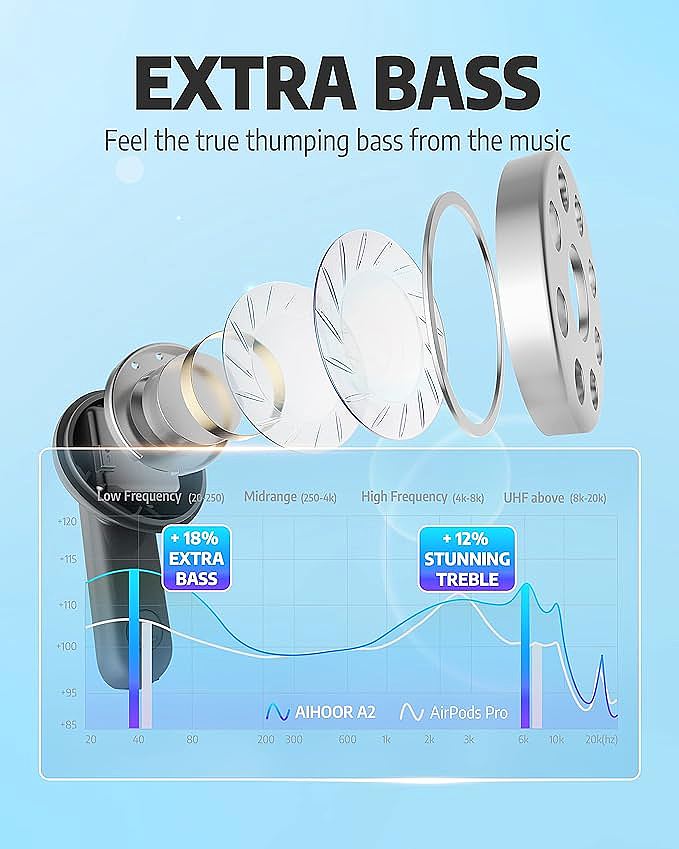
A 10mm PEEK+PU composite driver, like the one found in the AIHOOR A2, can generate sufficient sub-bass energy to pressurize that tiny cavity while maintaining the transient response to reproduce the leading edge of a snare hit with millisecond accuracy. The same driver in a larger cavity, like a room, would be hopelessly inadequate. But the ear canal is not a room. It is a sealed acoustic transmission line, and in that environment, precision trumps displacement.
The Ear Tip: The Final Acoustic Component
No discussion of earbud sound quality is complete without addressing the component most people treat as an afterthought: the ear tip. Passive noise isolation depends on creating an airtight seal between the silicone tip and the irregular walls of the ear canal. The physics here are brutal in their simplicity. Even a microscopic gap between the tip and the canal skin can cause a 20-decibel drop in sub-bass response, regardless of how well the driver performs. Twenty decibels is the difference between feeling a kick drum in your chest and hearing it as a distant tap.
This is why providing four ear tip sizes, XS through L, is not a marketing flourish. It is a strict functional requirement. Human ear canals vary enormously in diameter, shape, and angle. A tip that seals perfectly for one person may leave a channel open for another. Selecting the correct size is effectively the final step in the acoustic engineering chain, converting a generic mass-produced driver into a calibrated instrument matched to one individual's ear geometry.
Psychoacoustics: What Your Brain Actually Hears
The reason material science matters more than driver diameter comes down to how humans perceive sound quality. Psychoacoustic research has established that two technical properties dominate listener preference: harmonic accuracy and transient control. Harmonic accuracy means that when a cello plays a note at 220Hz, the overtones at 440Hz, 660Hz, 880Hz, and beyond are reproduced in the correct relative proportions. Transient control means that when a note starts and stops, the speaker follows the envelope faithfully, without overshoot or ringing.
A PEEK dome contributes directly to both. Its pistonic behavior ensures that harmonic overtones are not artificially boosted or suppressed by diaphragm flexing. The PU surround's high loss factor ensures that transients are clean, which listeners perceive as tightness in the bass and speed in the treble. These are the qualities that make a pair of earbuds sound precise and musical, and they have almost nothing to do with how many millimeters the driver measures.
When Budget Means Focus, Not Compromise
There is an engineering principle at work in products that skip features to concentrate on core performance. In the budget TWS market, the temptation is to pile on features: active noise cancellation, companion apps, spatial audio, wireless charging. Each of those features requires silicon, sensors, and battery capacity. Each draws from the same finite bill-of-materials budget. When a product priced around $27 includes a PEEK+PU composite driver, a material combination typically reserved for products costing five to ten times more, the math suggests that something else was sacrificed to make room.
In this case, that something is active noise cancellation. ANC requires external microphones to sample ambient noise, internal feedback microphones to monitor ear canal acoustics, a digital signal processor to compute inverted waveforms in real time, and the battery power to run all of it. For products under $50, the engineering tradeoff is real: the money spent on ANC hardware is money not spent on the driver. Choosing passive noise isolation instead, relying on the physical seal of a well-fitted ear tip rather than electronic cancellation, allows the entire acoustic budget to flow into the transducer itself.
Whether that tradeoff makes sense depends on where you listen. In a noisy subway car, ANC provides measurable reduction in ambient noise that passive sealing cannot match. In a quiet office, on a walking trail, or at the gym, passive isolation from a proper silicone seal is often sufficient, and the acoustic payoff of a better-funded driver is audible immediately.
The Question Bigger Than the Driver
The next time you see a product listing that leads with driver size, ask a different question. Ask what that driver is made of. Ask whether the material can hold its shape at 10,000 oscillations per second. Ask whether the surround can stop moving the instant the music tells it to. The millimeter number on the spec sheet tells you how much air the driver can push. It tells you nothing about how faithfully it translates electrical signals into the pressure waves your brain interprets as music. That translation, the part that actually determines what you hear, lives in the molecular structure of a polymer film thinner than a grain of sand. And in the confined geometry of the human ear canal, that molecular structure matters more than any number printed on a box.
AIHOOR A2 Wireless Earbuds
Related Essays
