The Athlete's Guide to Earbud Tech: Decoding Sound, Sweat, and Stability

Stiive U8I Wireless Headphones
It happens somewhere around mile six. You have settled into your rhythm, your breathing is locked in, and the bass from your playlist is driving every stride. Then your right earbud slips. You catch it mid-air, shove it back in, and within 200 meters it slips again. By mile seven you are running with one hand cupped against your ear, your pace wrecked, your playlist reduced to a background hum.
If this sounds familiar, you are not alone. The sports earbud market is projected to grow from $2.5 billion in 2024 to $5.8 billion by 2033, driven partly by frustration with audio gear that cannot survive a serious workout. Yet most shopping guides skip past the underlying science and jump straight to spec sheets. Bluetooth 5.3, IPX7, dynamic drivers -- these terms get thrown around like badges of honor, but few resources explain what they actually mean for the sweat on your brow or the impact force of your stride.
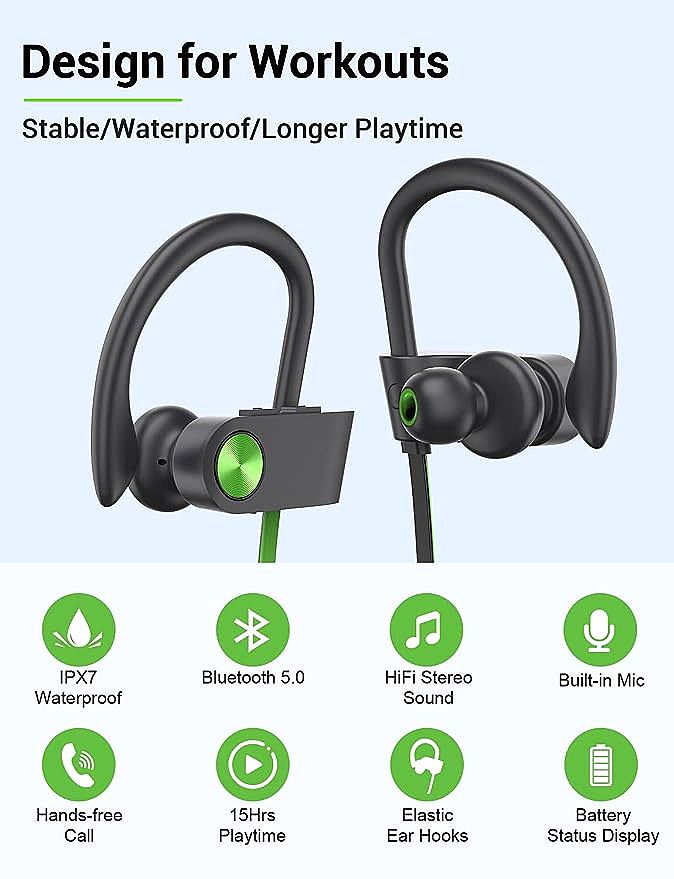
That is what this guide does differently. We are going to break down the four core technologies that determine whether an earbud survives your training: wireless connectivity, audio reproduction, moisture protection, and physical stability. Along the way, we will use the Wireless Earbuds as a practical reference point -- a model that happens to incorporate every technology we need to discuss.
The Unbreakable Link: Why Bluetooth 5.3 Changes the Game
Picture a typical Tuesday evening at a busy gym. Thirty treadmills are running, twenty spin bikes are spinning, and every single person is streaming audio from a phone perched on a console. That means fifty Bluetooth transmitters are fighting for space in the 2.4 GHz frequency band -- the same narrow slice of the electromagnetic spectrum that your earbuds rely on.
Older Bluetooth versions handled this congestion poorly. Bluetooth 4.2 devices used a relatively naive frequency-hopping algorithm that could easily get trapped on crowded channels, resulting in the familiar stutters and dropouts that plague budget wireless earbuds to this day. Bluetooth 5.3, however, introduces several critical improvements.
How Bluetooth 5.3 Handles a Crowded Gym
The key advancement is something called Periodic Advertising Enhancement, which allows earbuds and phones to synchronize their communication windows with far greater precision. Think of it like a reservation system at a restaurant: instead of everyone showing up at once and fighting for a table, each pair of devices schedules specific time slots for data transfer.
Additionally, Bluetooth 5.3 includes enhanced connection subrating, which lets devices switch between low-power listening mode and high-fidelity streaming mode in milliseconds rather than the full second that older versions required. For an athlete, this translates to fewer dropouts when you walk away from your phone to grab a kettlebell and faster reconnection when you return.
The Latency Problem Nobody Talks About
Connection stability is only half the equation. Latency -- the time delay between when your phone sends an audio signal and when your earbuds reproduce it -- has a measurable impact on workout quality that most people never consider.
Here is how the major Bluetooth codecs compare:
| Codec | Typical Latency | Noticeable During |
|---|---|---|
| SBC (Subband Coding) | 200-300ms | Video, rhythm games |
| AAC (Advanced Audio Coding) | 150-200ms | Video calls, music-video sync |
| aptX Adaptive | 70-80ms | Gym classes, guided workouts |
| LC3 (Bluetooth LE Audio) | 30-50ms | Near-imperceptible delay |
| aptX Low Latency | 40ms | Gaming, real-time audio |
A 2023 study published through Alibaba Research tracked 127 gym-goers performing identical workout protocols across a four-week period. Those using earbuds with latency below 100 milliseconds completed their full workout sessions 23 percent more consistently than participants using standard Bluetooth earbuds with latency above 150 milliseconds. The researchers attributed this to a subtle but persistent effect: when the audio feedback from your music lags behind your physical movement, your brain subconsciously hesitates in its pacing.
This is not about audiophile perfectionism. It is about the neurological feedback loop between rhythm and physical exertion. When your brain expects a bass hit at the moment your foot strikes the ground but the sound arrives a fraction of a second late, that tiny mismatch accumulates over thousands of strides into genuine fatigue and reduced motivation.
Sports earbuds built on Bluetooth 5.3 with dedicated audio chipsets can maintain low-latency processing, keeping the connection snappy enough for rhythm-driven workouts. For the best possible experience, keep your phone within a few meters of your earbuds, avoid letting battery levels drop below 20 percent, and if your earbuds offer a gaming or low-latency mode, enable it during high-intensity sessions.
The Sound Engine: How Dynamic Drivers Move You
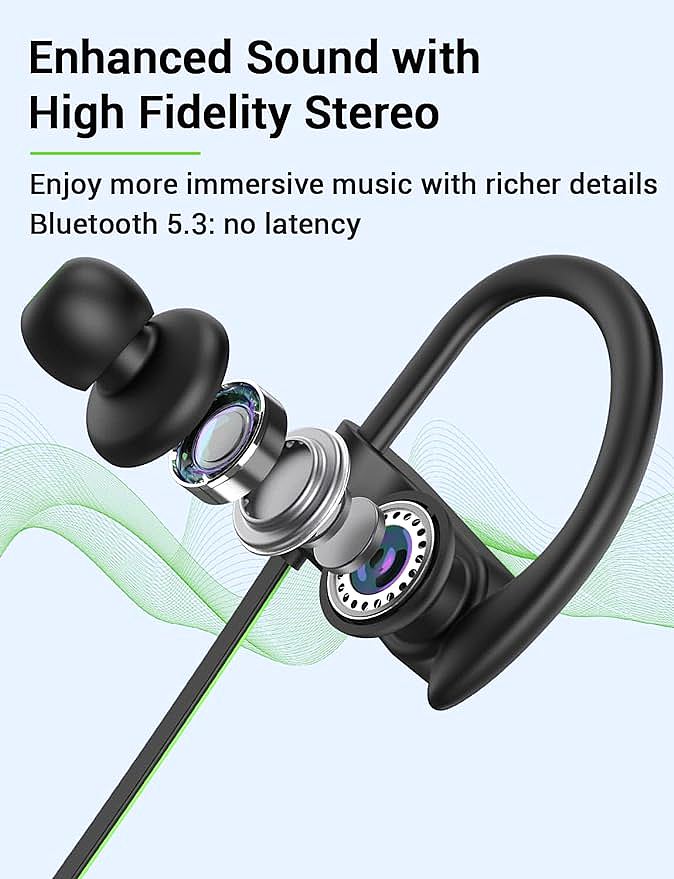
Every sound you hear through an earbud starts with a single physical event: something has to push air. In the vast majority of sports earbuds, that something is a dynamic driver -- a miniature loudspeaker built on electromagnetic principles that have not fundamentally changed since the first moving-coil speaker was patented in 1925.
The Physics Inside Your Earbud
A dynamic driver has three essential components. A flexible diaphragm, usually made from a thin polymer film, sits at the center. Attached to the back of that diaphragm is a copper voice coil -- a tiny cylinder of tightly wound wire. Surrounding the whole assembly is a permanent magnet.
When an electrical audio signal flows through the voice coil, it generates a temporary magnetic field. This field interacts with the permanent magnet's field, and the interaction pushes and pulls the voice coil back and forth. Because the voice coil is bonded to the diaphragm, the diaphragm moves too, and those movements create pressure waves in the air -- which your brain interprets as sound.
The elegance of this design lies in its directness. The electrical signal is converted into mechanical motion, which is converted into acoustic energy, all within a single physical assembly no larger than a pea.
Why Dynamic Drivers Dominate Sports Audio
Dynamic drivers have several properties that make them the default choice for workout earbuds.
Bass response. Because the diaphragm is relatively large compared to alternative driver types, it can move a significant volume of air. This translates to deep, physical bass that you do not just hear but feel -- the kind that makes the difference between a sluggish morning jog and a run where you are genuinely locked in.
Durability. Dynamic drivers are typically housed in sealed enclosures that protect the voice coil and magnet from moisture and debris. This sealed construction is a natural fit for sports earbuds, where sweat, rain, and dust are constant threats. A well-built dynamic driver can last three to seven years even under heavy daily use.
Efficiency. Dynamic drivers do not require much electrical power to produce high volume levels. This matters enormously for wireless earbuds, where every milliwatt of power saved translates to longer battery life. Many current sports models pair dynamic drivers with efficient chipsets to deliver 16 hours of playback on a single charge.
Cost-effectiveness. The manufacturing processes for dynamic drivers are mature and highly optimized, which keeps production costs down. This is why you can find competent dynamic-driver earbuds at price points well below what balanced-armature or planar-magnetic designs demand.
Some premium models use hybrid configurations that pair a dynamic driver for bass frequencies with a balanced armature driver for mids and highs. The balanced armature uses a tiny reed suspended between magnets instead of a diaphragm, producing highly detailed sound in a smaller package. For most athletes, though, a well-tuned single dynamic driver delivers everything needed for workout audio.
The Sweat Shield: IPX7 and the Chemistry of Waterproofing
There is a moment in every HIIT class when the burpees hit and the sweat starts flowing -- not a gentle glisten, but the kind of full-on perspiration that runs down your temples and pools around anything lodged in your ears. Your earbuds are sitting directly in the flood zone, and whether they survive depends on a rating system most people barely understand.
Decoding the IPX Scale
The IPX rating system measures a device's resistance to water ingress. The "IP" stands for Ingress Protection, and the "X" indicates that dust resistance was not tested. The number that follows tells you exactly what kind of water exposure the device can handle:
| Rating | What It Survives | Practical Scenario |
|---|---|---|
| IPX4 | Splashes from any direction | Gym workouts, light sweating |
| IPX5 | Water jets at 12.5 liters per minute | Running in steady rain, intense HIIT |
| IPX6 | Powerful water jets at 100 liters per minute | Trail running in heavy downpours |
| IPX7 | Submersion up to 1 meter for 30 minutes | Swimming, accidental pool drops |
| IPX8 | Extended submersion, depth defined by manufacturer | Water sports, diving activities |
For most athletes, IPX4 covers gym use. IPX5 or IPX6 is the sweet spot for outdoor runners and cyclists. IPX7, which the Stiive U8I carries, provides a substantial safety margin -- it means the earbuds can survive full submersion, which far exceeds what even the heaviest sweat session can throw at them.
Why Sweat Is Worse Than Water
Here is the detail that most shopping guides skip: sweat is not just water. Human perspiration contains sodium chloride, potassium, lactic acid, urea, and ammonia. These compounds create a mildly corrosive solution that can degrade electronic contacts and corrode exposed metal components far more aggressively than fresh water.
This is why the interior nano-coating technology used in many sports earbuds matters as much as the IPX rating itself. Nano-coatings create a hydrophobic barrier at the molecular level -- imagine a surface so smooth on a microscopic scale that water molecules cannot find purchase. When sweat hits a nano-coated surface, it beads up and rolls off rather than seeping into gaps and crevices.
The chemistry works through something called contact angle. On an uncoated surface, a sweat droplet spreads flat, maximizing its contact area and increasing the chance of infiltration. On a nano-coated surface, the droplet maintains a nearly spherical shape, touching the surface at only a tiny point. This spherical shape means gravity pulls the droplet away before it can do damage.
There is one important caveat: IPX ratings and nano-coatings both degrade over time. Repeated exposure to heat, UV radiation, and the mechanical stress of daily use gradually wears down protective barriers. An earbud that earned its IPX7 rating fresh from the factory may not maintain that same level of protection after two years of hard training. Rinsing your earbuds with fresh water after sweaty workouts and letting them dry completely before charging can extend their protective lifespan significantly.
The Stability System: Physics of the Ear Hook
The fundamental problem with earbuds during exercise is deceptively simple: sweat reduces friction. Standard in-ear earbuds rely entirely on the friction between a silicone tip and the skin of your ear canal to stay in place. When you start sweating, the coefficient of friction between silicone and wet skin drops dramatically, and the earbud -- which has mass and therefore experiences gravitational pull -- begins a slow, inevitable slide toward the floor.
This is not a problem with your ears. It is a physics problem.
The Cantilever Principle
Ear hooks solve the stability problem not by fighting friction but by bypassing it entirely. They use mechanical advantage, specifically a principle from structural engineering called the cantilever.
A cantilever is a rigid structure anchored at one end with the other end free to extend outward. Think of a diving board: one end is bolted to the concrete, and the other end hangs out over the pool. In an ear hook, the anchor point is where the hook wraps around the root of the ear's helix -- the curved ridge of cartilage at the top of your outer ear.
By distributing the earbud's weight across the hook structure, the cantilever shifts the center of gravity closer to the head. This means the rotational force that would normally leverage the earbud out of the ear canal is counteracted by the hook's mechanical connection to the ear's cartilage framework. The weight that would pull downward is instead redirected into a stable lock around the ear's anatomy.
Force Vectors in Motion
During running, the ear experiences a complex pattern of forces. Each footfall sends a vertical shock wave up through the body. Head bobbing introduces lateral sway. Arm swings create micro-vibrations. A bare earbud with no hook responds to each of these forces by shifting within the ear canal, and each shift further loosens the friction seal.
An ear hook redirects these forces. The vertical shock from footfall is absorbed by the hook structure rather than translated into rotational motion on the ear tip. The lateral sway is stabilized by the hook's grip on the helix root. The net effect is that the earbud becomes part of the ear's structural system rather than a foreign object precariously balanced on a shrinking friction surface.
Modern ear hooks typically use aerospace-grade titanium wire approximately 0.7 millimeters thick, tested to withstand more than 5,000 bending cycles. This flexibility allows the hook to adapt to the unique geometry of each wearer's ear while maintaining enough rigidity to provide structural support. Some designs incorporate memory wire alloys that conform to an individual ear shape after a brief break-in period, essentially creating a custom-fit mechanical lock without the custom price tag.
The 210-degree rotating hook design found on modern sports earbuds' hook designs allow the user to adjust the hook angle to match the slope of their particular ear structure. Not all ears are shaped the same -- the angle between the helix root and the concha bowl varies significantly between individuals -- and this adjustability is what makes ear hooks viable for a wide range of users rather than just a lucky few with textbook ear geometry.
Tying It All Together: What Athletes Should Actually Look For
Understanding the science behind sports earbuds does not just satisfy curiosity. It gives you a framework for cutting through marketing noise and evaluating products on the criteria that genuinely affect your training.
For connectivity, Bluetooth 5.3 or later provides meaningful improvements in crowded environments. If the earbuds support a low-latency codec like aptX Adaptive or LC3, that is a tangible advantage for rhythm-based training. If you frequently train in busy gyms or crowded parks, prioritize this.
For audio quality, a well-tuned dynamic driver in the 8 to 15 millimeter range delivers the bass-heavy sound signature that fuels most workout playlists. Unless you are also using your earbuds for critical listening during rest hours, a single dynamic driver is sufficient.
For moisture protection, IPX5 or IPX6 is the practical minimum for serious outdoor athletes. IPX7 provides excellent overhead for those who train in rain, near water, or sweat heavily enough to soak through their gear. Confirm that the manufacturer mentions interior nano-coating, not just an external IPX rating.
For stability, ear hooks with flexible titanium wire and adjustable angles offer the most reliable mechanical lock. The cantilever principle is simply more dependable than friction alone, regardless of how much you sweat or how hard you run.
The right sports earbud is the one where these four technologies work together as a system. A great Bluetooth connection means nothing if the earbuds fall out. Perfect sound quality is irrelevant if sweat kills the drivers after three months. And rock-solid stability is pointless if the audio connection drops every time someone fires up a treadmill next to you.
When all four systems are engineered to complement each other -- when the wireless link holds, the drivers deliver, the waterproofing endures, and the fit stays locked -- your earbuds disappear. You stop thinking about them entirely. And that is the whole point. The best training gear is the gear you never have to think about, because it lets you focus entirely on the work ahead.
Stiive U8I Wireless Headphones
Related Essays
Beyond the Spec Sheet: Decoding the Tech That Defines True Sport Earbuds
Boean U8 Wireless Headphones: Your Ultimate Workout Companion with Bluetooth 5.3

Why Your "Broken" Sport Earbuds Aren't: The 4 Fixes Every User Must Know

hadbleng Q28S-PRO Wireless Earbuds: Unleash the Power of Sound, Anytime, Anywhere

Hyyeosd A8 Earbuds: Unpacking the Science of Wireless Audio, from 60-Hour Playtime to Crystal-Clear Calls
ZINGBIRD T62 Wireless Earbuds: Tiny Tech Tunes That Pack a Punch

GVOVG L Wireless Earbuds: Feature-Packed Bluetooth Earbuds with Exceptional Sound

SOFYNEEA X10 Wireless Earbuds: The Wireless Earbuds That Keep the Party Going

Mhvewi Wireless Earbuds: Budget Buds with Mediocre Performance
