Shure AONIC 50 Gen 1: Adaptive ANC, 46-Hour Battery, and Studio-Grade Acousti...
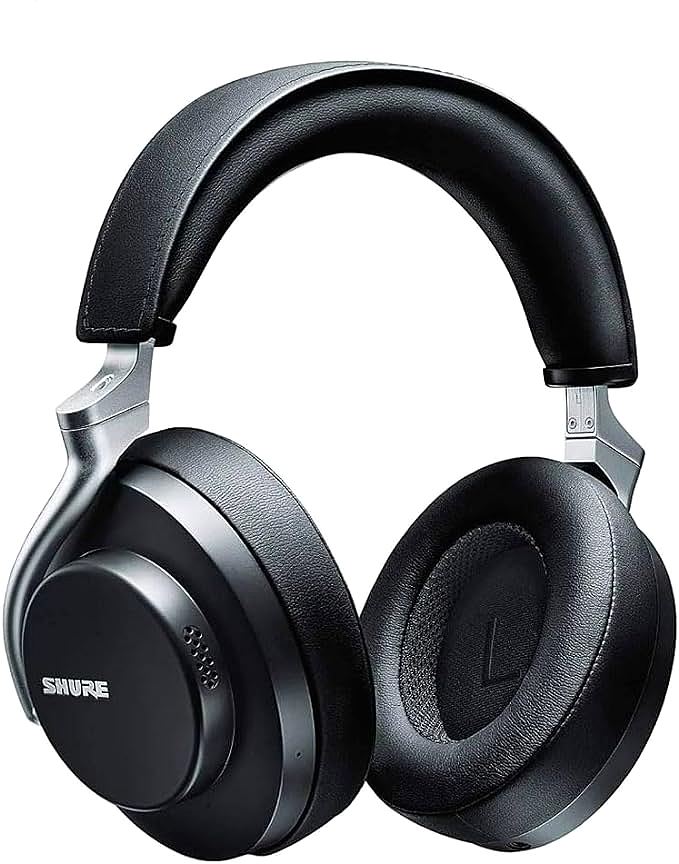
Shure AONIC 50 Gen 1 Wireless Headphones
The Tradeoff Nobody Talks About in Premium Wireless Headphones
Walk into any audio forum and you will find the same frustrated thread. Someone spent four hundred dollars on wireless headphones, wore them through a cross-country flight, and discovered that the active noise cancellation thinned out the bass. Or they found a pair with pristine sound but could not make it through a workday without reaching for the charger. The wireless headphone market at the premium tier is littered with compromises that manufacturers rarely advertise: noise processing that alters the frequency signature, battery cells that shrink to fit a folding hinge, and digital signal chains that introduce latency the moment ANC engages.
The core tension is physical, not marketing. Active noise cancellation works by generating an inverse waveform of ambient sound through a digital signal processor. That processing pipeline sits between the audio source and the driver, and every stage of it, microphone sampling, DSP computation, analog reconstruction, consumes power and introduces artifacts. The more aggressive the cancellation, the more the DSP works, and the more it can color the signal path. Separately, a large-aperture driver that reproduces sub-bass frequencies cleanly needs physical enclosure volume that conflicts with the portability expectations of a wireless design. Resolving these three competing engineering vectors simultaneously is the challenge, and the interesting question is not whether any single product succeeds, but how the underlying engineering choices address the physics.
Acoustic Tuning Philosophy: Flat Is a Design Decision
Most consumer wireless headphones target a frequency response curve that is deliberately sculpted. There is a bass shelf around 80 to 120 Hz, a dip in the lower midrange to create separation, and a treble peak that adds perceived detail. This curve is not an accident. It is the result of tuning for the compressed, low-bitrate streaming environment where a flat response can sound lifeless and a sculpted one produces immediate listener engagement.
A studio monitor philosophy diverges from this approach. Companies with decades of experience building in-ear monitors for stage musicians and reference headphones for recording studios tend toward a frequency target that is intentionally closer to linear, with less of the V-shaped consumer boost. The reasoning is straightforward. When a musician mixes a track on headphones, they need to hear what is actually in the recording, not what the headphone adds. A headphone that lifts the bass by 6 dB will cause a mix engineer to under-represent low frequencies, resulting in a thin master. A headphone with a midrange dip will mask vocal clarity problems that become obvious on other playback systems.
The driver unit in a premium over-ear headphone typically ranges from 40mm to 50mm in diameter. Larger drivers move more air, which translates to better low-frequency extension, but they also require more current and a stiffer suspension that can affect transient response. The relationship between driver size, voice coil mass, and diaphragm stiffness determines how accurately the headphone reproduces the attack of a snare drum or the decay of a piano note. A driver tuned for studio monitoring prioritizes linear excursion and minimal distortion at moderate listening levels over the high-efficiency, high-volume design goals of consumer products.
The acoustic enclosure matters as much as the driver. A closed-back design seals the rear of the driver, preventing sound leakage but creating internal pressure reflections that can muddy the midrange. An open-back design vents these reflections but lets ambient noise in and sound out. Wireless ANC headphones almost universally use closed-back enclosures because the ANC system needs a controlled acoustic environment to function. The challenge is managing those internal reflections through damping material and chamber geometry so the listener hears the driver, not the cup.
Active Noise Cancellation Is Not a Switch, It Is a Feedback Loop
The phrase noise cancelling has become shorthand for a surprisingly complex real-time control system. At its core, ANC relies on destructive interference. If the ambient environment produces a 200 Hz hum from an aircraft engine, the headphone generates a sound wave that is the exact inverse, 180 degrees out of phase, so the two cancel at the eardrum. In theory this is simple. In practice it requires a closed-loop system that samples the environment, computes the inverse, and injects it into the audio path fast enough that the listener never perceives the original sound.
Adaptive ANC takes this further. Instead of running a fixed algorithm tuned for a specific noise profile, the system continuously analyzes the spectral content of incoming sound and adjusts its filter coefficients. An aircraft cabin produces a low-frequency drone concentrated between 50 and 500 Hz. A train produces a broader spectrum with periodic transients. An office has mid-frequency chatter concentrated between 300 and 3000 Hz. Each environment requires a different filter shape, and a fixed ANC profile that is aggressive enough for an airplane may produce an unnatural pressure sensation in a quiet room.
The implementation uses two microphone paths. A feedforward microphone on the exterior of the ear cup captures ambient sound before it reaches the ear. A feedback microphone between the driver and the ear captures what the listener actually hears. The DSP combines these two signals to compute the correction waveform and also uses the feedback path to compensate for the acoustic transfer function of the ear cup itself. The latency budget for this entire loop is measured in microseconds. If the correction arrives more than a few milliseconds after the ambient sound, the cancellation degrades and the system can even amplify certain frequencies through constructive interference. This is why ANC quality varies so dramatically between models: the DSP algorithm, the microphone placement, and the analog-to-digital conversion quality all interact in ways that are difficult to optimize.
There is also an acoustic tradeoff. When ANC is active, the correction signal is mixed into the audio path. If the DSP is not transparent, it can alter the frequency response of the headphone. This is the phenomenon audiophiles describe as ANC changing the sound. It is a measurable effect: the correction path adds noise floor, the filter introduces phase shift, and the feedback loop can create resonance peaks in the sub-bass region. High-end implementations attempt to minimize this by using higher-resolution DSP processing and by keeping the correction signal as close to neutral as possible, but the tradeoff between cancellation depth and signal transparency is fundamental.
The Math Behind 46 Hours of Playback
Battery life in wireless headphones is a function of three variables: cell capacity, power consumption of active systems, and codec efficiency. A headline number like 46 hours is typically measured under specific conditions: ANC on, a particular codec, moderate volume, and a standardized test signal. Real-world results vary, but the engineering behind the number is worth examining.
A typical lithium-polymer cell in a premium over-ear headphone carries between 500 and 900 milliamp-hours at 3.7 volts. That is roughly 2 to 3.3 watt-hours of energy. To achieve 46 hours of playback, the total system power consumption must stay below approximately 70 milliwatts on average. Breaking that down: the Bluetooth radio and baseband processor consume 15 to 25 mW depending on the codec and connection quality. The ANC DSP and microphone bias circuitry add another 10 to 20 mW. The driver amplifier and audio DAC consume 15 to 30 mW at moderate listening levels. These numbers are rough but they illustrate the constraint: there is very little headroom.
Bluetooth audio codecs play a significant role in power consumption. The classic SBC codec is computationally inexpensive but delivers limited bitrates. AptX and AAC require more processing but provide higher fidelity. The more advanced codecs like LDAC can stream at 990 kbps, but the increased data rate means the radio transmitter works harder and the DAC processes more samples per second. Power consumption scales with codec complexity and bitrate. A headphone designed for maximum battery life will use a codec that balances processing load against audio quality, and the firmware will manage the Bluetooth connection to minimize retransmissions and connection retries, both of which spike power draw.
A 46-hour figure also depends on thermal management. Battery cells lose capacity at low temperatures and degrade faster at high temperatures. The ear cups trap heat from the driver and the electronics. If the internal temperature rises, the battery management system may reduce discharge current to protect the cell, shortening runtime. The interdependency between acoustic design, sealed cups that trap heat, and electrical design, battery placement inside those cups, is an engineering constraint that does not appear in spec sheets but affects real-world longevity.
Fast charging is the mitigation strategy when the math does not add up. A 10-minute charge delivering 5 hours of playback means the cell can accept a high current input without damage, which requires careful charge controller design. Lithium-polymer cells have specific charge rate limits, typically 0.5C to 1C for standard cells, where C is the cell capacity. A 600 mAh cell charged at 1C accepts 600 mA. Achieving a meaningful charge in 10 minutes means pushing closer to that limit, and doing so repeatedly affects cycle life. The engineering challenge is balancing fast-charge convenience against the long-term degradation curve of the cell.
Where Studio Monitoring Meets Daily Commuting
The practical value of studio-grade frequency response in a wireless headphone depends entirely on the use case. For someone who primarily listens to podcasts at the gym, a flat response is irrelevant. For a mix engineer who needs to check a session on the way home from the studio, it is essential. The typical scenarios for premium ANC headphones reveal where the engineering choices matter.
Air travel is the most demanding environment. Cabin noise is loud, 85 to 100 dB SPL, and concentrated in the low-frequency range where it masks musical detail and induces fatigue over time. ANC is most effective at low frequencies, with 20 to 30 dB of attenuation typical below 500 Hz. Above 1 kHz, passive isolation from the ear cup seal takes over. A well-designed ANC system combined with a good seal can reduce perceived cabin noise by a factor that makes quiet listening possible at safe volume levels. The acoustic tuning matters here because the brain compensates for ambient noise by increasing perceived bass. In a quiet room, a flat headphone sounds neutral. In an aircraft cabin without ANC, the same headphone sounds thin because the cabin noise masks low frequencies. With ANC engaged, the correction should restore the bass to its intended level.
Music production is a different use case entirely. Producers often work in untreated rooms where the acoustic environment colors what they hear. A reference-quality headphone with a known frequency response allows the producer to bypass the room and hear the mix directly. Wireless connectivity is useful here because it frees the producer from the DAW workstation during arrangement and recording. The tradeoff is codec compression. Bluetooth audio introduces a lossy compression stage with latency that can range from 150 ms to over 300 ms depending on the codec. For arrangement and mixing decisions, this latency is tolerable. For real-time recording with monitoring, it is disqualifying. This is why wireless headphones retain a wired mode: it bypasses the Bluetooth path for zero-latency monitoring.
Office and home office use is the middle ground. The noise environment is moderate, 60 to 70 dB with intermittent speech and mechanical sounds, so aggressive ANC is counterproductive because it creates an isolated pressure sensation. A transparent or ambient mode that passes external sound through the microphones is more useful. The adaptive system should detect the moderate noise level and reduce its cancellation depth accordingly, preserving the natural sense of the environment while suppressing the mechanical drone of HVAC systems.
Honest Limitations and Who Benefits
Understanding the engineering tradeoffs reveals the limitations. A closed-back ANC headphone will never match the soundstage of an open-back reference headphone at the same price. The ANC DSP, no matter how transparent, will alter the signal path. Bluetooth audio, no matter the codec, introduces compression and latency that wired listening avoids. And a headphone optimized for studio monitoring will not flatter poorly recorded source material the way a consumer-tuned V-shaped curve does.
The weight is a physical consequence of the engineering. A 50mm driver, a lithium-polymer cell, a DSP board, two ANC microphones per cup, and the damping material needed to control internal reflections add up. Premium ANC headphones typically weigh between 280 and 390 grams. That weight is distributed across the headband and ear pads, but physics limits how light they can be without sacrificing driver size, battery capacity, or structural rigidity. For extended sessions, the clamping force and pad material matter more than the absolute weight.
The price positioning reflects component cost and engineering investment. High-quality 50mm drivers with low distortion, a DSP capable of real-time adaptive filtering, a large-capacity battery cell with fast-charge support, and the acoustic research needed to tune the enclosure all add bill-of-materials cost. Whether the result justifies a premium price depends on whether the listener values studio-monitor accuracy over consumer flattery and whether they need the combination of ANC and extended battery life in a single package. For audio professionals who travel, the convergence of these three engineering vectors in one product addresses a real gap. For casual listeners, the same engineering choices may produce a sound signature that feels understated and a weight that feels unnecessary. The Shure AONIC 50 Gen 1 is one concrete instance of this design philosophy, but the principles apply broadly to any premium wireless headphone attempting to bridge studio fidelity and active noise cancellation.
Shure AONIC 50 Gen 1 Wireless Headphones
Related Essays

Are Bone Conduction Headphones Safe for Running?
Bluetooth Headset Faults Explained: Mic Dropouts, Choppy Audio, and Wind Noise

Bluetooth Headphone Setup Explained: Pairing, EQ Modes, and TV Audio in 2026

How Wireless Audio Delivers Perfect Sound Through Physics

The Physics of Desktop Audio: What an External DAC Does Differently
Why Expensive In-Ear Monitors Can Sound Worse Than Cheap Earbuds

IPX4 Rating Explained: Splash Resistance, Sweat, and Workout Headphones

Why Bluetooth Audio Sounds Worse Than Wired — And What...
