How $10 Wireless Earbuds Actually Work: The Engineering...

Vtkp S42 Bluetooth Headphones
Your wireless earbuds disconnect. The left one dies forty minutes before the right one. A call drops the moment you walk between two buildings. These are not rare frustrations. They are the predictable outcomes of packing a radio transmitter, a rechargeable battery, an amplifier, and a microphone into something smaller than a jellybean.
Most people never think about what sits inside that plastic shell. But understanding the technology changes how you buy, use, and troubleshoot these devices. And the story of how a pair of wireless earbuds can retail for around ten dollars tells us something larger about where consumer electronics are headed.
A Radio That Fits in Your Ear Canal
Every wireless earbud is, at its core, a very small radio. The Bluetooth chip inside handles one of the harder problems in consumer electronics: transmitting high-fidelity audio over a short-range radio link while consuming almost no power.
Bluetooth operates in the 2.4 GHz ISM band, the same crowded slice of spectrum shared by Wi-Fi routers, microwave ovens, and garage door openers. Avoiding interference in this band requires a technique called adaptive frequency hopping. The transmitter and receiver agree on a sequence of 79 channels and hop between them 1,600 times per second. When a channel is noisy, both ends skip it. This is defined in the Bluetooth Core Specification, maintained by the Bluetooth Special Interest Group, and has been refined across multiple generations.
Bluetooth 5.3, the version found in current budget earbuds, introduced several refinements over earlier revisions. Enhanced Attribute Protocol (EATT) allows multiple logical data streams to run concurrently, which matters when an earbud is simultaneously receiving audio, managing touch-input responses, and reporting battery levels. Periodic Advertising with Responses lets a device broadcast data without establishing a full connection, reducing the energy cost of simply being discoverable.
None of this is exotic technology. The silicon that implements it is produced by companies like Airoha, Realtek, and Bestechnic, often sold as complete System-on-a-Chip solutions for under two dollars per unit at volume. The R&D that once cost hundreds of millions has been amortized across billions of devices. The chip in a ten-dollar earbud is not the same silicon as the one in premium hardware, but it runs the same protocol stack and inherits the same interference-resilience algorithms.
The practical result: connection stability in budget earbuds has improved dramatically over the past five years, not because budget manufacturers innovated, but because the Bluetooth standard itself matured and the silicon became cheap enough to commoditize.
The Battery Math Behind "40+ Hours"
Battery life claims on earbud packaging deserve scrutiny. When a manufacturer advertises 40 or more hours, that number is never continuous playback from the earbuds alone. It is a combined figure that includes the charging case.
Here is how the arithmetic works. A typical budget earbud contains a lithium-ion polymer cell rated between 35 and 50 mAh. Under normal listening volume, this yields roughly five to eight hours of playback. The charging case houses a separate cell, usually between 400 and 500 mAh. Since each full recharge of both earbuds consumes roughly 100 mAh from the case, a 470 mAh case can provide approximately four to five additional full charges.
That gives you the initial six hours plus four recharges of six hours each, totaling roughly 30 hours. Manufacturers often arrive at higher claims by measuring at lower volume levels or using efficient codecs. The exact number varies, but the principle is consistent: the case is a portable power bank, and the total runtime is a function of case capacity divided by earbud consumption.
The batteries themselves are lithium-ion polymer cells, chosen for their high energy density and ability to be manufactured in thin, irregular shapes. A cylindrical 18650 cell, the kind used in older laptop batteries, would be useless here. LiPo cells can be as thin as two millimeters, which is why earbuds can be small enough to sit comfortably in a concha bowl.
Energy density in lithium-ion cells has improved at roughly 3 to 5 percent per year over the past decade, according to data published by the U.S. Department of Energy's Vehicle Technologies Office. While that research focuses on automotive-scale cells, the chemistry scales. The 470 mAh cell in a budget earbud case today would have been physically larger or lower-capacity five years ago.
Charging is handled by a dedicated power-management IC that regulates voltage, monitors cell temperature, and prevents overcharging. In budget earbuds, this chip is often integrated directly into the Bluetooth SoC, reducing component count and cost. The case recharges via a USB-C port or, in some models, a Qi-compatible wireless charging coil. Wireless charging adds cost and generates heat, so it appears less consistently in the cheapest products.
What Happens When Your Earbuds Get Wet
For the VTKP S42, IPX6 means it resists powerful water jets from any direction but is not rated for submersion. The IPX7 version of the same series adds 30-minute submersion at 1 metre depth.
The IP rating system, defined by the International Electrotechnical Commission in standard IEC 60529, classifies degrees of protection against solids and liquids. An IPX7 rating, commonly found on budget earbuds, means the device can withstand immersion in one meter of fresh water for up to 30 minutes. The "X" indicates no formal dust-ingress rating was tested.
Achieving IPX7 at low cost relies on two manufacturing techniques that have become standardized across the industry.
The first is physical sealing. Earbud housings are typically assembled using ultrasonic welding, a process that vibrates two plastic halves together at frequencies above 20 kHz until they fuse at the molecular level. This creates a seam with no adhesive gap, no gasket, and no mechanical fastener that could fail. Ultrasonic welding equipment is expensive to purchase but cheap to operate, making it well-suited to high-volume manufacturing.
The second technique is conformal coating, sometimes called nano-coating in marketing materials. After the circuit board is populated, it is sprayed or dipped in a thin polymer layer, typically a parylene derivative or an acrylic-based compound. This coating is hydrophobic, meaning water beads and rolls off rather than spreading across the surface and reaching vulnerable components. The coating adds less than fifty microns of thickness, so it does not interfere with the physical seal.
There are limits. IPX7 tests are conducted in still, fresh water at room temperature. Saltwater, chlorinated pool water, hot tub steam, and high-pressure jets are different chemical and mechanical environments. Sweat, which contains salts and oils, is chemically closer to saltwater than to the distilled water used in IP testing. An IPX7-rated earbud will survive a rainstorm. It may not survive a year of daily gym sessions without degradation, because repeated exposure to salty sweat gradually compromises both the seal and the coating.
The Small Sensor That Makes Pairing Feel Instant
Opening the lid of an earbud case and watching the earbuds connect to your phone within two seconds feels like magic. The component responsible is a Hall-effect sensor, one of the oldest and simplest magnetic-field detectors in electronics.
A Hall sensor generates a voltage proportional to the magnetic field passing through it. A small permanent magnet is embedded in the lid of the charging case. When the lid closes, the magnet sits directly above the sensor in the case body, and the sensor registers a strong field. When the lid opens, the field drops. This state change triggers an interrupt on the earbud's microcontroller, which wakes the Bluetooth radio and initiates pairing.
The Hall sensor costs approximately $0.05 in volume. It has no moving parts, consumes almost no power, and requires no calibration. It is a solved problem in the most literal engineering sense, and its inclusion in budget products is a direct consequence of how solved-problem components cascade downward through price tiers over time.
Sound Quality: Where the Trade-offs Live
If Bluetooth connectivity, battery life, and water resistance have all been commoditized, where do budget earbuds cut costs? The answer is acoustic engineering.
A moving-coil driver is the miniature speaker inside each earbud. Budget models typically use drivers between 10 and 13 millimeters in diameter, often described with a composite diaphragm, meaning the cone is made from multiple materials layered together. A triple-layer composite might combine a stiff outer layer for high-frequency clarity, a flexible middle layer for low-frequency extension, and a lightweight core for fast transient response.
Driver size and diaphragm material matter, but they are not the dominant factors in perceived sound quality. The acoustic chamber, the tuning of the frequency response, and the choice of audio codec all play equal or greater roles.
Acoustic chamber design is where premium manufacturers spend heavily. The internal shape of the earbud, the placement and diameter of sound tubes, and the size and location of vent holes all affect how sound waves interact before reaching the ear canal. This is an empirical process that requires specialized measurement equipment, anechoic chambers, and iterative prototyping. Budget manufacturers typically use a generic chamber shape optimized for manufacturing ease rather than acoustic performance.
Frequency response tuning determines the character of the sound. Budget earbuds are almost universally tuned to a V-shaped curve: boosted bass and treble with a slight recession in the midrange. This profile sounds immediately impressive on casual listening because it emphasizes the elements people notice first, which are punch and sparkle. It is less accurate for vocal reproduction and detailed acoustic music, where midrange fidelity matters.
The codec determines how much audio data reaches the earbud. The Bluetooth standard mandates support for SBC, the Sub-Band Codec, which compresses audio to approximately 328 kbps. Premium codecs like aptX (352 kbps with better psychoacoustic modeling) and LDAC (up to 990 kbps) preserve more detail but require licensing fees and compatible source devices. Budget earbuds use SBC. For podcasts, pop music, and casual listening, SBC is adequate. For critical listening, it is a real limitation.
How the Driver Size Changes the Sound
Budget earbuds use 8-11mm dynamic drivers. The driver size sets the low-end limit: an 8mm driver will not reproduce bass below roughly 50Hz cleanly. This is why a $10 bud cannot produce the physical sub-bass of a $100 unit, even when the frequency response curve looks similar on paper. The midrange, where voice sits, is usually the strongest part of the sound.
The Latency Question for Video and Games
Bluetooth 5.3 with SBC codec adds 80-150ms of audio delay at typical range. This matters for video lip-sync and rhythm games. Wired buds have near-zero latency; a $10 Bluetooth set will always lag slightly behind the picture. If you use the buds for phone calls and podcasts the delay is inaudible; for gaming it will be.

The LED Display and Perceived Value
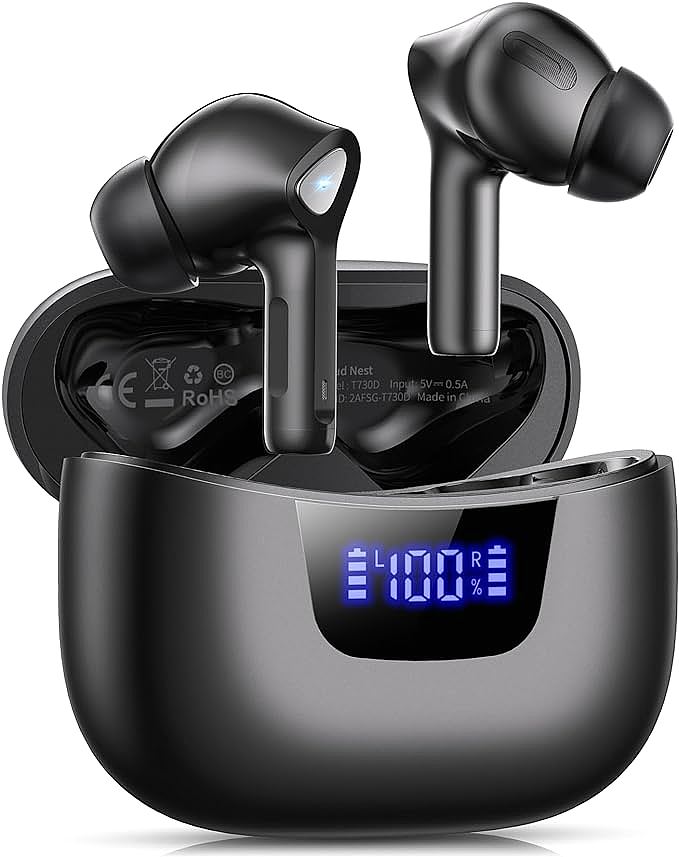
Some budget earbuds feature a small numeric LED display on the front of the charging case, showing the remaining battery percentage. This component is a seven-segment LED driven by a microcontroller that reads battery voltage through an analog-to-digital converter.
Battery voltage is not a perfectly linear indicator of remaining charge. Lithium-ion cells maintain a relatively flat voltage through the middle of their discharge curve and drop sharply at the extremes. A simple voltage reading will suggest the battery is at 100 percent for most of the cycle, then plummet to zero in the final minutes. Better implementations use coulomb counting, which integrates current over time to track actual energy consumed. Budget products sometimes skip this refinement, which is why the percentage display on inexpensive cases can feel imprecise.
The display adds approximately thirty cents to the manufacturing cost. It provides outsized perceived value because battery anxiety is one of the most common frustrations with wireless devices. Being able to glance at a number reduces uncertainty, and reduced uncertainty feels like quality.

Why the LED Display Is Mostly Marketing
The small numeric or bar display on the charging case is the most visible feature in product photos, which makes it the marketing differentiator for this price tier. In practice it shows only approximate remaining charge and does not track per-bud battery independently. The cost of a dedicated LED counter is negligible, but the display does not improve audio, battery, or pairing quality. It is a visual cue that the case has power, not a functional upgrade over a simple charge LED.
When Technology Becomes Invisible
The defining characteristic of mature technology is that it becomes boring. Bluetooth 5.3 is boring. Lithium-ion polymer cells are boring. Ultrasonic welding is boring. None of these technologies generate headlines anymore, and that is precisely why a ten-dollar pair of wireless earbuds can exist.
Each of these systems was once a research problem. Frequency hopping spread spectrum was patented in 1942 by Hedy Lamarr and George Antheil as a radio-guidance system for torpedoes. Lithium-ion batteries were commercialized by Sony in 1991 after two decades of materials science research. Ultrasonic welding was developed in the 1960s for bonding plastic components in the automotive industry. Conformal coatings originated in military aerospace applications, where moisture resistance was a survival requirement.
These technologies migrated from defense to industry, from industry to premium consumer products, and from premium to budget. Each step down the price ladder required no new invention, only volume manufacturing and incremental process optimization.
The question worth asking is not whether budget earbuds are good. The question is what happens when the remaining unsolved problems, which are battery energy density limits, Bluetooth latency for real-time applications, and acoustic miniaturization, follow the same trajectory. When those problems become boring too, the gap between a ten-dollar earbud and a two-hundred-dollar earbud will narrow further, not because premium products get worse, but because the floor keeps rising.
Vtkp S42 Bluetooth Headphones
Related Essays

TWS Technology: How Physical Separation Creates True Stereo Sound

Why Wireless Earbuds Sound Flat: DSP Trade-Offs Explained

How Budget Earbuds Deliver Sound and Survive the Elements
The Invisible Symphony: How Driver Size Shapes Your Audio Experience

How Audio Frequency Response Shapes Your Bluetooth...

Why Bluetooth Audio Sounds Worse Than Wired — And What...

Why Earbuds Sound Terrible on Calls: The Physics of ENC

Acoustic Endurance: The Engineering Behind the Jabra Elite 45h
