Wood Acoustics and Analog Signal Paths: The Physics Behind Natural Sound

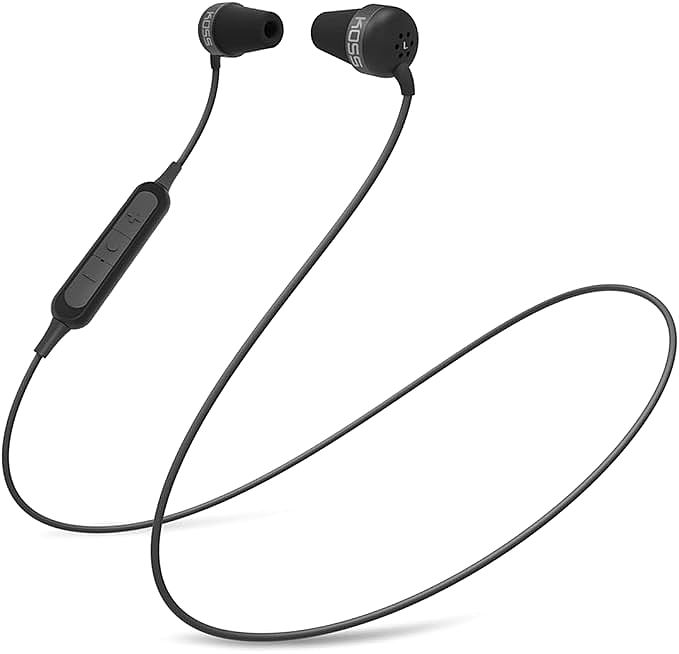
Symphonized NRG X Wired Earbuds
You press play, and something is missing. The bass guitar that should rattle your sternum feels hollow. The cymbal crash that should shimmer dies in a flat, metallic clang. You check the bitrate, you check the codec, and still the music sounds like it was squeezed through a garden hose. The problem is not your ears. The problem is the chamber between the driver and your eardrum, and the material that chamber is made from.
How Material Choice Governs What You Actually Hear
Every acoustic enclosure resonates. This is not a defect; it is physics. When a moving-coil driver pushes air, those pressure waves do not travel in a single direction toward your eardrum. They radiate outward in all directions, striking the interior walls of the earbud housing. Those walls absorb some energy, reflect some energy, and convert some energy into vibration. The character of that vibration determines what reaches your auditory canal.
Injection-molded ABS plastic, the default material for nearly all consumer earbuds, has a damping coefficient of approximately 0.005 to 0.01. Damping coefficient measures how effectively a material absorbs vibrational energy rather than reflecting it. A low coefficient means the material stores energy and releases it back as unwanted resonance. In practical terms, plastic housings tend to ring at specific frequencies, adding a hard, artificial coloration to the sound. Engineers compensate with digital signal processing, but the underlying physics of the chamber remain unchanged.
Natural wood tells a different story. Hardwoods like walnut and cherry exhibit damping coefficients between 0.02 and 0.04, roughly two to four times higher than ABS plastic. This difference originates in the cellular architecture of timber. Wood consists of cellulose fibers bound by lignin, a complex polymer that functions as a natural viscoelastic matrix. When sound waves encounter this structure, the lignin deforms microscopically under the pressure, converting vibrational kinetic energy into trace amounts of heat. The porous cellular network scatters reflected waves along irregular paths, breaking up standing waves that would otherwise create resonant peaks. The result is an enclosure that absorbs high-frequency harshness while allowing lower frequencies to decay naturally, producing what audio engineers describe as a warm profile.
This is not new knowledge. Luthiers have exploited these properties for centuries. The spruce soundboard of a violin, the mahogany back of a Martin guitar, the maple rim of a viola: each selection reflects an understanding that the enclosure is not a neutral container but an active acoustic element. The Symphonized NRG X earbuds apply this same principle at a miniature scale, using natural wood chambers where each unit carries unique grain density and porosity patterns that break up uniform resonance.
Inside the Moving-Coil Driver: Electromagnetism at Human Scale
The enclosure matters, but the engine that generates the sound matters equally. Understanding how a moving-coil driver converts electrical current into acoustic pressure requires a brief excursion into electromagnetism.
A moving-coil driver contains three core components: a permanent magnet (typically neodymium in modern earbuds), a voice coil made of tightly wound copper wire, and a flexible diaphragm. When the analog audio signal from your device reaches the voice coil, the fluctuating current generates a corresponding fluctuating electromagnetic field. This field interacts with the static field of the permanent magnet, producing a Lorentz force that pushes and pulls the coil. Because the coil is bonded to the diaphragm, that physical movement displaces air, creating the pressure waves your ear interprets as sound.
The precision demanded here is difficult to overstate. To reproduce a 10 kHz tone, the diaphragm must complete 10,000 full oscillation cycles per second. To reproduce a cymbal crash containing energy up to 20 kHz, the diaphragm must reverse direction 20,000 times per second with positional accuracy measured in micrometers. The 10mm moving-coil driver found in earbuds like the NRG X accomplishes this within a housing volume smaller than a cubic centimeter, a feat of miniaturization that would have been impossible before the commercialization of neodymium magnets in the 1980s.
Prior to that materials significant, headphone drivers relied on ferrite magnets, which produce far less magnetic flux density per unit of mass. The headphones of the 1960s and 1970s were heavy, bulky, and inefficient because the magnetic field required to drive the diaphragm demanded large, heavy permanent magnets. Neodymium reduced the magnet to a component small enough to fit inside an ear canal, shifting the engineering constraint from generating sufficient force to optimizing the acoustic environment around the driver.

Why Your Earbud Seal Determines Everything
Even the finest driver in the most acoustically optimized housing produces disappointing sound if the seal between the earbud and your ear canal is imperfect. This is not a minor point. It is the single most influential variable in in-ear audio quality.
Sound waves in open air obey the inverse-square law: their energy density halves with each doubling of distance. In the confined space of an ear canal, the physics shift toward pressure chamber behavior, where the enclosed air volume acts as a spring coupling the driver to the eardrum. If that chamber leaks, the coupling collapses. Low frequencies, which require substantial air displacement to generate audible pressure, escape first. The perceived result is a thin, tinny sound with no bass foundation.
Simultaneously, an unsealed canal allows external noise to enter. A psychoacoustic phenomenon called auditory masking means that a loud external sound at one frequency prevents your brain from perceiving a quieter sound at a similar frequency, even if both are physically present at your eardrum. A subway train at 80 dB will mask most of the midrange detail in your music, regardless of how accurately the driver reproduces it.
Passive noise isolation addresses both problems through a single mechanism: a physical barrier. Memory foam ear tips compress to fill the unique topography of your ear canal, then slowly expand to create an airtight seal. Silicone tips achieve a similar effect through elastic conformity. The inclusion of 12 distinct ear tip options across silicone, memory foam, and dual-flange designs reflects the engineering reality that no single tip geometry fits all ear canals. A proper seal can achieve up to 25 dB of noise reduction, which is comparable to the reduction provided by many active noise cancellation systems, without any battery, processor, or anti-phase waveform generation.
The Shannon-Hartley Ceiling: Why Wireless Audio Compromises Fidelity
The wired versus wireless debate is not a matter of nostalgia. It is a matter of information theory.
Claude Shannon and Ralph Hartley established the mathematical foundation for understanding the maximum rate at which information can be transmitted over a communication channel of specified bandwidth in the presence of noise. Their theorem, published in various forms between 1928 and 1949, defines a hard ceiling: channel capacity equals bandwidth multiplied by the logarithm of signal-to-noise ratio plus one.
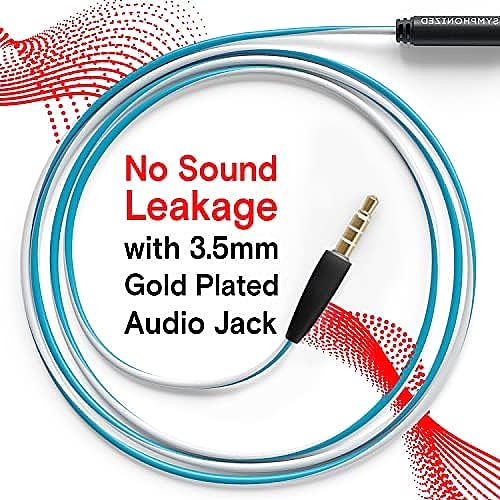
A 3.5mm analog audio connection sidesteps this ceiling entirely for the final delivery stage. The digital-to-analog converter in your source device translates the digital file into a continuous voltage waveform. That voltage travels down a copper conductor directly to the voice coil. No compression, no packetization, no codec. The signal that reaches the driver is identical to the signal the DAC produced.
Bluetooth audio cannot make this claim. The Bluetooth radio channel operates within the 2.4 GHz ISM band with limited bandwidth, shared with WiFi, microwaves, and countless other devices. To fit audio data through this constrained channel, the signal must be compressed using a codec such as SBC, AAC, or aptX. These codecs employ psychoacoustic models to identify and discard audio data that the algorithm predicts will be inaudible to the average listener. The discarded data is gone permanently. Even the highest-quality Bluetooth codecs operate at bitrates far below the 1,411 kbps of uncompressed CD audio, let alone the 4,608 kbps of 24-bit/96kHz Hi-Res files.
The consequences are measurable. Wired connections routinely deliver sound pressure range exceeding 120 dB. Wireless connections typically top out around 100 dB, a 20 dB gap that represents a tenfold reduction in the ratio between the loudest and quietest reproducible sounds. Latency tells a similar story: wired connections introduce less than 0.5 milliseconds of delay, while Bluetooth adds 100 to 300 milliseconds as the signal is compressed, transmitted, received, and decompressed. For music listening, this latency is perceptually tolerable. For video editing, gaming, or music production, it renders wireless audio functionally unusable.
This is why recording studios, broadcast facilities, and live sound engineers use wired monitors exclusively. Professional audio tolerates zero compromise in signal integrity.

Passive Physics Versus Active Algorithms
The audio industry currently divides along a philosophical fault line. On one side sits active noise cancellation, a technology that samples ambient sound with external microphones, computes an inverse waveform in real time, and drives the speaker to produce anti-noise via destructive interference. It is an impressive application of digital signal processing.
On the other side sits passive isolation and natural acoustic damping: the use of dense materials, precise seals, and viscoelastic enclosures to prevent unwanted acoustic energy from entering the system in the first place.
Each approach carries tradeoffs. Active noise cancellation consumes battery power continuously. The DSP processing introduces a faint audible noise floor, often perceived as a high-frequency hiss in quiet environments. The anti-phase generation can interact with the music signal itself, subtly altering the frequency response, particularly in the lower midrange where the cancellation algorithm operates most aggressively.
Passive isolation offers no such side effects. It works without power, without processing, and without adding any energy to the system. Its effectiveness depends entirely on the quality of the physical seal and the acoustic properties of the housing material. The tradeoff is that passive isolation cannot adapt to changing noise environments the way ANC can. A wood-and-silicone barrier provides consistent attenuation across a broad frequency range, but it cannot selectively eliminate a sudden engine roar while preserving a conversation the way an adaptive ANC system attempts to.
The two approaches are not mutually exclusive, but they reflect fundamentally different engineering philosophies. One fights energy with energy. The other prevents energy from entering at all.
What Wood Teaches Us About Engineering Restraint
There is a broader lesson embedded in the acoustics of organic materials. Wood does not try to correct problems after they arise. It absorbs vibrational energy at the point of contact, converting it to negligible heat before it can reflect back into the acoustic chamber and introduce coloration. This is engineering through subtraction rather than addition.
The thermal expansion coefficient of wood is approximately 3 to 5 millionths per degree Celsius. ABS plastic expands at 70 to 90 millionths per degree Celsius, roughly 20 times more. Over the temperature ranges a pair of earbuds experiences in daily use, from a cold car to a warm pocket to a sunlit desk, this difference means a plastic housing shifts dimensionally far more than a wooden one. Those dimensional shifts alter the internal volume of the acoustic chamber, subtly but measurably changing the frequency response over the course of a day. Wood, with its dimensional stability, maintains consistent acoustic geometry.
The internal loss factor, expressed as tan delta, quantifies how much vibrational energy a material dissipates per oscillation cycle. Wood registers between 0.015 and 0.035. ABS plastic registers between 0.005 and 0.01. This two-to-three-fold difference means that when a sound wave strikes the interior wall of a wooden earbud, significantly more of its energy is absorbed rather than reflected back to interfere with the primary signal. The music you hear is cleaner not because something was added, but because something was removed.
The aging behavior of wood reinforces this philosophy. Over the first 50 to 100 hours of use, a wooden acoustic chamber gradually settles. The cellular structure relaxes microscopically under repeated vibration, and the damping characteristics subtly shift toward a more uniform absorption profile. Audiophiles call this break-in. Materials scientists call it viscoelastic relaxation. Either way, the material improves with use rather than degrading, a property shared with vacuum tube amplifiers and vintage instruments, and one that no synthetic polymer can claim.
The next time you listen through a wooden enclosure, consider that the warmth you perceive is not a coloration added to the signal. It is the absence of the harshness that plastic would have reflected back at you. Good acoustic engineering, like good writing, often reveals itself through what it leaves out.
Symphonized NRG X Wired Earbuds
Related Essays

The Physics of Silence: Decoding 30dB Reduction and...

Chasing the Fletcher-Munson Curve: The Acoustic Architecture of V-Shaped Audio

The Physics of Silence: Why Passive Isolation Beats Budget ANC

The Case for Wires: Why the iRAG A101 Outperforms Bluetooth in Critical Scenarios

Bose SoundSport In-Ear Headphones - Deep, Clear Sound On the Go

Motorola 2-S Wired Earbuds: A Budget-Friendly Blast of Clear Sound

Holiper 023 Wired Earphones: A Budget-Friendly Option with Hi-Fi Sound and Comfort

Water Sounds for Sleep: The Science Behind Nature Sounds and Neural Relaxation

Hybrid Driver Coherence: The Wave Physics Behind Multi-Driver In-Ear Monitors