Lightning Audio and iPhone: How Digital Sound Replaced the Headphone Jack


Symphonized NRG MFI Wired Headphones
The Paradox at the Bottom of Your Pocket
There is a moment in the history of every technology when the invisible becomes more important than the visible. In 1877, Thomas Edison wrapped tin foil around a cylinder and heard his own voice played back for the first time. The real revolution was not the cylinder itself but the idea that sound could be captured, transformed, and reproduced as something else entirely. That idea would take another 139 years to reach its most peculiar expression: a world where music travels through your phone not as sound at all, but as mathematics.
This is the story of that transformation, and of the small, hidden engineering that makes it possible for a wired earbud connected to your iPhone to deliver music that was, moments earlier, nothing more than a stream of binary digits.
How Sound Becomes Numbers (And Back Again)
To understand what happens when you plug wired headphones into an iPhone, you have to start with a deceptively simple question: what is sound, really?
Physically, sound is a pressure wave, a disturbance in the air that propagates outward from a source at roughly 343 meters per second. When a guitar string vibrates, it pushes and pulls the air around it, creating alternating regions of high and low pressure. Your eardrum detects these fluctuations and your brain interprets them as music, speech, or noise. This is the analog world: continuous, smooth, infinitely detailed.
Digital audio works on a fundamentally different principle. Rather than capturing the continuous wave, it takes snapshots — measurements of the wave's amplitude at regular intervals. This process, called sampling, was formalized by Harry Nyquist and Claude Shannon at Bell Labs in the mid-twentieth century. Their sampling theorem proved that if you measure a wave at least twice per cycle at its highest frequency, you can reconstruct the original signal perfectly. The CD standard, established in 1982, samples at 44.1 kHz — meaning it takes 44,100 measurements per second of each audio channel.
Apple's Lightning audio specification goes further. It mandates support for lossless stereo 48 kHz digital audio output, the same sample rate used in professional film, broadcast, and studio recording environments. This is not a trivial difference: those additional 3,900 samples per second capture high-frequency detail that the CD standard intentionally omits.
The consequence is profound. When you connect wired headphones to an iPhone's Lightning port, the music that reaches your ears has been through a journey that Edison could never have imagined: analog sound was recorded, converted to numbers, compressed into a file format like AAC or ALAC, stored as magnetic charges on a flash chip, read out as binary data, transmitted as electrical pulses through a proprietary connector, converted back into analog electrical signals by a tiny chip inside the headphone itself, amplified to drive a miniature speaker, and finally pushed into your ear canal as pressure waves.
Every step of this chain involves engineering decisions that directly affect what you hear.
The Death of the 3.5mm Jack and the Birth of Lightning Audio
In September 2016, Apple removed the 3.5mm headphone jack from the iPhone 7. Phil Schiller, Apple's senior vice president of worldwide marketing, called it a decision requiring "courage." The justification was multifaceted: the jack consumed valuable internal space that could house a larger camera system and better battery, and it was a physical vulnerability in the phone's water resistance sealing.
Dan Riccio, Apple's senior vice president of hardware engineering, stated the jack was "holding us back from a number of things we wanted to put into the iPhone." The iPhone 7 debuted with IP67 water resistance and a larger camera module — features that the internal volume previously occupied by the headphone jack helped enable.
Ars Technica's analysis noted that unlike previous Apple transitions — the floppy drive in 1998, the optical drive in 2008 — the headphone jack was being removed before its replacement was clearly superior. The "courage" framing was widely mocked, but the engineering logic was sound: the 3.5mm jack was an analog anachronism in an increasingly digital device.
The 3.5mm jack itself traces its lineage to the late 1800s, when quarter-inch (6.35mm) plugs were used for telephone switchboard connections. The smaller 3.5mm version was introduced in the 1960s for transistor radios. Apple's removal ended a connector standard that had survived for over 50 years in its 3.5mm form and nearly 140 years in its original form.
The critical difference between the old 3.5mm jack and the Lightning connector is not shape or size. It is that the 3.5mm jack carries analog audio — a continuously varying electrical signal that directly represents sound pressure waves. The Lightning connector carries digital audio — binary data that represents sound as numbers. This distinction changes everything about how headphones must be designed.
Inside Lightning Audio: The Digital Pipeline
When you plug Lightning headphones into an iPhone, the following signal chain executes in real time:
First, the iOS audio stack — a subsystem called Core Audio — processes the digital audio file. It may apply equalization, volume normalization, and spatial audio effects. The output is raw PCM (Pulse Code Modulation) audio data, a stream of numbers representing the waveform.
Second, this digital data travels through the Lightning connector's data pins. The Lightning connector has eight pins arranged in a reversible configuration, with dedicated pins for power, data transfer, and identification. The audio data travels as digital packets, not as analog electrical signals.
Third, the authentication handshake occurs. Every MFi-certified Lightning accessory contains an Apple authentication coprocessor — a tiny cryptographic chip that performs a handshake with the iOS device. This chip verifies that the accessory is genuine and authorized. Non-certified accessories may trigger warning messages or simply fail to function. The communication uses Apple's iAP2 (iPhone/iPad/iPod Accessory Protocol), which handles authentication, audio streaming, remote control commands, and metadata exchange.
Fourth, the digital-to-analog conversion happens inside the headphones themselves. Lightning headphones must contain their own DAC (digital-to-analog converter), because the Lightning port no longer provides analog audio output. In the old 3.5mm era, the phone's internal DAC — a custom Apple/Cirrus Logic chip — handled this conversion. Now, the headphone manufacturer controls the quality of this critical step.
Fifth, a built-in headphone amplifier boosts the analog signal to a level sufficient to drive the speaker drivers. The amplifier's quality affects volume, dynamic range, and distortion characteristics.
Finally, the drivers produce sound waves, and the housing material shapes how those waves reach your ear canal.
This architecture has a significant advantage: the headphone manufacturer controls the entire analog conversion and amplification chain. As IEEE Spectrum reported, this gives designers "much greater freedom to improve sound quality" because they can choose their own DAC, amplifier, and signal path components. Audio engineer Rob Boomhower, quoted by IEEE Spectrum, stated that digital audio through Lightning should be "better in virtually all objective ways."
Ken Rockwell's laboratory measurements of the Apple Lightning audio adapter (which uses the same digital audio pathway) confirmed this potential. His tests showed remarkably good performance: THD (total harmonic distortion) of just 0.0011% into a high-impedance load, output impedance of only 1 ohm, and a frequency response "flatter than most audio analyzers." Rockwell concluded that "this tiny Apple device has better performance and more and cleaner output than many fancier audiophile devices."
What MFi Certification Actually Means
Apple's MFi (Made for iPhone/iPad/iPod) program is often misunderstood as a marketing badge. In reality, it is a rigorous technical certification that directly affects whether an audio accessory will work with your iPhone at all.
The certification process involves four stages. First, the manufacturer submits a Product Plan to Apple describing the accessory's intended functionality. Second, they design, develop, and test the accessory, procuring MFi-specific components — including the mandatory authentication coprocessor — from Apple-authorized suppliers. Third, they use Apple's certification tools and submit production-ready samples for review. Fourth, upon approval, they begin mass production.
For Lightning audio specifically, Apple provides two hardware configurations. The "Standard Lightning Headphones" configuration uses minimum components paired with a DAC supported by the Lightning Headphone Module — this is the simpler, more common approach used by most wired Lightning earbuds. The "Advanced" configuration adds a digital signal processor (DSP) alongside the DAC, enabling features like active noise cancellation, custom equalization, and enhanced microphone processing.
The authentication coprocessor is the gatekeeper. When you plug a Lightning accessory into an iPhone, the phone sends a cryptographic challenge. The coprocessor must respond correctly within milliseconds. If it fails — either because the chip is absent (as in counterfeit products) or because the firmware is outdated — the iPhone will display a warning and may refuse to pass audio through.
This is not merely a copy-protection measure. The authentication ensures that the accessory meets Apple's electrical specifications, which protects both the iPhone's Lightning port circuitry and the user's listening experience. A poorly designed Lightning accessory could, in theory, draw excessive current or introduce electrical noise into the phone's audio subsystem.
The cost of MFi membership is $99 per year, and only verified accessory developers, manufacturers, or brand owners can apply. This barrier to entry, while modest, ensures a baseline of manufacturer accountability.
The Definitive iPhone Compatibility Matrix
Understanding which iPhones support Lightning audio requires tracing two distinct hardware transitions: the introduction of the Lightning connector itself (replacing the 30-pin dock connector in 2012) and the later transition from Lightning to USB-C (beginning with the iPhone 15 in 2023).
Direct Lightning Audio Support (No Adapter Required):
- iPhone SE (1st, 2nd, and 3rd generation — all use Lightning)
- iPhone 6, 6 Plus, 6s, 6s Plus
- iPhone 7, 7 Plus, 8, 8 Plus
- iPhone X, XR, XS, XS Max
- iPhone 11, 11 Pro, 11 Pro Max
- iPhone 12, 12 Mini, 12 Pro, 12 Pro Max
- iPhone 13, 13 Mini, 13 Pro, 13 Pro Max
- iPhone 14, 14 Plus, 14 Pro, 14 Pro Max
All iPads and iPods with Lightning connectors also support Lightning audio devices.
USB-C Transition (Lightning Audio Requires Adapter):
- iPhone 15, 15 Plus, 15 Pro, 15 Pro Max
- iPhone 16, 16 Plus, 16 Pro, 16 Pro Max
These models use USB-C, not Lightning. Lightning headphones can still be used with a Lightning-to-USB-C adapter, but this adds cost and an additional point of failure in the signal chain.
Incompatible:
- Any Android device
- Any device without a Lightning port (or appropriate adapter)
The iPhone 15's transition to USB-C was driven by EU regulations requiring a common charging standard. This means Lightning audio accessories, which served the iPhone ecosystem for seven years, are now entering a legacy phase. However, with hundreds of millions of Lightning-equipped iPhones still in active use worldwide, the installed base remains substantial.
There are also practical limitations that apply to all Lightning headphones. Using the Lightning port for audio means you cannot charge the iPhone simultaneously — a fundamental constraint of the single-port design. Remote control functionality varies by product; some Lightning headphones support volume, play/pause, and track skipping, while others offer only basic volume and play/pause.
Wood, Warmth, and the Acoustics of Materials
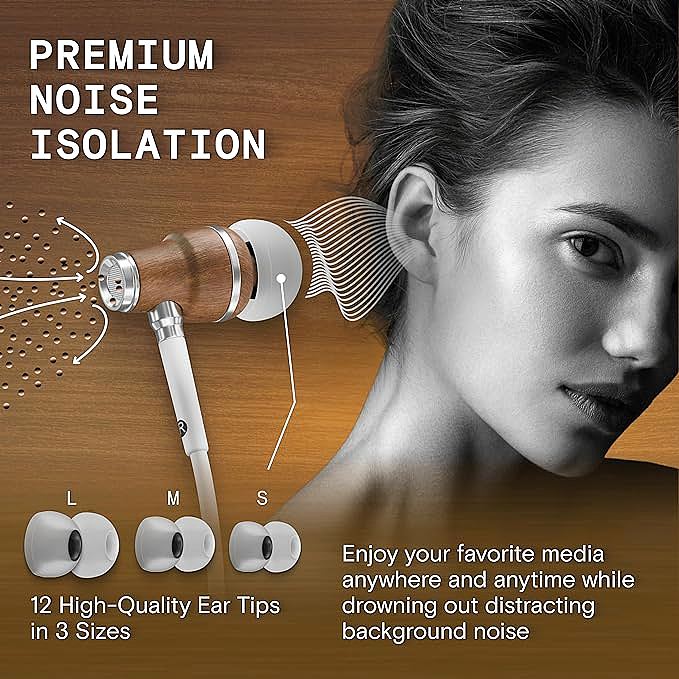
Among Lightning audio earbuds, some manufacturers use wood as a housing material — a choice rooted not in aesthetics alone but in verifiable acoustic physics. Understanding why requires a brief excursion into materials science.
Every material used in headphone construction vibrates in response to the sound produced by the drivers. These vibrations create secondary sound waves that color the audio, adding unwanted resonance, harshness, or distortion. The key acoustic property is internal damping — the material's ability to absorb and dissipate vibrational energy.
Plastic, the most common earbud housing material, is rigid and relatively uniform. It tends to resonate at specific high frequencies, adding a "tinny" or harsh quality to the sound. Metal reflects sound aggressively and can impart a brittle edge to treble frequencies, potentially leading to listening fatigue over extended sessions.
Wood is fundamentally different. It is a natural, non-uniform composite material with a fibrous cellular structure that provides high internal damping. It absorbs and dissipates unwanted vibrational energy as tiny amounts of heat rather than re-radiating it as sound. This is the same reason high-end musical instruments — violins, guitars, pianos — are made from wood rather than plastic or metal.
The scientific foundation for this was established in a landmark 2006 paper, "Wood for Sound," published in the American Journal of Botany by Wegst. The paper demonstrated that wood's acoustical performance is determined by three primary properties: density, Young's modulus (stiffness), and the loss coefficient (measuring internal damping). Different wood species are selected for different applications based on these material properties.
Specific hardwoods like Bubinga (African Rosewood), used in some premium wood-housed earbuds, offer high density and favorable damping characteristics. In the small form factor of an in-ear monitor, the wood housing's primary contribution is damping unwanted resonances from the driver. The driver produces both the intended sound and mechanical vibrations that travel through the housing. Wood's natural damping absorbs these secondary vibrations, resulting in a cleaner, more natural sound signature.
A 2025 peer-reviewed study in MDPI Forests journal examined acoustic resonance in birch wood loudspeaker enclosures. While focused on speakers rather than earbuds, its findings are directly relevant: wood enclosures showed measurably smoother frequency responses compared to MDF and plastic alternatives. The study confirmed that wood's acoustic wave resistance values were significantly higher than synthetic materials.
Troubleshooting Common Lightning Audio Issues
Even with MFi-certified Lightning headphones, users may encounter issues that are not immediately obvious in their cause.
Clicking Sounds During Phone Calls: Some users report clicking or popping sounds during phone calls with Lightning headphones on certain iPhone models. This is typically a firmware interaction issue between the iOS audio stack and the headphone's internal DAC. Restarting the device and ensuring iOS is updated often resolves this. If the issue persists, it may indicate a hardware incompatibility with a specific iOS version.
Playback Resume After Screen Lock: When you pause audio and lock the iPhone, pressing the inline remote's play/pause button may not resume playback from where you left off on all Lightning headphone models. This is because the iOS lock screen audio control behavior differs between Lightning-connected and Bluetooth-connected devices. In some cases, you may need to unlock the phone and resume playback from the app.
Intermittent Connection Drops: The Lightning connector's small pins can accumulate debris over time, leading to intermittent audio dropouts. Unlike the robust 3.5mm jack, which had large contact surfaces, the Lightning connector relies on eight tiny pins that must maintain clean electrical contact. Regular cleaning with a wooden toothpick (never metal) can prevent this.
Volume Asymmetry: If one earbud is noticeably louder than the other, check for ear tip seal first. In-ear headphones rely on a proper seal in the ear canal for balanced sound. Try different sizes of ear tips. If the asymmetry persists across different ear tip sizes, the issue may be related to the headphone's internal amplifier channel balance.
The Enduring Value of Wired Digital Audio
The wireless audio revolution — Bluetooth earbuds, AirPods, and the broader true wireless stereo ecosystem — has not eliminated wired digital audio. In fact, the engineering principles that make Lightning audio work reveal why wired connections still matter.
A wired digital connection eliminates the fundamental constraints of wireless audio: bandwidth limitations, latency, codec compression, and radio interference. Lightning's 48 kHz lossless stereo specification exceeds what any current Bluetooth codec can deliver in real-world conditions. The LC3 codec, the newest Bluetooth audio standard, achieves good quality at lower bitrates, but it is still a lossy compression format. Lightning audio transmits uncompressed PCM data.
Latency is essentially zero in a wired connection. The electrical signal travels through the cable at close to the speed of light. Bluetooth audio, even with the latest LE Audio improvements, introduces measurable latency — acceptable for music listening but problematic for gaming, video editing, and professional audio monitoring.
Perhaps most importantly, wired headphones never need charging. In a world increasingly burdened by battery management — charge your phone, charge your watch, charge your earbuds, charge your laptop — the simplicity of a wired connection that simply works, always, has a genuine appeal.
The USB-C transition on newer iPhones represents both an ending and a continuation. The Lightning connector as a physical form factor is entering legacy status, but the principle it established — that audio should travel as digital data from source to headphone, with the headphone manufacturer controlling the analog conversion — has become the new baseline. USB-C headphones operate on the same digital audio principle. The connector shape has changed. The engineering has not.
The next time you plug wired headphones into your phone and hear music, consider the invisible journey those sound waves have taken: from analog air pressure to digital numbers, through cryptographic authentication, across a tiny connector, back to analog electricity, and finally into the air once more — arriving at your eardrums as the same pressure waves that started the chain, except cleaner, more precise, and more controlled than anything the analog era could have achieved.
That is not magic. That is engineering. And it is happening every time you press play.
Symphonized NRG MFI Wired Headphones
Related Essays

