LIUHE HX 801 Neckband Headphones: Battery and IPX4 Fit


LIUHE HX 801 Neckband Bluetooth Headphones
Neckband designs still hold a slice of the wireless headphone market even as earbuds and over-ear headsets reshape the rest of it, and the LIUHE HX 801 Neckband Bluetooth Headphones are a plain example of why: a band that stays around your neck, earbuds on cables that roll back into a spring housing, and a weight low enough to forget. This piece works through how that retraction mechanism is built, what the battery and radio numbers support, where the unit sits inside the neckband price band, and which daily routines the design suits.
Search the phrase "retractable neckband bluetooth headphones" and you get back a narrow product class: neckband earbuds whose cables retract into the band instead of dangling. Most units in this class trade on a short list of concrete numbers, and the LIUHE is organized around three of them: 22 hours of music time, IPX4 splash resistance, and a 45 gram band. The sections below trace each of those figures to the spec sheet and to the mechanism behind it, so the numbers stay attached to something physical instead of floating in copy.
The retraction mechanism, explained
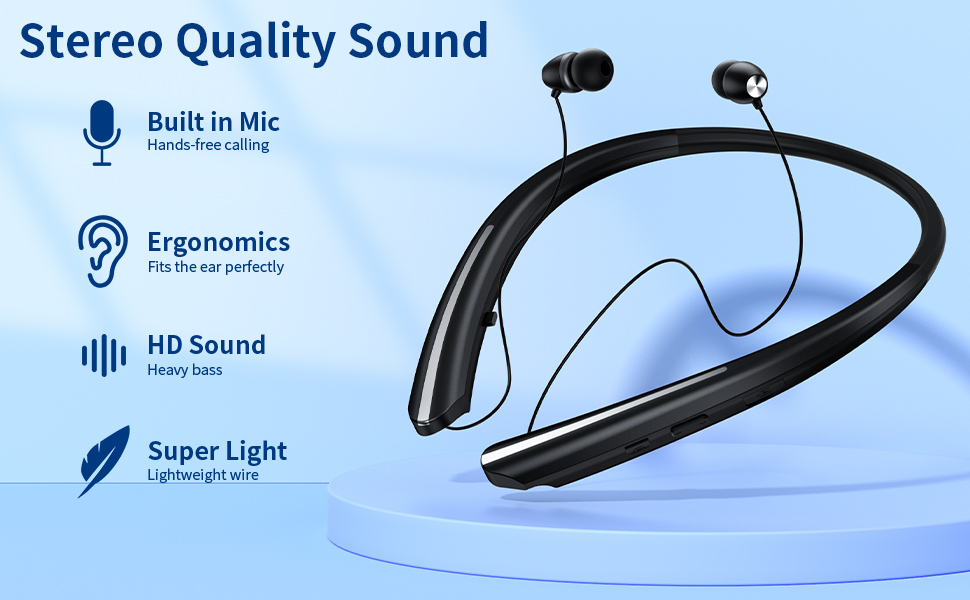
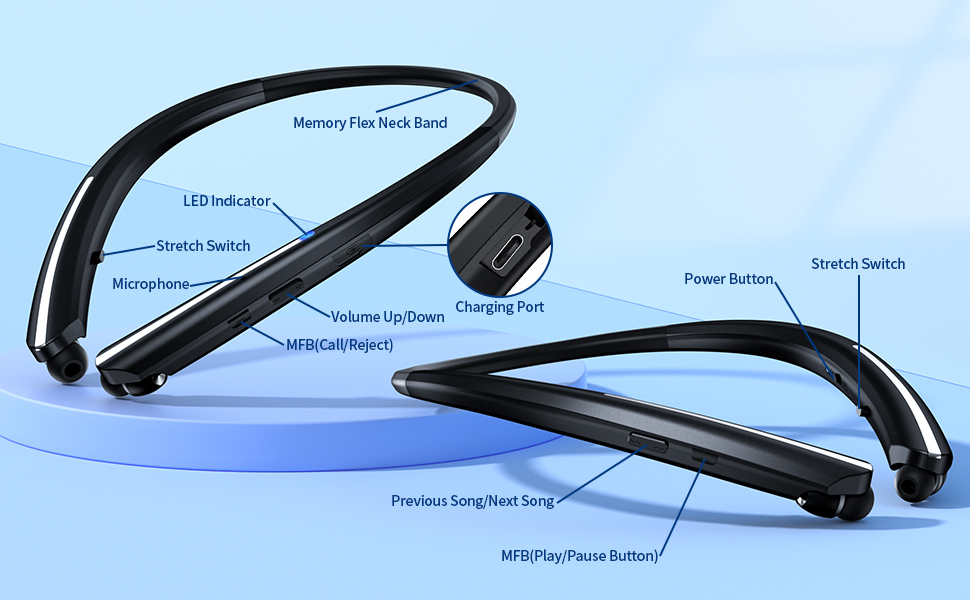
The retraction system is the unit's defining feature, and it is a miniature version of the spring clutch found in a retractable tape measure. Inside the neckband housing a calibrated spring spools the two earbud cables, and a friction clutch controls how far the cable can be pulled out and how firmly it holds at that length. Press the release button, and the spring winds the cables back into the housing, leaving a compact band you can clip to a collar, drop in a pocket, or pack into a gym bag without any knotting.
The reason this matters beyond neatness is wear. A free-hanging cable catches on zippers, door frames, and handlebars, and those snag points are where budget neckband cables fail first. The retraction housing keeps the wire out of the way, protects the conductor bends, and means the cable does not have to survive as many sharp turns over the life of the cable. The tradeoff is that the mechanism is the one moving part in the whole design, so its clutch and spring are the component you watch over a long ownership period.
Battery: 22 hours of music, 550 hours of standby
The spec sheet lists 22 hours of continuous music playback, 20 hours of talk time, and 550 hours of standby. The spread between those three numbers tells you how the unit is tuned: 22 hours of music is roughly five full workdays of listening on one charge, and 550 hours of standby means the unit can sit clipped to a bag or on a shelf for about three and a half weeks between uses without the lithium-ion pack sagging below a recoverable state.
The energy side is a standard lithium-ion pack sized for a low-draw radio. Bluetooth 5.1's low-energy link layer is one reason the figures hold up: the transmitter spends most of its time in low-duty states, and the control circuitry throttles the radio whenever the stream goes idle. That combination is what lets a small band carry a battery good enough for a full week of commutes.
In practice, the 22 hour figure maps onto usage the way most neckband owners keep the LIUHE: not charged every day. A routine of an hour or two of calls and an hour of music per working day lands well inside the figure, which means the charger gets involved once a week or less. That usage pattern is also kinder to the lithium-ion chemistry, because partial-depth cycling charges and discharges the pack at lower stress than the repeated full drains that a daily-charge habit would impose.
Bluetooth 5.1 and CVC 8.0 under the hood
Bluetooth 5.1 is a specification from the Bluetooth SIG, and the current Core Specification 5.1 (Amended) was updated on 2024-06-11 and took effect 2024-07-01, with specification updates 11838, 27096, 28936, and 28108 required to claim compliance. For a neckband the useful parts of 5.1 are the connection efficiency gains on the low-energy link, the reduced latency that keeps audio and video in sync, and the angle-of-arrival and angle-of-departure direction-finding features that ship in the same core. The band does not use direction finding; staying on the same 5.1 core is what keeps it pairable with devices on 5.1 or newer.
On the call side, the band runs CVC 8.0, the Clear Voice Capture DSP layer. CVC aims at the far end of the conversation: it isolates the speech band and subtracts room noise so the voice carries. The practical effect is that a call taken on a busy street or in a cafe lands on the other end cleaner than a plain unprocessed signal would deliver.
It is also worth separating CVC from active noise cancellation, because the two are often conflated at this price. ANC pushes an inverse of the ambient signal back into the earbud to reduce what you hear; CVC does the opposite job, cleaning the signal leaving your mouth so the far end hears you. A neckband with CVC 8.0 is not claiming to quiet your music environment, and it should not be judged on that. I do not judge this neckband on quiet; I judge it on what the far end hears of me, and call clarity is the specification this section is anchored to.
IPX4 and 45 grams: what the numbers mean in daily wear
IPX4 comes from IEC 60529, the ingress-protection standard. The X position means solid-particle protection is not rated, and the 4 means the unit is protected against splashing water from any direction: sweat from a run, rain on a walk, or a spill from a bottle. It is not submersion-rated, so a pool or shower is out of scope, but a workout or a wet commute is exactly what it is aimed at.
The LIUHE band itself weighs 45 grams, or 0.1 pounds, and is made from a flexible, skin-friendly silicone. That weight is what keeps the unit on through a run: the load sits evenly across the back of the neck instead of hanging on one ear, and the silicone stays put through head movement without the pinching that a stiffer band's clamp produces. For a device you wear for hours, the 45 gram figure is the single most comfortable number in the spec sheet.

Where the HX 801 sits in the neckband price band
The original listing record prices the HX 801 at $29.99 with a 7 percent discount down to $27.99, and a second color, Rose, at $24.99. Around it, the same PAAPI channel returns a broader neckband cluster today: a Lecefty at $25.99, CXK and Qeapaue units at $29.99, a Sony at $38.00, and a JUMAHEU at $59.99. The $27.99 tag puts the unit in the middle of a $25.99 to $59.99 band, and the newer units in that cluster push Bluetooth 5.3 with batteries from 180 to 280 mAh and IPX5 or IPX7 ratings, so the 5.1 plus IPX4 pairing on this unit is the value end of the field rather than the newest corner of it.
The listing carries a 3.6 out of 5 rating across 130 ratings, with 4 answered questions in the record. In the live PAAPI feed the lead ASIN B0BFDNJ8RJ currently shows out of stock, with a sales rank of 778378 and categories of Single Ear Bluetooth Headsets and iPhone Accessories. The stock state is a data point, not a quality signal: it is why the spec discussion above leans on the recorded listing rather than the live feed.
Compatibility, vibration alerts, and day-to-day use
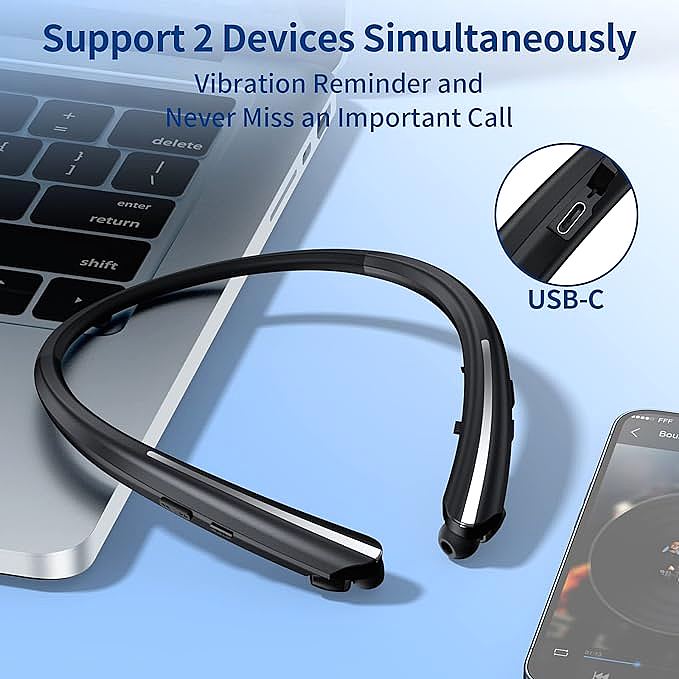
Pairing is the generic kind: the HX 801 pairs over standard Bluetooth with iPhone, Android, iPad, and Samsung devices. The incoming-call vibration alert is the other small but useful mechanism in the band. A compact motor, typically an eccentric rotating mass or a linear resonant actuator, buzzes the band against your neck when a call lands. So a call the phone would otherwise leave unheard still reaches you while the phone sits in a bag or on a muted desk.
The day-to-day picture that follows from those parts is a unit aimed at people who move between rooms and modes: a commuter who parks the phone, a gym habit where a dangling cable would grab the treadmill, a desk routine where the band stays on and the alerts carry the meetings. The retractable housing keeps the cables stowed, the 550 hour standby keeps it charged across the gaps, and the 45 gram band keeps it comfortable through the stretches in between.
The LIUHE HX 801 as a desk-and-gym daily driver
I would keep this unit for desk-and-gym duty: the 45 gram band survives a run, and the vibration alert keeps a call audible when the phone itself is out of sight. For a full wet run I would want IPX5 first, because the IPX4 rating on this unit stops at splash and sweat. On the audio side the mids are the first place to check, and a vocal track shows the limit of a call-focused neckband faster than a bass test.
It remains the clearest expression of the original retractable-earbud idea at a low price point, and the numbers above are the part that does the actual work. I have not run it long, because the lead listing is out of stock; this is a spec-and-short-term read, and the long-term wear notes wait for a unit on the shelf.
LIUHE HX 801 Neckband Bluetooth Headphones
Related Essays

Battery Volume vs. Miniaturization: The Physics Behind Wireless Headphone Runtime

Why Your Wireless Earbuds Last 48 Hours: The Physics Behind Battery and Sound

JBL Everest 110 In-Ear Wireless Headphones: The Science of Untethered Sound and Clear Communication

Anypub A11 Wireless Earbuds: Your Ultimate Audio Companion for Crystal-Clear Calls and Immersive Music

Boytond m20 Bluetooth Headphones - Impressive Sound and Battery at an Affordable Price

EUQQ Q125 Wireless Earbuds: Your Ideal Music Buddy for Sports

iJoy DHP2101 Disney Nightmare Before Christmas Headphones: A Symphony of Style and Sound

iJoy LGE-PRE-STL Wireless Headphones: Decoding the Tech Behind Your Everyday Audio Experience

Neckband Audio: Spatial Separation Enables aptX-HD at Budget Prices

