Why Cheap Wireless Earbuds Punch Above Their Price


Aiearbu Wireless Earbuds
You open a pair of in-ear buds for $11.99 and the spec sheet reads like a mistake. A Bluetooth 5.3 link. An IP7 seal that shrugs off a workout and a downpour. A charging case that stretches total playtime to 48 hours, with each bud running 8 hours on its own charge. A small LED screen that shows exactly what each bud still holds. A 14.3mm driver that pushes bass you would not expect at this price. Your first reaction is usually the same one. This has to be a scam. The part where something cheap works this well is the part that makes you suspicious.
It is not a scam. It is just very good at a narrow job. This piece walks the engineering and the economics of the budget wireless earbuds that sit at the very bottom of the price ladder, using the Aiearbu Wireless Earbuds, the B0FVRQ1476, as the concrete anchor, and it keeps the numbers from the cheaper generation that came before it. The goal is not to tell you which pair to buy. It is to show you exactly where the dollars go, where they do not, and why that decides what the sound is like.
Why a $11.99 pair does not feel like a scam
The short answer is scale. The more a Bluetooth earbud design sells, the more factories build it, and mass production drives the per-unit cost down until the savings reach the buyer. One shared industrial design cloned across a dozen brands is what the budget class sells: a barebones build that only needs a few dollars of margin because it is amortized over huge volumes. The factory earns its return on volume, not on a markup, which is why several hundred units a month at a thin margin can still hold the price at $11.99.
That same economics also sets the ceiling on reliability. Cheaper electronics hit more glitches and more dead units, purely as a matter of statistics, because the manufacturing shortcuts that keep the cost down are the same ones that reduce the depth of testing. The core audio path still works, and that is the part you notice every day. The long tail of durability is where the budget build quietly gives back, so a set that plays 48 hours a month will usually outlast a pricier one that sits unused.

Two ways a bud is made, and the cheap one is the second
There is a useful split for how a pair is designed. One class is built from the ground up: a brand designs its own enclosure, its own crossover, and its own tuning, and it charges for that engineering. The other class is off the shelf: a proven, shared design that many companies license and churn out with little in the way of new work. A $11.99 bud is squarely the off-the-shelf class, and that is the honest framing for it. You are buying a proven build near the lowest point of its curve, not a bespoke instrument.
The practical consequence is that the feature list on a cheap bud and the one on a much more expensive bud can look almost identical on the page. The difference lives in the last slice of refinement: the acoustic tuning, the codec licensing, and the depth of the microphone path. The spec sheet hides that slice, which is why two pairs can read the same while one costs several times more, and why the off-the-shelf class still sells in volume despite never winning an awards shelf.
Where the money goes, and where it is cut
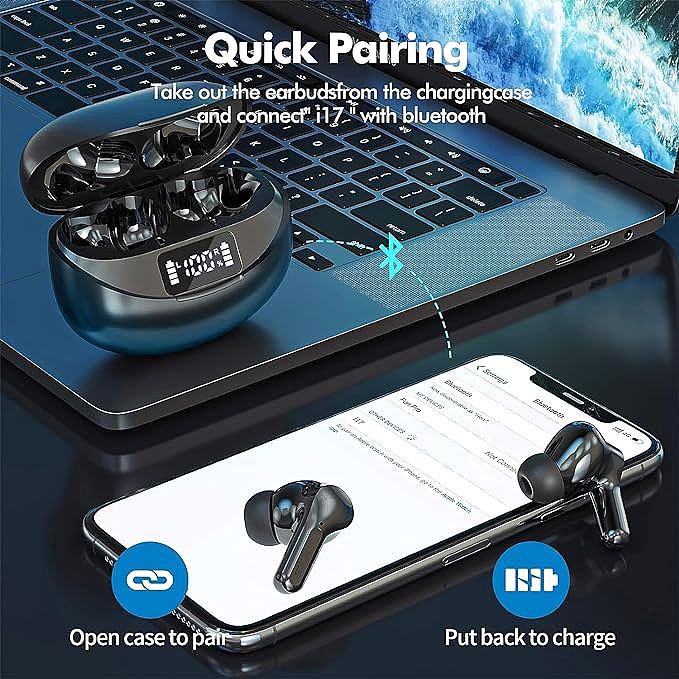
The two heaviest parts of a $11.99 bud are the driver and the Bluetooth 5.3 chip, both commodity items at volume. The features that feel premium cost almost nothing to add. The IP7 seal is a process, a nano-coating on the boards and a waterproof mesh over the openings, standardized and automated, so it adds pennies per unit. The long battery is a commodity too, because the phone industry scaled the cells down in price, and the more efficient 5.3 link stretches that same cell to 48 hours in total use, with 8 hours on a single charge before you reach for the case. The small LED display on the case is the cheapest premium feel you can buy: a simple driver plus a readout that shows the case level and the left and right bud separately, and it removes battery anxiety without costing the factory much at all.
What is missing is the expensive slice. True noise cancellation needs a second microphone array and a dedicated chip running the math. A licensed low-latency or high-resolution codec carries a per-unit fee that most budget boards skip. And studio-level tuning is hours of measurement and crossover work, not a part you can buy off a shelf. Those three are the cuts, and nearly every audible gap between a $11.99 bud and a $79 one traces back to one of them, because the 14.3mm driver is where the budget stops spending.

Why the low end flatters a small driver
The single biggest reason a small, inexpensive driver beats its price on the low end is that bass is the cheapest attribute to make. You can make it sound big by moving more air at the fundamental and by shaping the enclosure, and a 14.3mm dynamic driver with a composite diaphragm is more than capable of that. What is hard to buy cheap is fast, precise transient detail, the thing that makes an expensive driver sound clear at the top. So a budget maker leans into the low band, which flatters the transducer and masks the earlier treble roll-off, and the result reads fuller than the number of dollars behind it would suggest.
The curve that comes out is the warm, bass-forward one that reviewers use to describe budget winners. It is a real trade, not a trick. You get a bigger low end and give up the detail and the soft top end that a tuned, more expensive driver keeps. The codec does not rescue it either, because the driver is the bottleneck, and a better stream cannot add detail that a weak transducer never produced. This is also where a 3.6 gram bud from the cheaper generation, pairing its 36 hour case, sits in the same place: the mass is gone and the battery is longer now, but the tuning logic is identical across both.
What Bluetooth 5.3 does at this price
Bluetooth 5.3 is not a faster audio pipe, and it is not what makes the sound good. It is a more stable and more efficient link layer. What it buys at $11.99 is pairing reliability, lower power draw that extends real wall-clock playtime, and better handling of interference. That is why nearly every budget listing now ships 5.3 as the baseline instead of treating it as an upgrade. It is the feature that used to separate the tiers and now sits on the floor of the ladder, which is exactly why the total 48 hours figure holds up in practice.
What it does not give you is high-resolution lossless audio, which needs the newer LE Audio stack and the LC3 codec that most boards at this price do not carry. It also does not give you ultra-low gaming latency, which needs a licensed low-latency codec the budget chip omits. For music and video the standard stream is mostly fine, and the lag is easy to ignore. For competitive play it is the first cut you will notice, right after the microphone, because the call mic on this bud is a single ENC path that reduces background noise on calls but is not the multi-mic array that real noise cancellation runs on.
Where the $11.99 bud sits on the ladder
The budget floor keeps ratcheting up, because the features that hit zero marginal cost first become the baseline. A generation ago, the Bcaikair NEW-i17 carried this same profile at $9.99: a Bluetooth 5.3 link, an IPX7 seal, a 36 hour case, a dual LED display, and a 3.6 gram bud. It is delisted now, and its successor, the Aiearbu Wireless Earbuds B0FVRQ1476, at $11.99, keeps the same anchors and pushes the total battery from 36 hours to 48 hours. The pattern is the point. The seal, the efficient link, the long battery, and the display were premium once and are table stakes now.
Above that floor, the ladder is easy to read. Around $50 you reach a tier like the Soundcore P40i, and some picks there add the LDAC codec. At $79, a name like the Anker Soundcore Space A40 brings in real noise cancellation and a full equalizer, the exact features cut at the $11.99 tier. Independent benches that have measured hundreds of devices put the count in the 926 neighborhood for budget buds alone, and they all land on the same curve. The more you spend, the more of that last slice of refinement you are buying, and the less you are paying for the core, which is the part a $11.99 pair already covers.
A $11.99 bud is not trying to be a $79 one. It is trying to make the core Bluetooth experience cheap enough that the trade stops mattering. Once you know exactly which slice you are giving up, the price stops feeling like a mistake and starts feeling like what it is, a well-understood compromise at the bottom of a very real ladder.
Aiearbu Wireless Earbuds
Related Essays

Wireless Earbuds for Small Ears: Inside the $16 Renimer Q13

Budget Wireless Earbuds That Actually Perform: PHILIPS TAT1219 vs Three Real Alternatives

What IP7, Bluetooth 5.3, and 140H Battery Actually Mean for Your Earbuds

How to Pair and Master Wireless Earbuds Touch Controls

ANINUALE R8 Wireless Earbuds - Convenient and High-Quality Bluetooth Earbuds

DOBOPO A20-1 Wireless Earphones: A Sweat-Proof Battery Beast for Workouts

Decoding the $20 Best-Seller: How the iLuv myBuds Nails the "Anti-Anxiety" Essentials

The Science Behind Budget Wireless Earbuds: OYIB RS7 Deep Dive

The Biomechanics of Beat: Analyzing Sport Audio Design and Durability

