The Ergonomics of Suspension: Deconstructing Air Conduction with the PSIER SP05


PSIER SP05 True Wireless Open Ear Headphones -
For years, the personal audio industry operated on a single premise: isolation equals quality. To hear the music, we were told, we must block out the world. This led to the proliferation of in-ear monitors (IEMs) that act like earplugs, sealing off the ear canal to pressurize sound waves directly against the eardrum.
However, biology disagrees. The human ear is an evolved alarm system, designed to remain open to the environment. The rise of "Open-Ear" technology represents a correction to this isolationist trend. Devices like the PSIER SP05 are not just headphones; they are experiments in Air Conduction physics, challenging the notion that we need to plug our ears to enjoy audio.
To understand this category, we must dissect the engineering required to make "open sound" viable, focusing on three critical pillars: The Mechanism of Transmission, The Physics of Driver Size, and The Biomechanics of Suspension.

The Physics of Transmission: Air vs. Bone
A common confusion in the market is equating "Open Ear" with "Bone Conduction." While both leave the ear canal open, their delivery methods are fundamentally different.
Bone Conduction (like the tech found in Shokz) uses transducers to send vibrations through the zygomatic arch (cheekbone) directly to the cochlea. While effective, this mechanical vibration can cause a "tickling" sensation at higher volumes and often struggles with high-frequency fidelity due to the density of bone.
Air Conduction, utilized by the PSIER SP05, is acoustically simpler but technically demanding. It uses standard dynamic drivers positioned outside the ear canal . * The Beamforming Challenge: The challenge is to project sound into the ear without it scattering into the wind. This requires directional audio—imagine a laser beam of sound. The drivers are angled to fire directly into the concha (the bowl of the ear), using the ear's natural funneling shape to capture the waves. * The Advantage: Because sound travels through air (its natural medium) before hitting the eardrum, the frequency response is more linear and natural, avoiding the "muffled" quality sometimes associated with bone conduction.
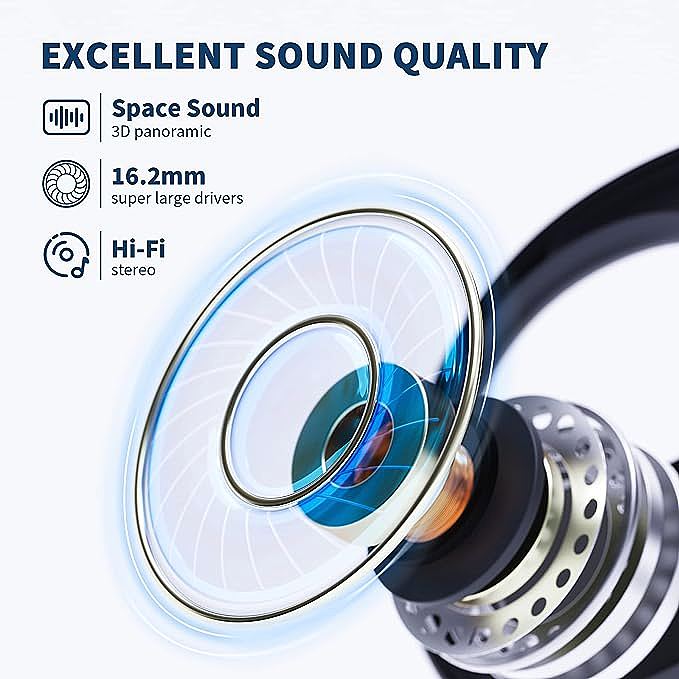
The Acoustic Necessity of 16.2mm Drivers
In the world of sealed earbuds, a 6mm driver is sufficient. So why does the PSIER SP05 employ massive 16.2mm vibrating diaphragm drivers? This isn't just marketing inflation; it is a solution to the physics problem known as Acoustic Short Circuiting.
In an open environment, low-frequency sound waves (bass) are omnidirectional and weak. Without a silicone tip to trap the air pressure, bass energy dissipates rapidly into the surrounding atmosphere. * Air Displacement: To compensate for this loss, the driver must move a significantly larger volume of air. A 16.2mm driver has roughly 7x the surface area of a standard 6mm earbud driver. * Compensation Curve: This massive surface area allows the diaphragm to generate the necessary sound pressure levels (SPL) to deliver perceptible bass, even without a seal. It is a brute-force engineering solution to the delicate problem of open-air acoustics.

Biomechanics: Gravity vs. Friction
Comfort is often subjective, but the mechanics of fit are objective. Traditional earbuds rely on Friction Fit—they stay in by pushing outward against the sensitive skin of the ear canal. Over time, this constant pressure causes fatigue and can trap moisture, leading to ear infections.
The SP05 utilizes a Gravity Suspension System via its earhooks. * Load Distribution: The weight of the device is carried by the Helix Root (the bridge where the ear joins the head). This is cartilage, which is far more robust than the sensitive canal skin. * The "Floating" Effect: By suspending the speaker component gently over the ear canal without touching it, the design eliminates "occlusion effect" (the booming sound of your own voice/footsteps) and allows for natural ventilation. This makes it particularly suited for endurance athletes who sweat heavily; with IPX5 water resistance, the device creates no seal to trap sweat inside the ear.

The Battery Equation in Open Audio
Physics dictates that generating bass in an open environment requires more energy than in a sealed one. The driver has to work harder. Consequently, open-ear headphones generally require larger batteries.
The bulky case of the SP05, often cited in reviews, is a direct result of this requirement. To achieve 40 hours of total playtime (with the case), the physical cells must be larger. In the trade-off triangle of Size - Battery Life - Audio Quality, open-ear designs compromise on size (they are not discreet) to maximize the other two. The digital display on the case acts as a necessary "fuel gauge" for this high-consumption engine.

Conclusion: The Era of Aware Listening
The PSIER SP05 represents a maturing of the "Open-Ear" category. It acknowledges that for many users—runners dodging traffic, parents listening for a child, or office workers collaborating—isolation is a bug, not a feature.
By leveraging Air Conduction and massive 16.2mm drivers, it solves the fidelity issues of bone conduction. By utilizing Earhook Suspension, it solves the comfort issues of in-ear buds. It is a device built for the reality of a shared, noisy world, allowing us to overlay a digital soundtrack onto our lives without hitting the mute button on reality.
PSIER SP05 True Wireless Open Ear Headphones -
Related Essays

The Paradox of Stillness: When Opposing Forces Create Perfect Silence

The Mechanics of Clarity: ENC Beamforming and Driver Physics

The Physics of Open Audio: Directional Beamforming and Diaphragm Mechanics

The Physics of Hybrid Transduction: Engineering Coherence in In-Ear Monitors

Hacking the Cochlea: The Physics of Bone Conduction Audio

The Algorithm of Clarity: How Environmental Noise Cancellation (ENC) Redefined Personal Communication

Control in the Chaos: The Ergonomic Superiority of Mechanical Buttons in Activewear Audio

The Tesla Engine: Magnetic Flux, Transient Response, and the Physics of Detail

The Neckband Renaissance: Engineering Comfort and Fidelity in the Wireless Age

