The Second Pathway: The Science of Bone Conduction and Auditory Safety


PHILIPS GO A6606 Open-Ear Bone Conduction Bluetooth Headphones
We often think of hearing as a singular process: sound waves enter the ear, hit the drum, and we hear. But anyone who has ever been startled by the sound of their own voice on a recording knows this isn't the whole story. The voice you hear inside your head is rich and resonant, while the recording sounds thin and foreign. This discrepancy reveals a fundamental biological truth: humans possess two distinct auditory pathways.
The first is air conduction, the public highway of sound. The second is bone conduction (osteo-phonic conduction), a private, internal path where vibrations travel directly through the skull to the inner ear. For decades, this second pathway was a medical curiosity or a military secret. Today, it is the foundation of a safety revolution in personal audio, embodied by devices like the Philips GO A6606. By understanding this technology, we can see why "blocking out the world" is no longer the only way to listen.
The Physiology of the "Private Path"
To understand how the A6606 works, we must look at the anatomy of the ear. In traditional hearing (air conduction), sound waves travel down the ear canal, vibrating the tympanic membrane (eardrum). These vibrations are amplified by three tiny bones (ossicles) and sent to the cochlea, the fluid-filled organ that converts mechanical energy into electrical nerve impulses.
Bone conduction bypasses the eardrum and ossicles entirely. The transducers on the headphones vibrate against the zygomatic arch (cheekbones). These vibrations propagate through the cranial bone directly to the cochlea. The cochlea, encased in the temporal bone, shakes in response, stimulating the hair cells just as airborne sound would.
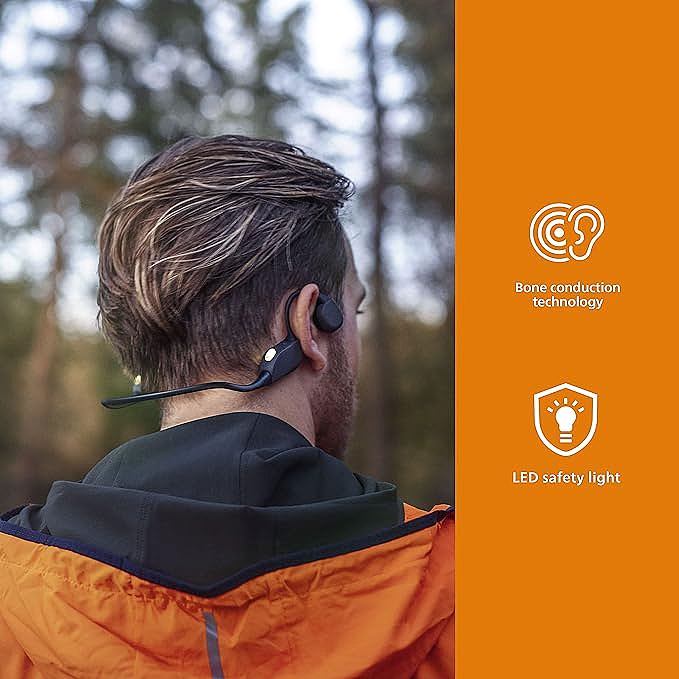
This bypass is not just a clever trick; it is a safety feature. By leaving the ear canal open, the "air conduction" pathway remains free to process environmental sounds—traffic, sirens, or footsteps. This allows the brain to maintain situational awareness, processing the music (via bone) and the world (via air) simultaneously without interference.
From Battlefield to Bike Path
Historically, bone conduction was developed for tactical environments where auditory isolation could be fatal. Special forces needed to hear radio comms without blocking the sounds of their surroundings. The Philips A6606 adapts this tactical heritage for the urban athlete.
The engineering challenge here is transducer efficiency. Unlike a speaker pushing light air molecules, a bone conduction driver must vibrate a heavy mass (the human skull). This requires significant electromechanical force. The A6606 utilizes specialized transducers designed to maximize vibrational transfer at contact points while minimizing leakage into the air.
Furthermore, the device integrates active safety features. Beyond the passive safety of open ears, it includes high-visibility LED running lights. This acknowledges that safety is multisensory: being heard (by the user) and being seen (by drivers).

The Material Science of the Fit
Vibrational transmission requires consistent, firm contact. If the pads lift off the skin, the sound vanishes. To maintain this pressure without causing pain, engineers turn to titanium memory alloys.
The neckband of the A6606 is crafted from titanium, a metal chosen for its high tensile strength and elasticity. It acts as a spring, applying a calibrated clamping force that keeps the transducers coupled to the cheekbones during vigorous motion. Titanium is also biocompatible and resistant to corrosion—essential for a device rated IP67.
- IP67 Rating: The '6' indicates the unit is dust-tight. The '7' means it can withstand immersion in 1 meter of water for 30 minutes. This level of sealing protects the internal electromechanical drivers from the corrosive effects of sweat and rain, ensuring the delicate vibrational mechanism isn't compromised by the elements.
The Physics of "Missing Bass"
Users often note that bone conduction headphones lack the deep, thumping bass of in-ear monitors. This is a matter of physics, not quality. Low-frequency sounds (bass) require large movements of air or mass to be perceived. While bone is an excellent conductor of high frequencies (voice, guitars), it dampens low frequencies significantly.
Additionally, without a sealed ear canal to create a "pressure chamber," low-frequency energy dissipates. This acoustic trade-off is intentional. The primary goal of the A6606 is not audiophile immersion, but auditory integration. It provides a soundtrack to your life without overwriting the reality of the world around you.
Conclusion: Augmented Reality for the Ears
The Philips GO A6606 represents a shift in how we view personal technology. Rather than using tech to escape reality, bone conduction uses biology to augment it. By leveraging the body's natural "second pathway" for hearing, it offers a solution where music and safety can coexist. It is a reminder that the most advanced technology is often the one that works in harmony with human physiology.
PHILIPS GO A6606 Open-Ear Bone Conduction Bluetooth Headphones
Related Essays

PHILIPS A4216 Wireless Headphones: Stay Cool and Powered Up During Your Toughest Workouts

Why Your Earbuds Keep Falling Out: The Anthropometry and Engineering Behind Secure-Fit Design

The Unsealed Ear: A History and Science of Open-Ear Audio

Bypassing the Eardrum: The Evolution of Haptic Audio

Bypassing the Eardrum: The Biomechanics of Cranial Audio Transmission

Beyond the Eardrum: The Science and Trade-offs of Bone Conduction Headphones

Generic K50 Pro Wireless Headphones - Open-Ear Sound for Sports

JOYWISE Wireless Headphones: Immersive Sound, Uninterrupted Playtime

Philips A3206 : Secure Fit & Open Sound for Active Lifestyles (IP57 Rated)

