Why Dual Drivers Split Your Music Before It Reaches Your Ears

Backwin Dual-Drive Iron Ring In-Ear Wired Earbuds
Your favorite song has bass you can feel in your chest and vocals so clear you catch every breath the singer takes. But when you play it through a single tiny speaker sitting inside your ear canal, the low frequencies blur into the midrange and the highs lose their edge. You turn up the volume hoping for clarity, and instead you get mud. The problem is not your ears or the recording. The problem is that one driver cannot move fast enough to reproduce high frequencies while simultaneously moving far enough to reproduce low ones. Physics will not allow it.
This is not a new problem. Loudspeaker engineers solved it decades ago by assigning separate drivers to separate frequency ranges -- a woofer for bass, a tweeter for treble, and sometimes a midrange driver in between. The same principle, scaled down to the millimeter scale, is what dual-driver earbuds attempt inside a housing no larger than a jellybean.
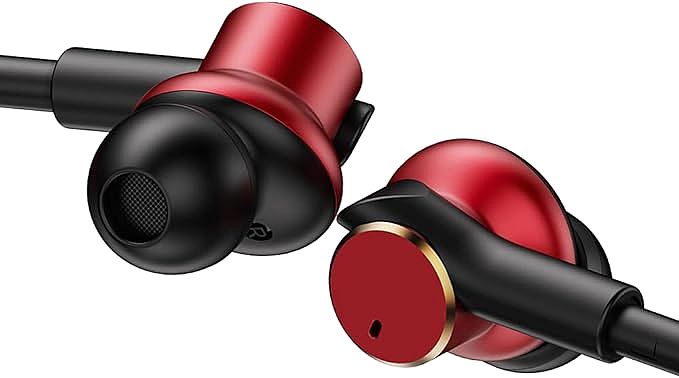
The Physics of a Single Driver Trying to Do Two Jobs
A speaker driver is a diaphragm attached to a coil of wire sitting inside a magnetic field. When an audio signal passes through the coil, electromagnetic force pushes the diaphragm back and forth, creating pressure waves in the air that your brain interprets as sound. To reproduce a bass note at 80 Hz, the diaphragm needs to move relatively slowly but with large excursions -- displacements of a millimeter or more. To reproduce a vocal sibilance at 8,000 Hz, the same diaphragm needs to move eight thousand times per second with excursions measured in microns.
Asking a single diaphragm to do both simultaneously creates mechanical interference. The large, slow excursions required for bass displace the diaphragm from its resting position, which distorts the small, rapid vibrations needed for treble. The technical term is intermodulation distortion, and it is measurable. Single-driver earbuds producing bass-heavy content routinely show total harmonic distortion figures of two to five percent at the frequency extremes. Well-designed multi-driver systems can hold below one percent across the audible range.
The 10mm oversized dynamic driver found in neckband headphones like the Yarayeon HX-831 pushes the single-driver approach as far as it can go by increasing the diaphragm area. A larger diaphragm moves more air per excursion, improving bass response and efficiency. But surface area is a compromise. A larger diaphragm has more mass and lower resonant frequency, which means it is even less responsive to high-frequency signals than a smaller one. You gain bass authority but trade high-frequency transient response. There is no free lunch in transducer physics.
How Crossover Networks Divide the Workload
In a dual-driver configuration, an electronic circuit called a crossover splits the incoming audio signal into two or more frequency bands before sending each band to a dedicated driver. The crossover contains filters -- typically capacitors and inductors in passive designs, or digital signal processing in active ones -- that define where the split occurs. A common crossover point for in-ear monitors is around 2,000 to 3,000 Hz, sending everything below to a dynamic driver sized for bass and everything above to a balanced armature tuned for treble.
The crossover frequency is not arbitrary. Human hearing sensitivity peaks between 2,000 and 5,000 Hz, the range where consonant sounds in speech carry most of their intelligibility. Placing the crossover point near this sensitive region means any phase mismatch or amplitude dip between the two drivers will be clearly audible. Engineers must align the acoustic output of both drivers so that their combined frequency response is flat at the crossover point, a process that requires precise measurement and careful tuning of the filter components.
When the crossover is well-executed, the result is a frequency response that no single driver can match. The bass driver handles low frequencies without being taxed by treble demands, and the treble driver responds to high-frequency transients without being shaken by bass excursions. Each driver operates within a narrower mechanical range, where its distortion characteristics are more favorable and its transient response is more controlled.
Balanced Armature: The Treble Specialist
The balanced armature is the driver technology most commonly paired with a dynamic driver in dual-driver in-ear designs. Unlike a dynamic driver, which moves air by displacing a large diaphragm, a balanced armature uses a tiny reed suspended between two magnets inside a sealed metal housing the size of a grain of rice. When the audio signal energizes the coil wound around the reed, the reed pivots and drives a small diaphragm that connects to a sound tube leading to the ear canal.
Because the moving mass of the reed is orders of magnitude smaller than the diaphragm of even the smallest dynamic driver, the balanced armature can respond to transients with remarkable speed. A typical balanced armature has a moving mass measured in milligrams, compared to the tens or hundreds of milligrams of a dynamic driver diaphragm. This low mass translates directly into faster acceleration and deceleration, which is why balanced armatures excel at reproducing the rapid attacks of percussion, the breathiness of vocals, and the air around acoustic instruments.
The trade-off is bass response. Balanced armatures are sealed systems with a fixed internal air volume, which limits their maximum diaphragm excursion and thus their ability to move the large volumes of air needed for deep bass. Employing a dynamic driver for the low frequencies alongside the balanced armature for highs gives each technology the job it performs naturally, without asking either to operate outside its mechanical comfort zone.
The Room Inside the Earbud Housing
Dual-driver designs introduce a spatial challenge. Two drivers, a crossover circuit, and two sound tubes must all fit within an earbud housing that also contains a Bluetooth radio, antenna, battery, and charging contacts. In a neckband headphone, the battery and most of the electronics live in the collar band, leaving the earbud housings with considerably more internal volume for acoustic engineering. This is one of the less obvious structural advantages of the neckband form factor: the earbud does not need to double as a battery container.
With more internal volume available, engineers can incorporate acoustic dampers, tuned bass ports, and multiple sound tubes that merge at the ear tip. Each of these elements shapes the frequency response in ways that are difficult to achieve when the available space is consumed by a battery cell. The application of acoustic tuning chambers inside the earbud housing is analogous to the ported enclosure designs used in bookshelf speakers, just scaled to cubic millimeters instead of liters.
The crossover network itself also benefits from physical space. Passive crossovers using high-quality capacitors and air-core inductors occupy more volume than the tiny surface-mount components found in ultra-compact TWS designs, and their electrical characteristics are more precise. Better component tolerances mean more accurate frequency splitting, which means fewer artifacts at the crossover point where both drivers are contributing to the same sound.

What You Actually Hear From a Well-Tuned Dual Setup
The audible difference between a single driver and a well-implemented dual-driver system is not subtle. Bass notes maintain their pitch definition and textural detail rather than blurring into a generic low-frequency rumble. High-frequency transients -- the initial attack of a snare drum, the pick striking a guitar string, the sibilance in a whispered vocal -- arrive with a crispness that single drivers struggle to reproduce. Midrange instruments sit in their own acoustic space rather than competing with bass energy for the same diaphragm excursion budget.
This separation has a measurable effect on listening fatigue. When intermodulation distortion is high, the ear's cochlea receives ambiguous signals that the auditory cortex must work harder to parse. Over extended listening sessions, this extra processing load contributes to the sense of exhaustion or irritation that some people experience with lower-quality audio reproduction. A dual-driver system that keeps distortion low across the frequency range reduces this cognitive load, allowing longer listening sessions with less fatigue -- a consideration that matters more than most people realize for someone wearing headphones eight or more hours per day.
The Engineering Honesty of Trade-offs
Dual drivers are not a universal improvement. The crossover introduces a phase relationship between the two drivers that must be managed precisely, and poor crossover design can create a hollow or disconnected sound that is arguably worse than a single well-tuned driver. The additional driver and crossover components increase manufacturing cost, which is why dual-driver designs remain less common in budget and mid-range price segments. And the physical space requirements mean that the smallest, most aesthetically discreet earbuds on the market will continue to use single drivers, accepting the acoustic compromise in exchange for miniaturization.
The 10mm dynamic driver in a single-driver neckband earbud is a pragmatic engineering choice. It gives up the frequency separation of a dual-driver system but gains simplicity, lower cost, and the internal volume efficiency that allows the earbud to remain small. For casual listening, podcasts, and phone calls, this compromise is entirely reasonable. The single driver is not broken. It is honest about what it can and cannot do within its constraints.
What dual-driver designs remind us is that audio reproduction is always a negotiation between physics and packaging. Every transducer has a mechanical sweet spot where it performs with minimal distortion and maximum transient accuracy. The closer you keep each driver to that sweet spot by narrowing the range of frequencies it must reproduce, the cleaner the output. Splitting the workload is not a gimmick. It is a response to the fundamental truth that a single moving surface cannot simultaneously optimize for two very different physical tasks.
Backwin Dual-Drive Iron Ring In-Ear Wired Earbuds
Related Essays

Balanced Armature or Dynamic Driver: 2026 IEM Truths

Sony XBA-Z5: Three Drivers, One Mission in High-Resolution Audio

Why Your 8-Driver IEM Might Sound Worse Than a 2-Driver...

Balanced Armature Drivers Explained: How Quad-Driver IEMs Separate Frequencies

Hybrid Driver Technology: Why Multiple Drivers Create the Crossover Challenge

Why Your Next Earbuds Need a Woofer and Tweeter Inside

YASEZ in-Ear Headsets and the Secret History of Moving Iron Technology

The Architecture of Sound: Deconstructing the 9-Driver Hybrid IEM (Case Study: Dragonfly 81T)

Westone Audio Pro X30 IEM Earphones: Professional Sound, On the Go
