Waterproof MP3 Player Swimming Review: What Happens to Sound When You Dive Un...


Swimaudios Waterproof MP3 Player
The Moment Your Earbuds Die in the Pool
Picture this: you push off the wall for your first lap, and three strokes in, the music cuts out. Your right earbud gurgles, sputters, then goes silent. By the time you reach the other end, the left one follows. You pull them out, shake water from the speaker grille, and watch a tiny bead of moisture roll across the driver diaphragm. That pair cost you forty dollars and lasted exactly one pool session.
This is not a rare story. It happens to swimmers constantly, and the root cause is not shoddy manufacturing. It is physics. Water and consumer audio gear were never meant to coexist, and the engineering required to make them cooperate is far more involved than a rubber gasket and a prayer.
Why Water Destroys Ordinary Headphones
Sound, at its core, is vibration traveling through a medium. In air, that medium has a density of roughly 1.2 kilograms per cubic meter. Water weighs about 830 times more. This single fact reshapes every assumption that standard headphone design relies on.
A typical earbud driver is a tiny diaphragm, usually 6 to 13 millimeters across, mounted inside a small air chamber. The diaphragm vibrates, pushes against the air column in that chamber, and the pressure wave travels down the ear canal to your eardrum. The entire system is tuned for air: its compliance, its impedance matching, its resonance frequency.
Drop that same earbud into a swimming pool and everything changes. Water floods the air chamber instantly. The diaphragm now has to push against a medium that is 830 times denser. Its excursion drops to almost nothing. The resonant frequency shifts downward by an order of magnitude. What was a crisp, balanced driver in air becomes a muffled, barely-moving membrane underwater.
There is also the corrosion problem. Most earbud internals use copper traces and solder joints that oxidize within hours of water exposure. Even if the driver somehow survived acoustically, the electronics would fail from galvanic corrosion between dissimilar metals in a chlorinated or saltwater environment.
IPX8: What the Rating Actually Means for Swimmers
The Ingress Protection (IP) rating system, defined by the International Electrotechn Commission standard IEC 60529, uses two digits. The first digit (0-6) rates protection against solid objects like dust. The second digit (0-9K) rates protection against liquids. When you see "IPX8," the X means solid particle protection was not tested, and the 8 means the device can survive continuous immersion beyond 1 meter depth.
Here is where it gets complicated. The IPX8 standard does not specify a universal depth or duration. Instead, the manufacturer defines the test conditions, which must be "more severe" than IPX7 (1 meter for 30 minutes). One company might test at 2 meters for 60 minutes. Another might test at 4 meters for 120 minutes. Both can legally claim IPX8.
For swimmers, this distinction matters enormously. A competitive swimmer's head reaches 0.5 to 1.5 meters below the surface during flip turns and streamlines. An open-water swimmer might dive to 3-4 meters during sighting. A recreational pool swimmer stays near the surface. Each of these scenarios demands different minimum depth ratings.
The chlorine factor adds another variable. Laboratory IPX tests use fresh water at room temperature. Chlorinated pool water is mildly corrosive (pH 7.2-7.8, with free chlorine at 1-3 ppm). Saltwater is far worse, with chloride ion concentrations around 35,000 ppm. A device rated IPX8 in fresh water may not survive a single saltwater session because the corrosive chemistry attacks seals and gaskets differently.
Temperature cycling also plays a role. A device stored at room temperature (20C) and plunged into a heated pool (28-30C) experiences thermal expansion that can compromise seals over time. The gasket materials most commonly used in consumer electronics, silicone rubber and EPDM, have thermal expansion coefficients that shift their compression fit by enough to create micro-gaps after repeated hot-cold cycles.
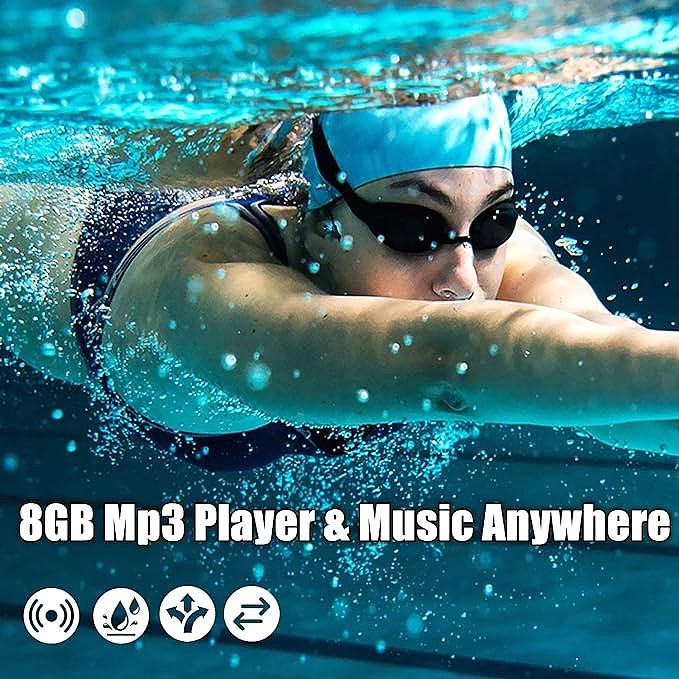
The Physics of Underwater Sound: Bone Conduction vs Air Conduction
This is where most product marketing departs from engineering reality. Bone conduction headphones transmit sound vibrations through the skull bones directly to the cochlea, bypassing the eardrum and ear canal entirely. In air, this is a neat trick that leaves your ears open for ambient awareness. In water, the physics shift in ways that both help and hinder.
Sound travels through bone at roughly 3,000-4,000 meters per second, depending on bone density and type. In water, sound travels at about 1,500 m/s. In air, it crawls at 343 m/s. The impedance mismatch between bone and air is enormous, which is why bone conduction headphones in air lose a lot of energy at the bone-to-air boundary. When your head is submerged, that boundary effectively disappears. The water surrounding your skull has an acoustic impedance much closer to bone than air does, which means vibrations transfer more efficiently.
In theory, this makes bone conduction superior underwater. The vibrations from the transducer travel through the temporal bone to the cochlea with less energy loss than in air. Several manufacturers have built underwater bone conduction devices on this premise.
But there is a catch. The human skull is not a simple transmission line. It has complex geometry, variable thickness, and internal structures (sinuses, fluid-filled spaces) that create resonances and cancellations. Above roughly 4,000 Hz, bone conduction efficiency drops sharply because the skull acts as a low-pass filter. This means high-frequency detail, the crispness of consonants in vocals, the shimmer of cymbals, gets progressively muddier as frequency rises.
Air conduction in water takes a completely different path. Some waterproof MP3 players use sealed earbuds that trap a small air pocket inside the ear canal. The driver vibrates against this air column, which then transmits to the eardrum normally. The challenge is maintaining that air pocket. If the seal breaks, water rushes in, and the acoustic coupling collapses. If the seal is too tight, it creates discomfort during extended sessions and can trap water against the ear canal skin, increasing the risk of swimmer's ear (otitis externa).
There is a third option that sits between these two: the hydrodynamic speaker. Instead of fighting water's density, some designs use it. A speaker driver mounted in a waterproof housing vibrates the water directly, creating a pressure wave that reaches the ear through the surrounding water. The sound quality is limited by the lack of a sealed acoustic chamber, but the approach eliminates seal-failure risk entirely. The tradeoff is frequency response: without a tuned chamber, bass drops off sharply below about 200 Hz, and the open-water path means ambient pool noise (splashing, other swimmers) competes directly with the audio.
Each approach has genuine merits. Bone conduction preserves ear canal comfort and works regardless of ear shape. Sealed air-conduction earbuds offer the most familiar sound signature, closest to what you hear on dry land. Hydrodynamic designs are the most mechanically solid since there is no seal to fail. The "right" choice depends on what a swimmer values most: sound fidelity, comfort, or mechanical reliability.
Storage, Battery, and the Engineering Tradeoffs Inside a Waterproof Player
A waterproof MP3 player for swimming faces constraints that a phone or a standard music player never encounters. Every port, seam, and button is a potential leak point. The entire device must be sealed, which means the battery is not swappable, the storage is not expandable (no microSD slot), and charging requires either a proprietary magnetic connector or a sealed USB port with a gasket that must be checked before every session.
Storage capacity is the first tradeoff. Flash memory chips are solid-state and inherently waterproof, so the storage itself is not the problem. The problem is cost and power consumption. An 8 GB flash chip stores roughly 2,000 songs at 128 kbps MP3, or about 1,000 at 256 kbps. For a swimmer doing 45-60 minute sessions, this is more than enough. For someone doing marathon open-water training sessions of 3-4 hours at higher bitrates, it starts to feel limiting.
The battery is the more critical constraint. Lithium-polymer cells are the standard for compact devices, and they perform reasonably well in the temperature range of pool water (24-30C). But the battery must be small enough to keep the device lightweight (a heavy device bounces during flip turns and falls out of position), yet large enough to power the amplifier and DAC for the full session duration.
Most waterproof MP3 players target 8-10 hours of playback. At typical swimming session lengths of 45-90 minutes, this means charging once every 5-12 sessions. But battery capacity degrades over time, especially if the device is stored fully charged in a warm environment (a common scenario when left in a gym bag). After 300-500 charge cycles, lithium-polymer cells typically retain about 80% of their original capacity, meaning that 10-hour rating drops to 8 hours, then 6.
The audio codec matters too. MP3 decoding at 128-256 kbps requires minimal processing power and draws less current than AAC or FLAC decoding. This is partly why most waterproof players default to MP3 support: it is not because MP3 is the best format, but because the decoder is simpler and more power-efficient, which directly translates to longer swim sessions per charge.
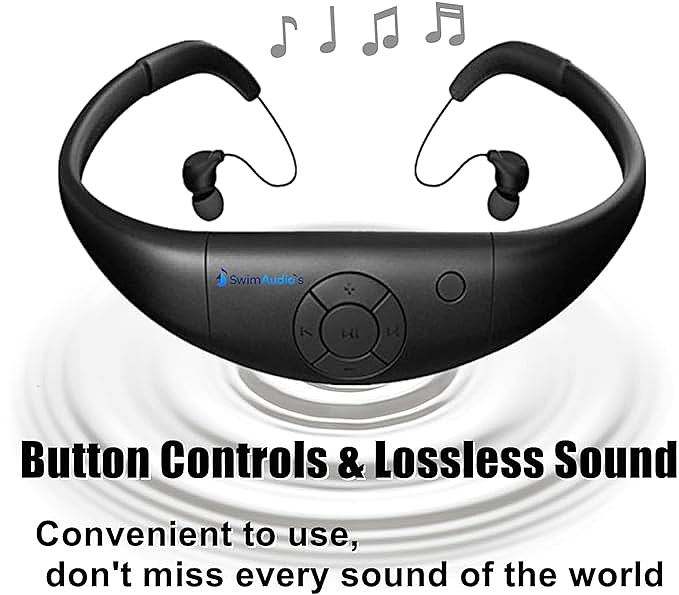
A Case Study in Waterproof Audio Design
The Swimaudios Waterproof MP3 Player illustrates many of these engineering compromises in a single product. With 8 GB of internal storage, it sits in the sweet spot for recreational and competitive swimmers. The sealed housing eliminates the microSD slot that some competitors offer, trading expandability for a simpler, more reliable waterproof seal. Battery life in the 8-10 hour range aligns with typical training cycles.
What makes devices like this interesting from an engineering perspective is not any single spec. It is how the specs interact. The 8 GB limit, for example, is not a memory shortage. It is a deliberate choice that keeps the bill of materials low enough to hit a sub-$50 price point while still providing enough storage for most swimmers' needs. The sealed design means fewer failure points but also means the battery will eventually degrade without replacement options. The waterproof rating, if tested to genuine IPX8 standards at meaningful depths, covers the vast majority of pool swimming scenarios.
Who Benefits and Where the Limits Are
A dedicated waterproof MP3 player is not for everyone, and understanding the boundaries helps avoid disappointment.
Competitive swimmers who train 5-6 days per week benefit the most. They spend enough hours in the water that the entertainment value justifies a dedicated device. Triathletes transitioning between pool and open-water training also find value, provided the device is rated for both chlorinated and saltwater exposure.
Water aerobics participants and recreational lap swimmers are the next tier. Their sessions are shorter and less intense, but the desire for music is just as real. For this group, the simplicity of a standalone player, no phone to protect, no Bluetooth pairing to manage, just load music and go, has genuine appeal.
The limitations are real, though. Sound quality underwater will never match dry-land listening. The acoustic environment of a pool, with its reflected sounds, splashing, and the water itself damping high frequencies, creates a fundamentally different listening experience. Bass response is often better underwater (water couples low frequencies more efficiently than air), but mids and highs suffer. Swimmers who expect studio-quality audio will be disappointed.
There is also the ear hygiene concern. Any device that seals the ear canal traps moisture, which creates a warm, humid environment where bacteria and fungi thrive. Swimmer's ear is already common among frequent swimmers, and sealed earbuds can make it worse. Swimmers prone to ear infections should consider bone conduction or open-ear designs, even if the sound quality tradeoff is noticeable.
The price point of dedicated waterproof players, typically $30-60, positions them as a mid-range accessory. They cost more than disposable earbuds but less than premium Bluetooth sport headphones. For swimmers who destroy a pair of regular earbuds every few months, the economics work out quickly. For someone who swims once a month, a waterproof phone pouch and wired earbuds might be the more practical choice.
Underwater audio remains a niche engineering challenge. The physics of sound in water, the material science of waterproof sealing, and the power constraints of sealed miniaturized electronics all push against each other. Every design is a set of compromises. The swimmers who get the most out of these devices are the ones who understand those compromises and choose accordingly, rather than expecting a $40 gadget to replicate the experience of headphones in a quiet room.
Swimaudios Waterproof MP3 Player
Related Essays

Monster Open Ear Headphones Review: Bone Conduction vs Air Conduction Technology

IPX4 Explained: Splash, Sweat, and Workout Headphones

Best Hydration Pack for Hiking: Lightweight 2L and 3L Picks Worth Carrying

Open Ear Earbuds for Running: How Air Conduction Drivers Work

The Physics of Desktop Audio: What an External DAC Does Differently
Open Ear Earbuds for Running: How Air Conduction Drivers Work

What IPX5 Actually Protects Against: Water Jets, Not Swimming Pools

Are Bone Conduction Headphones Safe for Running?

