Optimization at Scale: Deconstructing the Acoustics and Engineering of Kurdene Wireless Earbuds
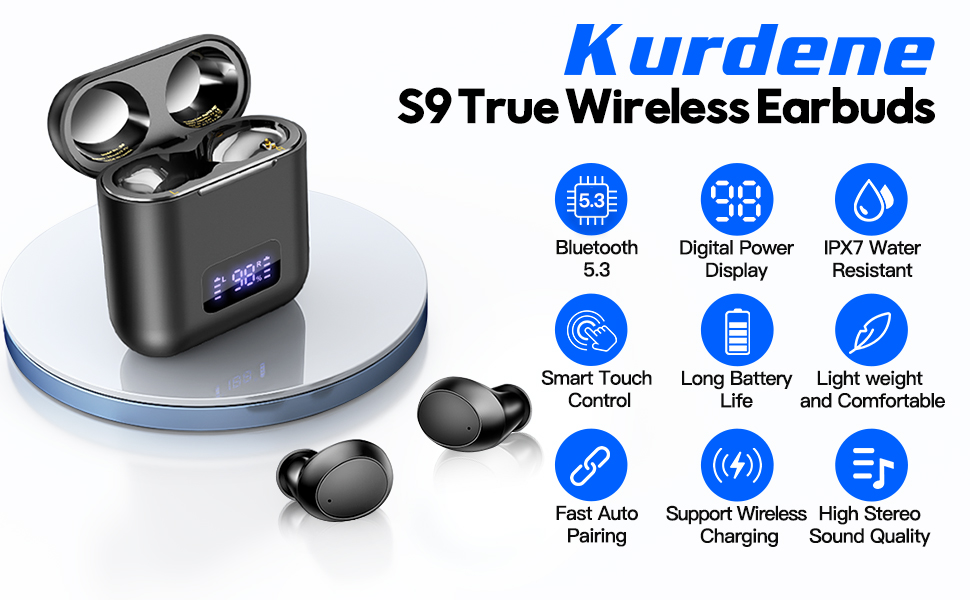

Kurdene S9 Wireless Earbuds
Kurdene S9 Wireless Earbuds
The Kurdene S9 Wireless Earbuds combines solar charging technology with active noise cancellation, offering up to 80 hours of battery life on a single charge — and potentially infinite playtime in sunlight.
Priced at $135.99 for Midnight Black and $199.00 for Sand Gold, it targets outdoor commuters and travelers who want to eliminate cable anxiety.
The Magnetic Heart: Why 8mm Neodymium Drivers Matter
At the core of any earbud lies the driver, the transducer responsible for converting electrical signals into sound waves. The Kurdene earbuds utilize an 8mm dynamic driver, a size that strikes a calculated balance between frequency response and ear canal ergonomics. But the critical specification here is not just the size, but the magnet type: Neodymium.
Neodymium (NdFeB) is a rare-earth material known for having the highest magnetic field strength per unit volume of any commercially available magnet. In audio engineering, a stronger magnetic field translates to greater magnetic flux density in the voice coil gap. * Transient Response: The intense magnetic field exerts tighter control over the diaphragm's movement. This allows the speaker to start and stop vibrating more quickly, resulting in sharper percussion and more distinct vocals. * Efficiency: Stronger magnets require less electrical power to drive the diaphragm to a given volume. This efficiency is a key factor in extending battery life without increasing the battery's physical size.
While larger drivers (10mm+) can move more air for bass, an 8mm driver driven by a high-grade Neodymium magnet often provides a tighter, more controlled bass response that avoids the "muddy" resonance often found in budget audio. It represents a deliberate acoustic choice: prioritizing clarity and definition over overwhelming, uncontrolled rumble.
The Connectivity Backbone: Bluetooth 5.2 and Signal Integrity
Wireless audio is fundamentally a data transmission challenge. The transition from older standards to Bluetooth 5.2 represents a significant leap in how devices manage this data stream. The Kurdene earbuds leverage this protocol to address two perennial issues: connection stability and power consumption.
Bluetooth 5.2 introduces enhancements like Isochronous Channels (ISOC), which are foundational for the next generation of Bluetooth Audio (LE Audio). Even in current applications, the 5.2 standard improves the Attribute Protocol (ATT), allowing for more efficient data exchanges between the source (phone) and sink (earbuds). * Interference Management: In environments saturated with 2.4GHz signals (like gyms or offices), Bluetooth 5.2's improved frequency-hopping algorithms allow the earbuds to maintain a robust connection, minimizing dropouts. * Latency Optimization: By streamlining the data packet transmission, the lag between visual content and audio playback is reduced, a crucial factor for video streaming and gaming.
This protocol efficiency works in tandem with the hardware to deliver the stated 40 hours of total playtime (with the charging case). It is a testament to how software standards can dramatically enhance hardware capability.
Defining Durability: The Engineering of IPX5
For personal audio devices, moisture is the primary environmental threat. The Kurdene earbuds carry an IPX5 rating, a specification that is often misunderstood.
The Ingress Protection (IP) code is an international standard (IEC 60529). The first digit ("X") indicates that dust protection was not formally tested. The second digit ("5") is the key metric for water resistance. * IPX4: Protects against splashing water (like light rain). * IPX5: Protects against low-pressure water jets (6.3mm nozzle) from any direction for at least 3 minutes.
From an engineering perspective, achieving IPX5 requires more than just tight seams. It typically involves the application of hydrophobic nanocoatings on internal circuit boards and the use of acoustic meshes that repel water while allowing sound waves to pass through. For the user, this specific rating means the device is engineered to withstand not just sweat (which is corrosive), but also direct rinsing or heavy rain. It transforms the earbud from a delicate accessory into a robust tool for high-intensity interval training (HIIT) or outdoor running.
Biomechanics: The 4.1g Weight Advantage
The human outer ear, specifically the concha and ear canal, is highly sensitive to pressure. The mechanical design of the Kurdene earbuds focuses on minimizing mass inertia. Weighing in at just 4.1 grams per earbud, they significantly reduce the gravitational pull exerted on the ear canal.
In biomechanical terms, lighter earbuds generate less momentum during head movements (such as running or jumping). This reduces the need for aggressive mechanical retention (like tight jamming into the ear canal), which is a primary cause of "listener fatigue." By combining this low mass with ergonomic silicone tips (provided in S/M/L sizes), the design relies on a secure seal rather than friction for stability. This not only improves comfort but also ensures a consistent passive noise isolation seal, which is critical for maximizing the performance of the 8mm drivers.
Clarifying Noise Cancellation: ENC vs. ANC
The product specifications highlight "Call Noise Canceling," a feature often confused with Active Noise Cancellation (ANC). It is vital to distinguish between the two from a signal processing standpoint. * ANC (Active Noise Cancellation): Uses microphones to create "anti-noise" to cancel out ambient sound for the wearer. * ENC (Environmental Noise Cancellation): The technology used in these Kurdene earbuds. It utilizes the microphone array to monitor background noise (wind, traffic, chatter) and employs digital signal processing (DSP) algorithms to filter these frequencies out of the outgoing audio signal.
Essentially, ENC is for the benefit of the person you are talking to. By isolating the voice frequency band and suppressing transient background noise, the earbuds ensure clear communication even in less-than-ideal acoustic environments. This feature transforms the device from a passive listening tool into a capable communication endpoint.
Conclusion: Engineering for the Everyday
The Kurdene Wireless Earbuds illustrate that a satisfying audio experience is not solely defined by price, but by the intelligent application of technology. Through the use of high-flux Neodymium magnets, the efficiency of the Bluetooth 5.2 protocol, and rigorous IPX5 sealing, these devices offer a calibrated balance of performance and durability. They remind us that in the age of modern manufacturing, precise engineering can make high-quality audio and reliable connectivity a standard, rather than a luxury.
Kurdene S9 Wireless Earbuds
Related Essays

How Tiny Drivers Produce Big Sound: The Physics Behind Wireless Earbuds
How Tiny Drivers Produce Big Sound: The Physics Behind Wireless Earbuds
How Tiny Drivers Produce Big Sound: The Physics Behind Wireless Earbuds
How Tiny Drivers Produce Big Sound: The Physics Behind Wireless Earbuds

Why 42mm Drivers Hit the Physics Sweet Spot for Headphone...

Final A3000 In-Ear Wired Earphones – A Relaxing and Natural Sound Experience

Silencing the Copper Wire: The Invisible Architecture of Modern Audio

Why Your Conference Calls Sound Terrible: The Physics...

Why Your Conference Calls Sound Terrible: The Physics...

