Wireless Earbud Battery Anxiety: Why 180 Hours Changes the Math

WERDEDE 001 Wireless Earbuds
Your earbuds die at 3 PM. Again. The morning commute drained half the charge, a lunchtime call took the rest, and now you are staring at a blinking red light with four hours left in the workday. This is not a rare event. It is the default experience for most wireless earbud owners.
The average true wireless earbud delivers 4 to 6 hours per charge. The charging case adds another 15 to 20 hours. That sounds generous until you factor in real usage patterns: back-to-back calls, long podcast sessions, forgetting to dock the earbuds overnight. Battery anxiety becomes a background hum that never quite goes away. These earbuds take a different approach to this problem, packing a charging case that delivers approximately 180 hours of total playtime. But the real story is not about a single product. It is about what happens when battery capacity crosses a psychological threshold.
The Lithium-Ion Math Behind 180 Hours
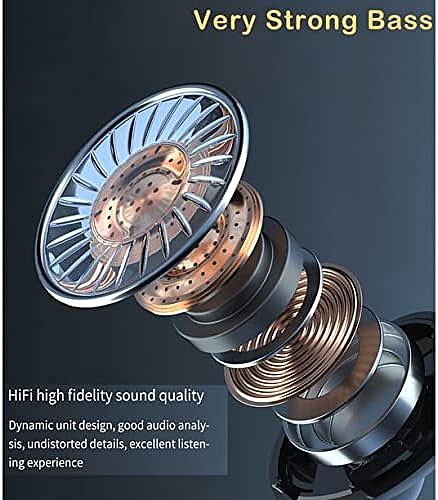
Lithium-ion batteries store energy through the movement of lithium ions between a graphite anode and a cobalt-oxide cathode. This chemistry, commercialized by Sony in 1991, remains the backbone of portable electronics because of its high energy density: roughly 250 watt-hours per kilogram. That number matters because earbud batteries are tiny, often between 30 and 50 mAh each. The charging case, by contrast, can hold a much larger cell.
The charging case recharges the earbuds approximately 40 times. If each earbud charge delivers around 4.5 hours of playback, the arithmetic works out: 40 recharges multiplied by 4.5 hours equals 180 hours. The case itself functions as a portable power bank, a design choice that shifts the battery equation from daily charging to weekly charging.
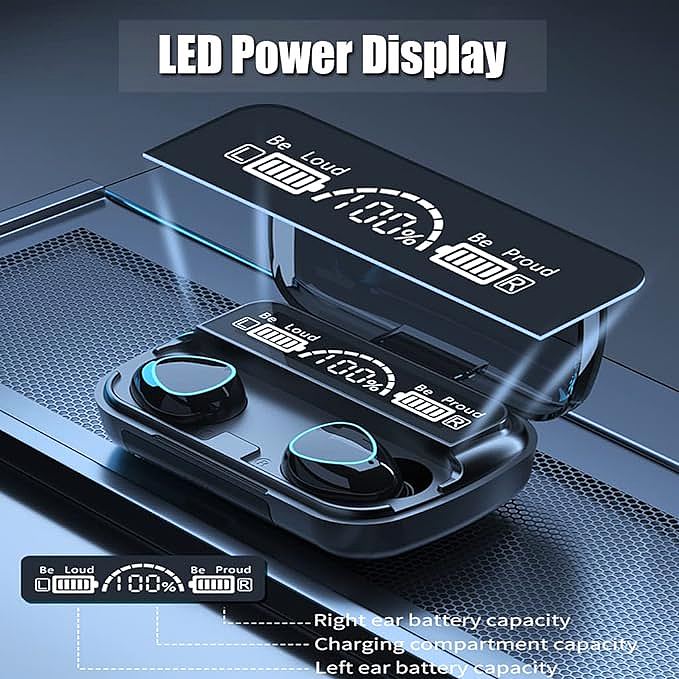
This is a meaningful shift. Human memory research shows that habits form around 21-day cycles, but anxiety forms much faster. When you charge your earbuds every night, the ritual becomes automatic. When you charge them once a week, the ritual disappears. The cognitive load of tracking battery status drops to near zero. The LED digital display on the case, which shows the remaining charge for each earbud independently, serves as a confirmation tool rather than a planning tool. You glance at it occasionally, the way you glance at a car fuel gauge on a long highway drive.
Bluetooth 5.1: The Quiet Efficiency Gain
Battery life and wireless protocol efficiency are inseparable. Bluetooth 5.1, the version used in this model, introduced several improvements that directly affect power consumption. The protocol operates in the 2.4 GHz ISM band, the same frequency used by microwave ovens and Wi-Fi routers. What makes Bluetooth 5.1 different from its predecessors is how it manages that crowded spectrum.
The specification supports HSP, HFP, A2DP, and AVRCP profiles. A2DP handles high-quality stereo audio streaming. HFP manages hands-free calling. Each profile has its own power profile, and Bluetooth 5.1 optimizes the handoff between them. The result is lower average current draw during mixed usage, which is exactly how most people actually use earbuds: alternating between music, calls, and silence.
Connection stability also improves. Bluetooth 5.1 uses enhanced error correction and adaptive frequency hopping to avoid interference. Fewer dropped packets mean fewer retransmissions, and fewer retransmissions mean less power wasted on redundant data transfers. The practical range extends to approximately 33 feet under normal conditions, though walls and other 2.4 GHz devices will reduce that distance. The one-step automatic pairing, which connects the earbuds to each other and to your phone the moment you remove them from the case, eliminates the pairing overhead that earlier Bluetooth versions required.
CVC 8.0: Noise Cancellation for the Other Person
Here is a common misunderstanding: CVC 8.0 is not Active Noise Cancellation. It does the opposite job. ANC reduces the noise that reaches your ears. CVC reduces the noise that reaches the person you are calling.
Qualcomm developed Clear Voice Capture as a digital signal processing technology specifically for voice transmission. Version 8.0, the current generation, uses MEMS microphones combined with DSP algorithms that perform four operations in sequence. First, the microphones capture both your voice and the ambient sound. Second, the DSP analyzes the frequency, amplitude, and timing characteristics of each sound source to separate speech from noise. Third, the algorithm suppresses the identified noise components while preserving the voice signal. Fourth, the cleaned audio is transmitted to the caller.
This distinction matters in practice. If you take a call from a busy coffee shop, the person on the other end hears your voice clearly, not the espresso machine. But you still hear the espresso machine. CVC 8.0 protects your caller from your environment. It does not protect you from theirs. For users who spend significant time on calls, this is arguably more valuable than ANC, since the caller experience is often the bottleneck in call quality.
The technology also improves voice assistant accuracy. Siri and Google Assistant perform better when the input signal is clean, which is why CVC 8.0 can make the triple-tap activation on these earbuds more responsive in noisy settings.
IPX7: What the Rating Actually Guarantees
The IP code system, defined by IEC standard 60529, classifies degrees of protection against solid objects and liquids. The first digit covers solids. The second digit covers liquids. An IPX7 rating means two things: the device was not tested for dust protection, and it can withstand immersion in water up to 1 meter deep for 30 minutes.
That specification is more rigorous than most people realize. IPX4, the minimum rating for splash resistance, only covers water splashing from any direction. IPX5 adds low-pressure water jets. IPX6 handles high-pressure jets. IPX7 jumps to full submersion. The nano-coating applied to the the earbuds and case creates a hydrophobic barrier that prevents water from reaching the electronic components.
There is a critical limitation, however. IPX7 does not mean swimming-safe. Swimming involves varying water pressure that exceeds the 1-meter static test condition. The rating also degrades over time as the coating wears. Sweat is less corrosive than chlorinated pool water, but the salts in perspiration can eventually compromise the seal. For gym workouts, running in rain, and accidental splashes, IPX7 provides reliable protection. For swimming, it does not.

Touch Controls and the Capacitive Sensor Problem
Physical buttons on earbuds create a mechanical challenge. Every button requires a physical opening in the housing, and every opening is a potential entry point for water and dust. Touch controls solve this by using capacitive sensors embedded beneath the surface of the earbud shell.
Capacitive sensors detect the electrical properties of the human finger. When your skin contacts the sensor pad, it changes the local capacitance, which the controller registers as a touch event. These earbuds map these events to specific actions: single tap for play, pause, or call answer; double tap for track skip; triple tap for voice assistant; long press for volume adjustment.
The design has trade-offs. Capacitive sensors can register false touches from ear movement or from water on the surface. They also lack the tactile feedback that physical buttons provide, which means you cannot confirm an action by feel alone. The ergonomic silicone eartips help by stabilizing the earbud position, reducing the likelihood of accidental contact. The secure fit also improves passive noise isolation, since a proper seal in the ear canal physically blocks external sound from reaching the eardrum.
The Honest Limitations
No discussion of budget wireless earbuds is complete without addressing what they do not do. These earbuds lack Active Noise Cancellation. For commuters on noisy trains or frequent flyers, this absence is significant. ANC uses microphones to detect external noise and generates an opposing sound wave to cancel it. Without it, you rely entirely on the passive isolation provided by the silicone eartips.
The 3.8-star average from 1,120 reviews tells its own story. Fifty-three percent of reviewers gave five stars, but fifteen percent gave one star. The feature-specific ratings are revealing: battery life scores 3.4 out of 5, sound quality 3.2, and noise cancellation 3.0. These numbers suggest that the 180-hour claim may not hold up consistently under real-world conditions, and that the audio reproduction is adequate but not exceptional.
At $19.99, the price point implies certain engineering compromises. The drivers, codecs, and acoustic tuning will not match premium alternatives. The absence of aptX or LDAC codec support means audio transmission is limited to the standard SBC codec or possibly AAC, both of which apply lossy compression that reduces fidelity compared to wired listening or high-resolution Bluetooth codecs.
When Capacity Becomes Freedom
The central insight here extends beyond any single product. Battery anxiety is a form of cognitive overhead that most wireless earbud users have simply accepted as normal. When charging frequency drops from daily to weekly, the mental model changes. The earbuds stop being a device you manage and become a device you use.
This threshold effect appears elsewhere in technology. Smartphones crossed it when batteries grew large enough to last a full day. Laptops crossed it when eight-hour battery life became standard. Each crossing did not just add convenience. It changed how people related to the device, shifting from conscious monitoring to unconscious reliance.
With 180-hour total playtime, sits at that crossing point for wireless earbuds. The trade-offs are real: no ANC, average sound quality, and mixed reliability reports. But the battery proposition addresses a genuine friction that has persisted since true wireless earbuds first appeared. Sometimes the most meaningful improvement is not a new feature. It is the removal of an old annoyance.
WERDEDE 001 Wireless Earbuds
Related Essays

Xmenha Neckband Bluetooth Headphones – A Versatile and Durable Choice

PloutoRich Wireless Earbuds - Colorful Design and Advanced Features

The Engineering of Battery Endurance: Why Some Wireless Earbuds Last Weeks While Others Die in Hours

What Does "Hi-Fi Stereo" and "Noise Cancelling" Really Mean on a $30 Earbud?

PocBuds K6 Wireless Earbuds – The Perfect Companion for Your Music Journey

Ruisnto V17 Wireless Bluetooth Earbuds: 100-Hour Playtime for Your Active Lifestyle

AUOUA Life On Music J5 PRO Wireless Earbuds: Long-Lasting Battery & Clear Calls

Occiam K23-2023 Wireless Earbuds: Long-Lasting Battery & Crystal-Clear Calls

TEGAX S20 Wireless Earbuds: Immersive Sound and Ultimate Convenience for Active Lifestyles
