The Democratization of Fidelity: How Value Engineering Rewrote Audio Norms
Update on Dec. 20, 2025, 9:49 a.m.
In the history of consumer electronics, there exists a predictable trajectory known as the “trickle-down effect.” Technologies that begin as exclusive, expensive novelties—like anti-lock brakes in cars or fingerprint sensors in phones—eventually mature, scale, and become standard expectations. The wireless audio market is currently undergoing this precise transformation. Features once reserved for flagship audiophile gear are permeating the broader market, fundamentally altering user expectations.
This shift is not driven by magic, but by “Value Engineering”—the systematic method of improving the value of goods by examining function. It’s about achieving necessary functions at the lowest possible cost without sacrificing performance. Devices like the TAGRY X08 serve as case studies in this industrial evolution, illustrating how advanced energy management and acoustic composite materials have transitioned from luxury to utility.

The Psychology of Energy Transparency
One of the most profound, yet often overlooked, aspects of modern mobile technology is “Range Anxiety.” Originally coined for electric vehicles, this psychological stress applies equally to our daily wearables. When a user relies on a device for communication, navigation, or motivation, the uncertainty of remaining power creates a subtle cognitive load.
Historically, budget audio devices relied on vague indicators—a blinking LED that might flash red when the battery is critically low. This binary signal (Good/Dead) offers no granularity, leaving the user to guess whether they have 20 minutes or 2 hours of usage left.
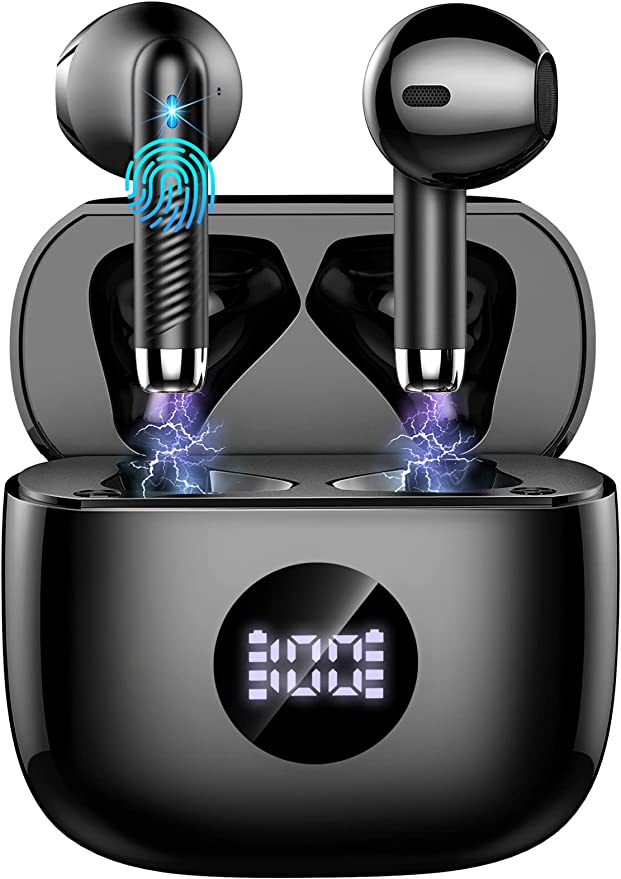
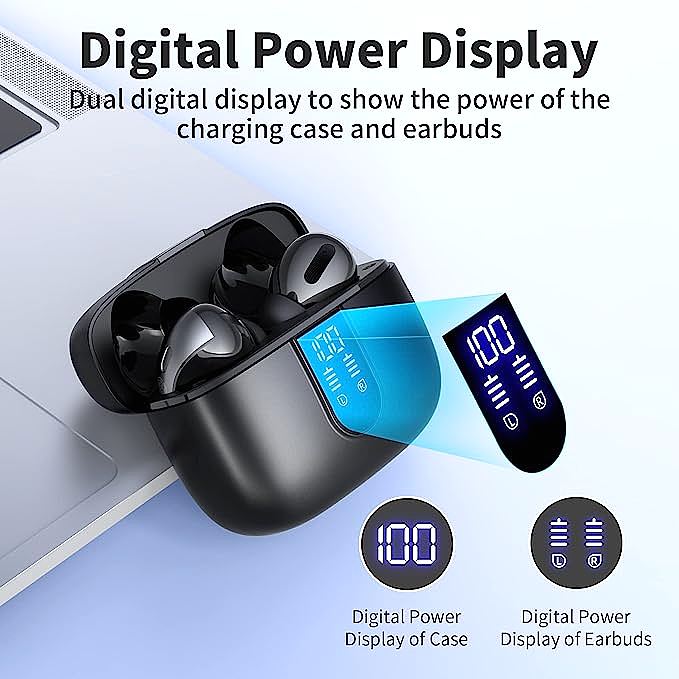
The industry response has been a shift towards “Energy Transparency.” By integrating precise, numerical LED displays directly into the charging case, engineers convert an abstract variable (chemical energy stored in Lithium-Polymer cells) into concrete data (a percentage). This visual feedback loop serves a biological purpose: it reduces cortisol levels associated with uncertainty. Seeing “85%” allows for planning; seeing a blinking light invites panic. The dual-display approach, monitoring both the reserve tank (the case) and the active units (the earbuds), represents the maturation of User Interface (UI) design in screenless devices.
The Physics of Displacement: Why Size Matters
While electronics handle the user experience, the core function of an earbud remains purely physical: moving air. Sound is a pressure wave, and generating low-frequency sounds (bass) requires moving a significant volume of air. In the constraints of a micro-earbud, this creates a physics problem.
Small drivers (6mm-8mm) often struggle to produce convincing bass without artificial digital boosting, which can introduce distortion. The engineering solution adopted in more capable systems is the use of larger dynamic drivers, such as 13mm units. The surface area of a 13mm driver is significantly larger than an 8mm driver, allowing it to displace more air with less excursion (movement). This physical advantage translates directly to a “warmer,” more authoritative bottom end that is felt as much as heard.
The Composite Solution
However, size introduces a new problem: mass. A larger diaphragm is heavier, which can make it sluggish in responding to high-frequency transients (treble). To solve this, engineers employ material science, specifically “Composite Diaphragms.”
Instead of using a single material, a composite diaphragm layers different materials to achieve conflicting goals: high rigidity (to prevent warping), low mass (for speed), and high internal damping (to stop ringing). A triple-layer composite might use a stiff central dome for crisp highs and a flexible outer ring for deep bass excursion. This “sandwich” construction allows a single driver to cover the full audible spectrum (20Hz-20kHz) with surprising linearity. It is a prime example of how material science allows mass-market manufacturing to replicate the performance characteristics that previously required complex, multi-driver setups.