How the LORELEI B-C6 Hits 50-Hour Playtime
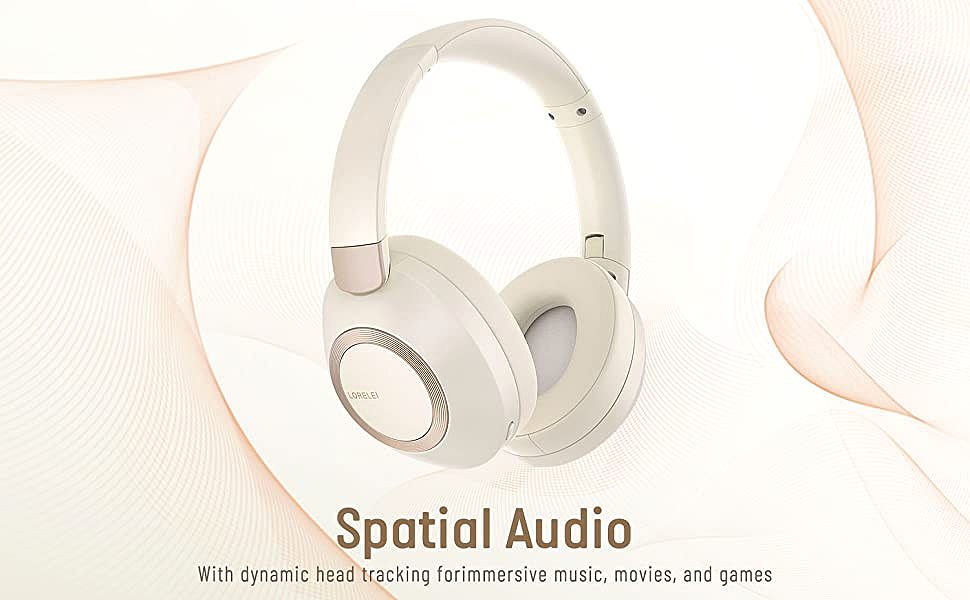

LORELEI B-C6 Wireless Over Ear Headphones
Why Marathon Headphone Battery Claims Are a Balance, Not a Race
When a spec sheet promises a wireless headphone that plays for an entire work week on one charge, the number usually carries a set of assumptions that rarely match how you listen. Rated playtime is measured at a fixed volume, a fixed codec, room temperature, and with the extra processing switched off. The LORELEI B-C6 wireless headphones, which carry a nominal rating of about 50 hours on a single charge, make a useful concrete case for understanding where that number comes from and what quietly trades against it. The sections below walk through the measurable pieces of the design - the drivers, the Bluetooth stack, the battery, and the physical fit - and explain, with figures a buyer can verify against the listing, how endurance, volume, comfort, and sound interact.
The central point is that endurance is not a single knob. A bigger battery does not automatically mean more listening time, because every watt the radio, the amplifier, the signal processor, and the drivers consume has to come from somewhere, and every gram of added cushion or a heavier cone changes the physical fit in turn. The sections below break that budget apart, piece by piece, so the final number stops feeling like marketing and starts feeling like arithmetic.
What the LORELEI B-C6 Ships With
To keep the discussion grounded, here are the specifications that can be checked against the product listing and the manufacturer's user guide: two 40 mm dynamic drivers covering a 20 Hz to 20,000 Hz range, a 32 ohm impedance, Bluetooth 5.3 with SBC and AAC codec support, a built-in 500 mAh battery, and a rated playtime of about 50 hours at full volume. The ear cushions use protein leather over memory foam, and the ear cups rotate inward to roughly 100 degrees and fold to about 120 degrees, which is what makes the unit compact enough for a travel bag. A built-in microphone handles calls, and a 3.5 mm stereo cable provides a wired path for when the battery runs low.
Two clarifications belong up front, because promotional copy for this product line in some markets has advertised features the current retail specification does not carry. Certain listing text has cited up to 80 hours of playtime and has mentioned solar-assisted charging; the shipping spec sheet instead lists about 50 hours and a standard battery with no solar panel. Likewise, where the marketing described the noise handling as active noise cancellation, the current spec labels the noise control as passive sound isolation rather than an active system. Holding those labels apart matters, because each one has a very different engineering cost and a very different effect on battery life.
How the 40 mm Drivers Shape the Sound
The driver is where a headphone makes or breaks its tonal balance, and the B-C6 uses two 40 mm dynamic transducers. A 40 mm cone sits in the middle of the over-ear class: large enough to move enough air for a full low end, small enough to stay light and efficient inside a compact housing. The stated 20 Hz to 20,000 Hz response is the band the unit is engineered to cover, not a promise that every frequency inside it will land at equal loudness. In practice the shape of the curve, whether the bass extends cleanly or rolls off and whether the mids sit forward or stay recessed, is set by the magnet, the voice coil, and the enclosure, none of which the spec sheet itemizes in detail.
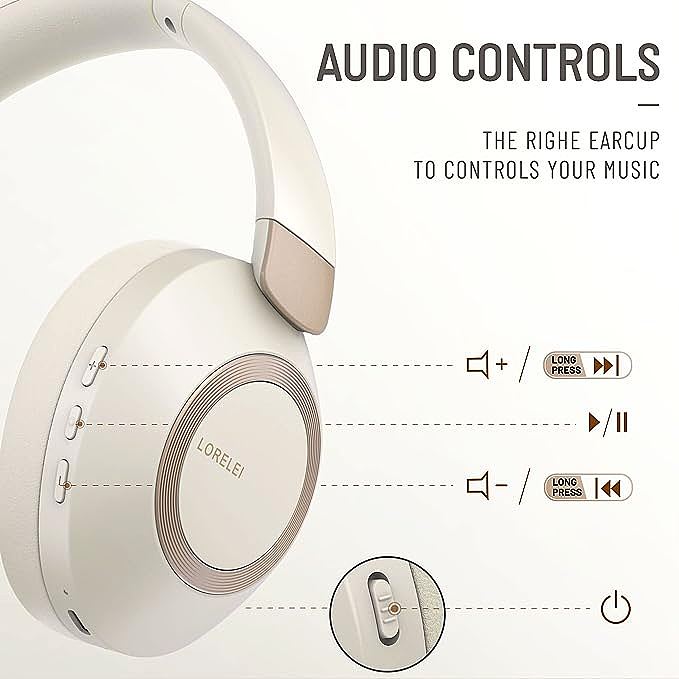
The 32 ohm impedance is relevant to how much current the on-board amplifier must push. Lower-impedance drivers are generally easier for a small headphone amplifier to drive to a given level, but the impedance figure by itself does not tell you the maximum output. Two headphones with the same 32 ohm impedance can still reach very different peak sound pressures, because that depends on the cone's sensitivity and the amplifier's headroom. The deep bass the product copy leans on is ultimately a function of how far the cone travels before the suspension limits it, so it is best read as a design goal rather than a measured quantity.
Bluetooth 5.3, the Codecs, and Where the Power Goes
The single largest drain in any wireless headphone is the radio, where the connection is maintained, where interference is negotiated, and where audio packets are re-sent when a neighbouring Wi-Fi network causes a collision. The 500 mAh battery has to feed the radio, the amplifier, the digital signal processing, and the drivers at the same time, so the rated 50 hours is the result of keeping each of those lines low, not simply of picking a large cell. A modest 500 mAh lithium-polymer pack stores on the order of 1.85 watt-hours at its nominal voltage; for that to stretch into the dozens of hours, the average draw has to sit in the low single-digit milliwatts for most of the session.
Bluetooth 5.3 helps because its low-power link features let the radio spend most of its time in a brief wake-up-and-check state instead of holding a continuous full-power link. The codec choice matters just as much. The B-C6 supports SBC and AAC. SBC is the baseline codec that every Bluetooth device must accept; AAC, which pairs naturally with Apple hardware, carries more information per second and therefore gives the radio more work. If the phone offers a higher-bitrate option such as LDAC, choosing it raises the audio ceiling but spends the battery that the 50-hour figure was tuned against. The advertised playtime assumes a fairly economical transmission; pushing the quality setting toward the higher codecs shortens the clock in proportion.

Comfort, Weight, and the 3.5 mm Wired Fallback
Endurance and comfort compete for the same material budget. To keep the unit light enough for a long session, the headband and the ear cups are kept slim and the cushions are memory foam wrapped in protein leather, which is comfortable but less breathable than an open mesh, so heat can build up in a warm room. The clamping force sits in a deliberate middle ground: enough to hold the acoustic seal that gives passive over-ear isolation, but not so tight that it leaves pressure marks after a few hours. The folding mechanism, roughly 100 degrees of rotation and 120 degrees of fold, is what makes this a travel unit, and it is the physical reason the ear cups stay smaller than the 50 mm cones you find in desk-bound reference headphones.
The 3.5 mm cable is a practical escape hatch. When the battery finally gives out, the wired path keeps the audio working, which is also why the rated playtime can stay high: the designer can size the battery for typical wireless use and lean on the cable for the tail end instead of packing in a larger, heavier cell. That single fallback is one of the quiet reasons a modest 500 mAh pack can still deliver a two-week number on paper. The whole unit lands in the region of three hundred grams on the scale, which is on the lighter side for an over-ear pair and is the main reason the headband can stay slim without a counterweight.
The Price Point, the Ratings, and What Matters
The retail pricing for the colour variants clusters in the low-to-mid twenties, with the beige listing showing around $19.99 and the black around $23.99, which places this squarely in the value tier where the 50-hour figure is the headline. That figure is real under its stated conditions, but it is the kind of figure that assumes moderate volume, an efficient codec, and no extra processing stacked on top. Three things a buyer can check directly, without any lab: the codec support, which is SBC plus AAC and therefore what an iPhone will use; the 32 ohm impedance; and whether the passive isolation does enough for the loudest environment, since there is no active system to fall back on. The user community sits around four-and-a-half stars across well over a thousand ratings, with the recurring themes being the long playtime and the light weight on one side, and the modest maximum volume and the warm, mid-forward tuning on the other.
A Balance You Can Measure, Not a Number to Take on Faith
The 50-hour figure on the LORELEI B-C6 Wireless Over Ear Headphones is the visible end of an invisible set of trade-offs: a mid-size driver chosen for efficiency, a modest battery sized against a low power budget, a codec stack that rewards restraint, and a physical design that keeps the weight down so the ear cushions do not become the first thing you reach for to adjust. None of those choices contradicts the others; they constrain each other. What the marketing language can quietly elide is the distance between the tested number and the way you listen. Keeping that gap in mind, and remembering that the solar and active-noise features some promotions hint at are not part of the shipping spec, turns the spec sheet from a list of impressive digits into something you can reason about with confidence.
LORELEI B-C6 Wireless Over Ear Headphones
Related Essays

The Invisible Wire: Unpacking the Engineering of Modern Wireless Audio

The Physics of Endurance: Micro-Energy Management in Wireless Audio

The Silent Symphony: Engineering the Modern Wireless Soundscape

The Anatomy of Affordable Hi-Fi: Decoding Drivers, Diaphragms, and Connectivity
The Endurance Beast: Why occiam C16-2’s 64-Hour Battery and Tactile Controls Win
The Physics of Silence and Stamina: Decoding ANC and Battery Engineering in Wireless Audio

