Mucro MB-232 Wired Sport Earbuds: Secure Fit and Sweatproof Design Science

MUCRO MB-232 Wired Earbuds
The Problem with Earbuds During Exercise
Every runner knows the frustration. You are three miles into your morning jog, the playlist is perfect, and then — the left earbud slips loose. You stop, dig it back into your ear canal, and keep going. Thirty seconds later, it falls out again during a burst of speed. By the time you reach the halfway mark, you have spent more energy managing your earbuds than actually running..
This is not a motivation problem. It is an engineering problem. Standard earbuds were designed for seated listening on a daily commute, not for the dynamic forces of exercise. When you jump, sprint, or sweat, gravity and inertia work against anything that relies purely on an ear canal seal for retention. The difference between a good workout and a frustrating one often comes down to whether your audio equipment can keep up with the physical demands you place on it.
The MUCRO MB-232 wired sport earbuds address this fundamental mismatch through a combination of over-ear hook engineering, sweatproof construction, and a straightforward 3.5mm wired connection. At $18.99, they occupy a space that wireless alternatives simply do not reach: reliable sport audio without battery dependency, without premium pricing, and without the compromises that come with miniaturizing electronics into a truly wireless form factor.
This article examines the science behind each design choice in the MB-232, explains why the wired audio approach remains relevant for active users in a wireless-dominated market, and identifies the specific use cases where this design philosophy delivers genuine advantages over more expensive alternatives.

The Science of Secure Fit — Over-Ear Hook Engineering
The most distinctive feature of the the this design is its over-ear hook design. To understand why this matters, it helps to look at the anatomy of the outer ear and the physics of how forces interact with it during vigorous movement.
The human pinna — the visible portion of the ear — consists of several structural landmarks: the helix (the curved upper rim), the antihelix (the Y-shaped ridge inside the helix), and the concha (the bowl-shaped cavity leading directly to the ear canal). These structures vary considerably between individuals in size, shape, and depth, which is why a one-size-fits-all in-ear solution rarely achieves uniform retention across different users. Two people with identical earbud models may experience dramatically different levels of stability during the same workout.
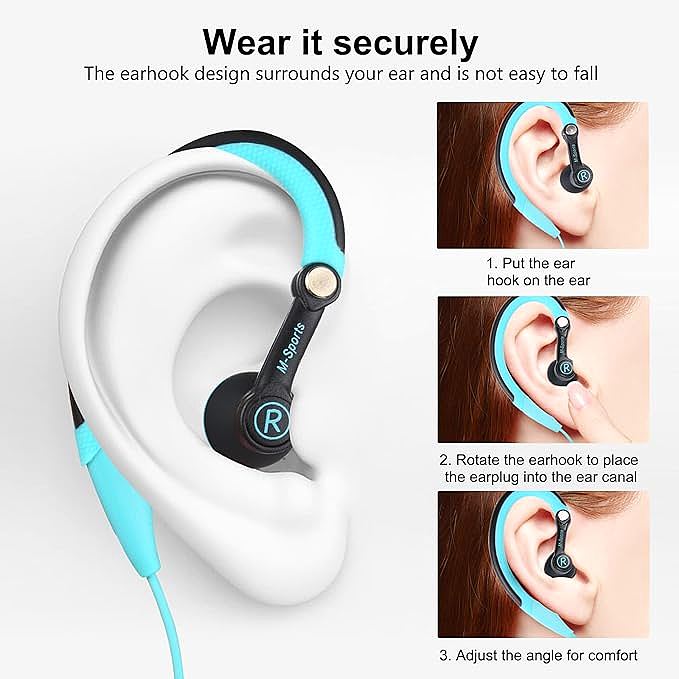
An over-ear hook leverages these anatomical features through a principle called the cantilever effect. The hook wraps around the outer edge of the pinna and rests against the antihelix, creating a fixed anchor point that is mechanically separate from the ear canal seal. When inertial forces act on the earbud during exercise — such as the vertical acceleration during a box jump or the rapid directional changes in a HIIT routine — the hook transfers those forces away from the delicate ear canal seal and into the broader, more robust structure of the outer ear cartilage.
This weight distribution matters because the ear canal is simply not designed to bear lateral forces. A traditional in-ear earbud that relies solely on its silicone tip for retention experiences continuous shear stress with every movement. The over-ear hook converts much of that shear into compressive force against the more resilient cartilage of the pinna, which can absorb considerably more energy before displacement occurs. The result is a physical retention system that scales with the intensity of your activity rather than breaking down under it.
The practical result is a raised dislodgement threshold. Removing an this design earbud intentionally requires pulling the hook away from the ear and then extracting the tip from the canal — two distinct motions that ambient movement during exercise rarely triggers accidentally. This is why users consistently report that wired sport earbuds with over-ear hooks stay put through activities that eject standard earbuds within minutes.
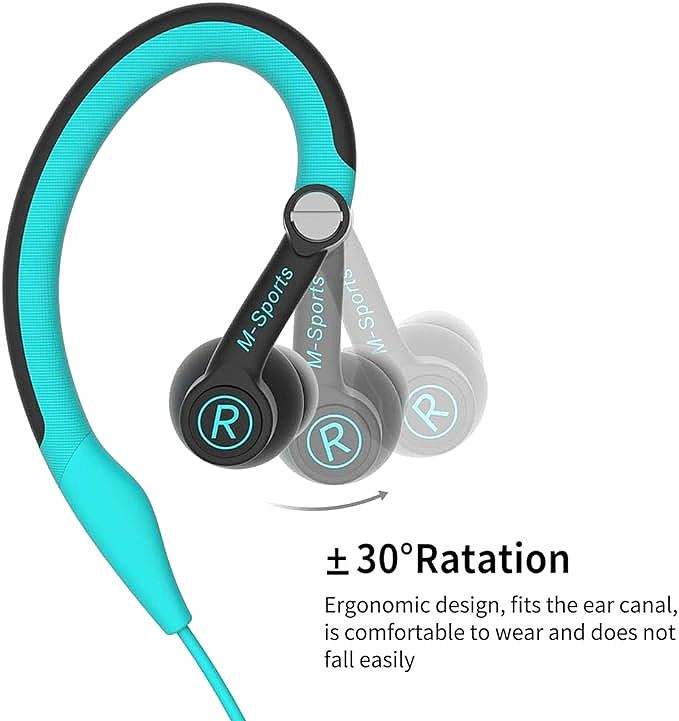
Real-world scenarios where this design proves advantageous include CrossFit workouts involving box jumps and burpees, trail running on uneven terrain where head movements are unpredictable, sprint intervals where sudden accelerations create significant inertial forces, and agility drills that combine lateral and vertical motion in rapid succession. In each case, the over-ear hook provides a mechanical advantage that standard earbuds cannot match regardless of how tightly the tip fits.
The flexible materials used in the hook also accommodate varied ear anatomies effectively. Unlike rigid plastic clips that apply constant pressure at a single point and can cause discomfort during extended wear, the this design hooks conform gradually to the individual contours of the pinna, distributing contact force evenly across a wider surface area and preventing the pressure points that cause users to remove their earbuds mid-workout.
In-Ear Design — Passive Noise Isolation Explained
The this design uses an in-ear form factor, meaning silicone or foam tips create a physical seal within the ear canal. This design serves two purposes simultaneously: retaining the earbud securely in place and providing effective passive noise isolation without any electronic components.
Passive noise isolation works through a straightforward acoustic principle. When the ear canal is properly sealed, sound energy from the earbud drivers has nowhere to escape except toward the eardrum. Simultaneously, external ambient sounds face difficulty entering the sealed canal because the eartip material absorbs and reflects a significant portion of incoming sound waves. The degree of isolation depends on the seal quality, the density and thickness of the tip material, and the frequency range of the ambient noise being blocked.
Unlike active noise cancellation, which requires dedicated electronics, built-in microphones, and continuous battery power to generate anti-phase sound waves, passive isolation is entirely mechanical. There is nothing that can malfunction electronically, nothing that requires charging, and nothing that degrades over time beyond the normal wear on the eartips themselves. This simplicity translates directly to long-term reliability, especially in the harsh environment of a sweaty gym.
This distinction carries important implications for volume safety. When ambient noise is reduced through passive isolation, users can hear their audio clearly at lower volume levels. Higher-volume listening in noisy environments — a common pattern with standard earbuds that lack adequate isolation — is a well-documented contributor to noise-induced hearing loss over time. By improving sound clarity at lower volumes, the in-ear design of wired sport earbuds like the this design provides a genuine health benefit alongside the performance advantage of staying focused during workouts.
There are trade-offs to consider. The same seal that improves audio quality and reduces ambient noise also reduces situational awareness, which matters considerably for outdoor activities like road running or cycling where awareness of approaching traffic is a genuine safety concern. Users must balance audio immersion with environmental awareness based on their specific activity and location. The degree of isolation also varies depending on eartip material — memory foam typically provides stronger isolation than silicone due to its conforming properties, though foam may degrade faster under repeated sweat exposure.
Sweatproof Technology — Material Science in Action
Sweat is not water. It is a complex biological fluid containing water, dissolved salts, urea, lactate, and trace proteins, with a variable pH that ranges from slightly acidic to neutral. This chemical composition makes sweat conductive and corrosive — properties that are particularly damaging to electronic devices over repeated exposure cycles that are inevitable for anyone who exercises regularly.
The the this design describes its construction as sweatproof rather than waterproof, and this distinction is important for setting realistic expectations. A sweatproof design acknowledges the specific challenges of exercise environments — sustained exposure to warm, saline moisture — without claiming protection against submersion, high-pressure water jets, or prolonged rainfall.
Several material-level strategies typically contribute to sweatproof construction in this price category. Moisture-resistant polymers and synthetic rubbers form the external housing, materials chosen specifically because they do not absorb water or chemically degrade when exposed to saline solutions over time. Internal electronic components may receive a hydrophobic nano-coating — a molecular-level treatment that causes water droplets to bead and roll off the surface rather than spread and penetrate toward sensitive circuitry.
The enclosure design itself plays a critical role in moisture management. Sealed seams and tight manufacturing tolerances between components prevent moisture from reaching sensitive internal areas through capillary action along microscopic gaps. Acoustic vents, which must allow sound waves to escape the driver chamber while blocking liquid moisture, often incorporate fine mesh screens that serve as effective moisture barriers without considerably affecting the audio frequency response across the audible spectrum.
The this design does not carry an official IPX score. IP ratings provide standardized, laboratory-tested measurements of moisture and dust resistance according to internationally recognized specifications, and the absence of one means the exact level of moisture protection is unspecified by the manufacturer. This does not indicate poor construction — many products in this price range skip formal certification to avoid the expense of independent testing — but it does mean users should manage expectations appropriately and follow basic care practices.
The practical significance of sweatproof design becomes apparent over time rather than during initial use. Earbuds without adequate moisture protection develop degraded sound quality, intermittent audio in one channel, and eventual complete failure as sweat corrodes internal electrical contacts and deteriorates driver materials. For athletes who exercise multiple times per week, this degradation cycle can reduce the usable lifespan of non-sweatproof earbuds to just a few months of regular use.
Wired vs Wireless — Why 3.5mm Still Matters
The current audio market heavily favors wireless solutions, with major manufacturers directing the majority of their research and marketing budgets toward Bluetooth technology. Yet the 3.5mm wired connection maintained its position as the universal audio standard for decades for reasons that extend far beyond simple inertia or manufacturer reluctance to adopt new formats. Understanding these reasons explains why wired sport earbuds like the the this design continue to serve specific use cases effectively and why an increasing number of athletes are choosing the cable over Bluetooth.
Signal integrity represents the most significant technical advantage of a wired connection. A 3.5mm cable transmits audio as an analog electrical signal through a physical copper conductor, introducing zero latency and zero audio compression. Bluetooth audio, by contrast, compresses audio data to minimize the bandwidth requirements of the wireless link, and the encoding-and-decoding process introduces measurable delay — typically between 40 and 200 milliseconds depending on the codec and hardware implementation. For casual music listening this delay is imperceptible, but for synchronized activities like cadence-based running training or rhythm-based dance workouts, zero-latency audio provides a tangible performance benefit.
The battery question deserves equal attention in any comparison. Wireless earbuds require periodic charging, and the smaller the form factor, the more frequently charging becomes necessary. True wireless earbuds in the $25 to $50 price range typically offer between four and eight hours of playback per charge. After the lithium-ion battery degrades — which happens inevitably with repeated charge cycles — the entire unit becomes unusable and must be replaced.
Total cost of ownership further distinguishes the wired approach from wireless alternatives. At $18.99 for the standard 3.5mm version and $19.99 for the USB-C adapter version, the this design costs considerably less than any wireless alternative with comparable sport-specific features. a popular true wireless sport earbud earbuds carry a $49.95 price tag with an IP67 score but require regular charging and will eventually need battery replacement. a mainstream true wireless option true wireless earbuds at $24.99 offer eight-hour battery life but provide no sweatproof guarantee exceeding basic splash resistance.
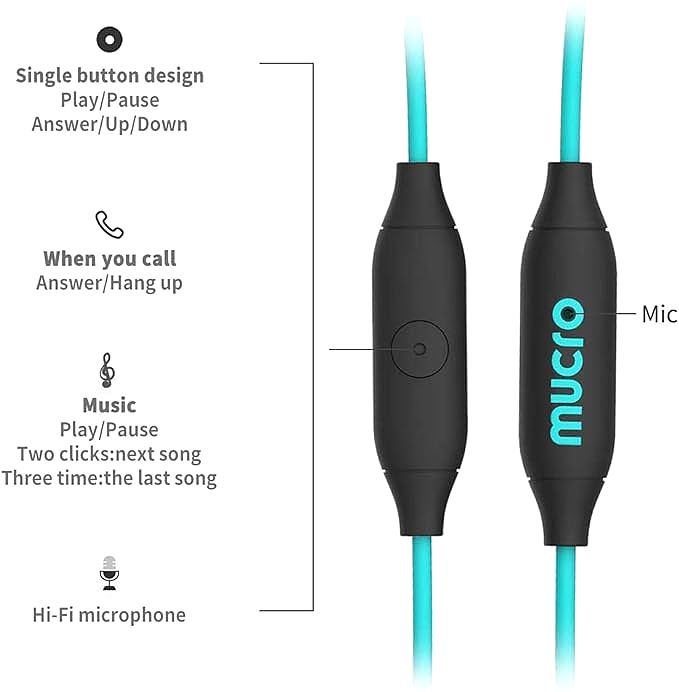
The 3.5mm TRRS connector used by the this design carries stereo audio plus microphone signals in a single plug, enabling simultaneous music playback and phone call functionality without switching modes or going through a Bluetooth pairing procedure. Universal compatibility means these earbuds work with virtually any device featuring a 3.5mm jack — smartphones, tablets, laptops, dedicated music players, and gym equipment with built-in audio systems. No pairing, no waiting, no firmware updates.
How These Features Work Together
The design choices in the the this design create a cohesive system where each feature reinforces the others in ways that produce a more capable product than any single specification sheet might suggest. The over-ear hook ensures the earbud stays firmly in place during vigorous movement, which maintains the in-ear seal necessary for both physical retention and effective noise isolation. The sweatproof construction protects the internal components from the moisture that would otherwise accumulate during the very exercises that test the hook's retention capabilities.
This integrated approach produces a device optimized for a specific use case rather than attempting to excel at everything simultaneously. Consider a typical morning routine: a user plugs in the this design, puts them on, and begins a workout immediately. The over-ear hooks secure the earbuds through box jumps, burpees, and rope climbs. The in-ear seal blocks distracting gym noise and allows focused listening at safe volume levels. Sweat accumulates throughout the session but does not penetrate the sealed construction.
Compare this to a wireless alternative requiring the same routine: the user must first verify the earbuds are adequately charged before leaving, manage a Bluetooth pairing procedure at the start of the workout, deal with potential wireless interference in a crowded gym environment filled with competing signals, place the earbuds carefully in a charging case afterward to prevent loss, and eventually replace the degraded battery after months of regular use. Each additional step introduces a potential point of failure that can derail the entire experience.
The synergy extends to economics as well. The simplified wired design reduces manufacturing complexity and component count, which lowers the retail price substantially. That lower price point reduces the financial stress of losing or damaging earbuds during intense training sessions. At $18.99, replacing worn-out eartips or even purchasing a second pair for backup remains economically trivial compared to the replacement cost of wireless alternatives. This economic advantage is one reason why wired sport earbuds continue to maintain a loyal following among cost-conscious athletes who prioritize function over form.
Understanding the Right Fit
The the this design serves three primary user segments effectively, each with distinct needs that this product addresses directly.
The practical athlete values consistency and reliability above all other considerations. This person has likely experienced wireless earbud failures during workouts — a dead battery mid-run on a cold morning, a dropped true wireless earbud lost forever beneath gym equipment, or a Bluetooth pairing failure at the worst possible moment during a competition. They prefer technology that functions predictably without requiring management, configuration, or regular maintenance. The this design's zero-setup, zero-charging approach aligns directly with this preference for straightforward dependable performance.
The budget-conscious consumer understands that quality sport audio does not require a premium price tag. This users compares total cost of ownership rather than focusing solely on the upfront purchase price. They recognize that wireless earbuds at similar price points typically compromise on build quality, battery capacity, or both to hit the target retail price. At $18.99 with over 3,523 ratings averaging 3.8 stars and consistent monthly purchases exceeding 200 units, the this design demonstrates a proven track record of satisfying users without demanding a significant financial investment.
The multi-device user owns multiple products with 3.5mm audio outputs — perhaps an older phone kept as backup, a tablet, a laptop, and gym equipment with built-in audio systems — and wants a single earbud solution that works reliably across all of them. Platform-specific wireless earbuds create fragmentation and inconvenience in this scenario, but the universal 3.5mm standard eliminates that problem entirely and provides seamless interoperability.
These wired sport earbuds are less suitable for users who primarily listen to music while commuting on public transit and need active noise cancellation to block engine rumble, for those who exclusively use modern devices without 3.5mm headphone jacks and do not want to carry a dongle, or for people who value the convenience of true wireless freedom and are willing to accept ongoing battery management trade-offs to achieve it.
Final Assessment — Value Proposition
The the this design wired sport earbuds deliver a focused, well-engineered solution to a specific and persistent problem: keeping audio secure, dry, and reliable during physical exercise. The over-ear hook engineering addresses the most commonly reported complaint about sport earbuds — dislodgement during vigorous movement — through straightforward mechanical design rather than electronic complexity. The sweatproof construction handles the environmental challenge of sustained exercise moisture without requiring expensive third-party certification. The wired connection eliminates battery dependency entirely, a benefit that becomes more apparent with each forgotten charging session or degraded battery cycle.
At $18.99, the price positions these wired sport earbuds well below wireless competitors while delivering sport-specific features that cheaper wireless options often omit entirely. The 3.8-star average from over 3,500 verified users indicates consistent performance that meets expectations for the intended use case, and the steady monthly purchase volume suggests growing recognition of the product's value among practical athletes.

The ideal users is someone who exercises regularly, has experienced the frustration of earbuds falling out or wireless batteries dying at inconvenient times, and values dependable performance over novelty features and marketing differentiation. For this user, the this design represents a rational choice grounded in practical engineering rather than incremental feature upgrades that justify premium pricing.
The wired sport earbuds category remains underserved by major manufacturers, and products like the the this design fill a genuine gap in the market. They demonstrate that sometimes the simplest technology — a cable carrying an analog signal, a driver producing sound, and a well-designed hook keeping everything in place — delivers exactly what active users need without the complications, costs, and compromises of miniaturized wireless electronics.
MUCRO MB-232 Wired Earbuds
Related Essays
Wired Sport Earbuds: The Engineering Case for Over-Ear Hooks and 3.5mm Audio
Mucro MB-232 Wired Sport Earbuds: Secure Fit and Sweatproof Design Science
