Anchored Audio: The Physics of Sound in Motion

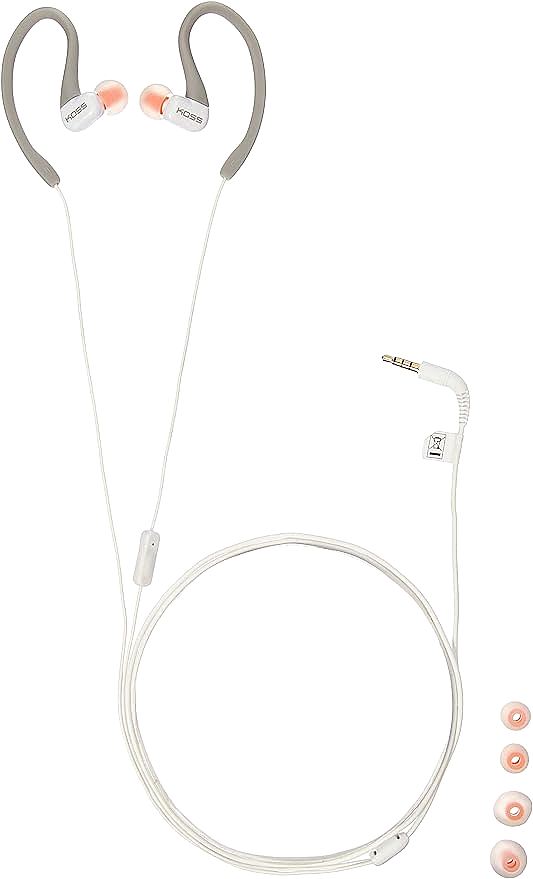
Koss KSC32i GRY Sport Clip Headphones
For the athlete, gravity is a constant adversary. With every stride of a run, the human body experiences impact forces measuring up to three times its own weight. This rhythmic deceleration sends shockwaves through the skeletal structure, challenging the stability of any wearable device. In the realm of personal audio, this creates a specific engineering problem: how to maintain a consistent acoustic coupling with the ear canal when the entire system is subject to violent kinetic energy and sweat—nature's ultimate lubricant.
Standard earbuds rely on friction to fight gravity. It is often a losing battle. To solve this, audio engineers must look beyond simple friction and turn to mechanical interlocking, leveraging the unique topography of the human ear to anchor sound to the listener.
The Biomechanics of Stabilization
The human ear is not designed to hold objects; it is designed to funnel sound. However, the external ear structure, the pinna, offers cartilaginous ridges—specifically the helix and the concha—that can serve as load-bearing anchor points.
Friction vs. Suspension
Most in-ear monitors (IEMs) function like a cork in a bottle, relying on the expansion of silicone against the ear canal walls. This is the friction-fit method. When sweat is introduced, the coefficient of friction drops precipitously. Combined with the vertical G-forces of running, the earbud slides out.
The suspension method, utilized by sport clip headphones like the Koss KSC32i, fundamentally shifts the load. By utilizing a flexible clip that navigates around the root of the helix (where the ear attaches to the head), the weight of the driver is supported by the ear structure itself, not the canal. This "FitClip" design transforms the ear from a passive receptacle into an active structural support. The result is mechanical stability that remains unaffected by perspiration or rapid head movements, ensuring the acoustic seal—and therefore the bass response—remains consistent throughout a workout.

Acoustic Transparency and Survival
In controlled environments like a gym, total isolation is a luxury. On the open road, it is a liability. The safety of a runner or cyclist depends on situational awareness—the ability to perceive and localize external auditory cues, such as the tire noise of an approaching vehicle.
The Physics of Masking
Sound isolation works by sealing the ear canal, physically blocking air pressure waves from the environment. While excellent for immersion, this creates a "closed system." The KSC32i adopts a semi-open architecture. Instead of hermetically sealing the canal, the driver sits just outside it, cushioned by soft foam or silicone.
This arrangement allows for acoustic transparency. High-frequency environmental sounds (which are directional and critical for localization) can diffract around the earbud housing and enter the ear. This allows the listener to maintain a connection to their surroundings without pausing the music. It is a deliberate engineering compromise: sacrificing absolute silence for safety, ensuring that the rhythm of the playlist does not mask the warning signs of the real world.
The Dynamic Driver Engine
At the core of the audio experience is the transducer. The KSC32i employs a dynamic driver, a miniature loudspeaker consisting of a diaphragm, a voice coil, and a magnet.
Broad Spectrum Reproduction
The goal of any driver is to move air. The KSC32i boasts a frequency response of 15 Hz to 25,000 Hz. While the upper limit of human hearing typically caps at 20,000 Hz, extending the driver's capability ensures that frequencies within the audible range are reproduced with greater linearity and less distortion. * Low Frequency (Bass): The 15 Hz lower limit suggests a driver capable of significant excursion, moving enough air to create the physical sensation of bass, which is crucial for maintaining cadence during exercise. * Impedance Matching: With an impedance of 16 Ohms, these headphones present a low electrical load. This makes them highly efficient, requiring very little voltage to drive to high volumes. This is essential for battery-powered portable devices, ensuring that the limited amplification power of a smartphone can still produce dynamic, full-bodied sound.

The Reliability of the Physical Link
We live in a wireless age, yet the wire persists. Why? Because in the context of endurance sports, the wire represents absolute reliability.
Wireless signal transmission (Bluetooth) involves encoding, transmitting, receiving, and decoding data. Each step introduces potential points of failure—signal interference in crowded gyms, battery degradation over time, or compression artifacts.
A physical connection, like the standard 3.5mm jack found on the KSC32i, creates a zero-latency, uncompressed analog pathway. There are no batteries to die mid-marathon, no pairing protocols to fail, and no wireless codecs compressing the audio data. For the athlete focused purely on performance, this simplicity is a feature, not a bug. It removes the cognitive load of "battery anxiety," allowing the user to focus entirely on the physical task at hand.
Conclusion
The design of sport audio gear is a balancing act between physics and physiology. It requires understanding how the body moves, how the ear anchors objects, and how the brain processes sound in dynamic environments. Devices like the Koss KSC32i demonstrate that the solution isn't always high-tech wizardry; often, it is smart mechanical engineering. By leveraging the anatomy of the ear for stability and maintaining a wired connection for reliability, they offer a listening tool that is as rugged and enduring as the athletes who wear them.
Koss KSC32i GRY Sport Clip Headphones
Related Essays

The Anatomy of a Modern Miracle: Excavating the Technology Inside Budget Audio

Commoditized Excellence: Deconstructing the Engineering Behind Budget Sport Audio

The Physics of Minimalist Audio: Decoding Open-Back Dynamics and Impedance Efficiency

The Physics of Air Conduction: Large Drivers and Open Soundscapes

Situational Awareness and Reliability: The Safety Protocols of Urban Athletic Audio

The Resurgence of the Open Driver: The Physics of Flat-Head Acoustics

The Physics of Fidelity: Anatomy of Dual-Driver Acoustic Architectures in Modern Audio

The Anatomy of Safety: Situational Awareness, Titanium Memory, and Material Science

The Physics of Fidelity: Why the Wired Sennheiser CX 300S Still Matters
