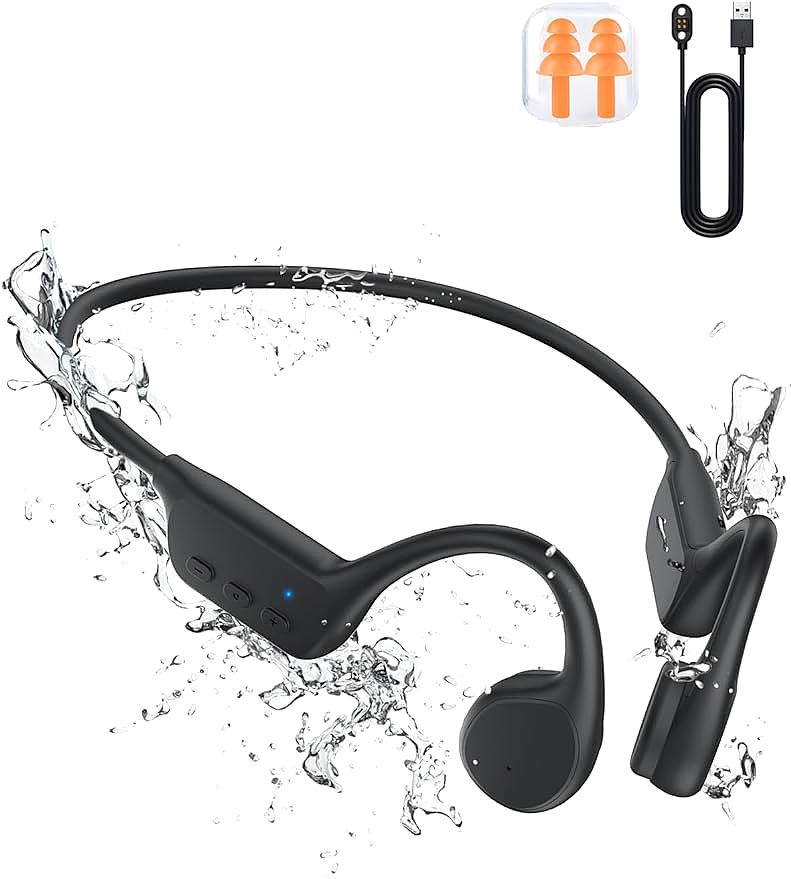
HCMOBI X18Pro Bone Conduction Headphones - Your Perfect Swimming and Sports Companion


HCMOBI X18Pro Bone Conduction Headphones
It’s a story that sounds almost like folklore. In the early 19th century, the great composer Ludwig van Beethoven, increasingly lost to the world of sound by his profound deafness, found a way to hear his piano. He would clamp a special rod between his teeth and press the other end against the instrument's soundboard. As he played, the piano's vibrations would travel up the rod, through his jaw, and directly into the bones of his skull, bypassing his damaged ears entirely. He wasn't hearing in the conventional sense; he was feeling the music in his very bones.
This desperate, ingenious act wasn't magic. It was a raw application of physics, a testament to the fact that sound is, at its core, simply vibration. Two centuries later, this same principle, refined and miniaturized, is at the heart of a fascinating class of audio devices, exemplified by products like the HCMOBI X18Pro Bone Conduction Headphones. They solve a uniquely modern problem—how to listen to music while swimming—by leaning on a very old secret.

A Symphony Through Your Skull
To understand what makes bone conduction so different, we first have to appreciate how we normally hear. Traditional headphones are tiny speakers that create sound waves in the air. These waves travel down your ear canal and vibrate your eardrum, which in turn moves a chain of tiny bones that stimulate the fluid-filled cochlea, or inner ear. It’s a remarkable biological machine, but it requires an open pathway for air.
Bone conduction technology throws that playbook out the window. Instead of speakers, devices like the X18Pro use small transducers that rest gently on your cheekbones, just in front of your ears. These pads vibrate minutely, sending sound waves directly through your skull to that same inner ear, completely bypassing the eardrum. If you want a low-tech demonstration, plug your ears tightly and hum. The sound you hear, rich and clear inside your own head, is a perfect example of bone conduction.
The most immediate benefit of this “open-ear” design is profound: your ears remain completely unobstructed. For a cyclist on a city street or a runner on a park trail, this means having a personal soundtrack without being dangerously isolated from the sounds of traffic, pedestrians, or nature. It’s the best of both worlds: audio immersion and situational awareness.

The Aquatic Gauntlet: Engineering an Underwater Concert
Taking this technology from the running path to the swimming lane presents a monumental engineering challenge. Water and electronics are, famously, not friends. To survive, a device needs more than just a good seal; it needs to be a veritable submarine for your sound.
This is where we encounter the IP68 rating. This isn't just a marketing buzzword; it's a specific standard from the International Electrotechnical Commission (IEC 60529) that certifies a device's resilience. The ‘6’ means it’s completely sealed against dust ingress. The ‘8’ is the crucial part for swimmers: it certifies protection against continuous immersion in water, in this case, up to 3 meters (nearly 10 feet) deep. Achieving this requires meticulous design, right down to the charging method. A traditional USB-C port, even with a rubber flap, is a point of weakness. The X18Pro’s use of a magnetic charging port eliminates this opening entirely, creating a seamless, uninterrupted hull that is far more reliable against water pressure.
But even with a perfectly waterproof body, a new problem arises: the signal. Bluetooth, which operates on the 2.4 GHz radio frequency, is effectively useless underwater. Water molecules are fantastic at absorbing the energy of these specific radio waves, meaning the signal from a phone at the edge of the pool would die within inches of entering the water.
This is where a seemingly "old" technology makes a brilliant comeback. The HCMOBI X18Pro includes 8GB of onboard MP3 storage. This isn't a nostalgic gimmick; it's a necessary and elegant engineering solution. By loading your music directly onto the device, you create a self-contained audio ecosystem. It becomes a tiny, waterproof music player that doesn't need an external signal, ensuring your playlist is with you, crystal clear, for every single lap.

The Human Element: Where Titanium Meets Tissue
Of course, a device isn't just a collection of specs; it's an object that has to live on a human body. The X18Pro’s frame is made of titanium, a material prized in aerospace and medical implants for its incredible strength-to-weight ratio and flexibility. At a mere 30 grams (0.9 ounces), it's designed to be forgotten once worn.
However, the leap from the drawing board to the diversity of human anatomy reveals the inherent compromises of any "one-size-fits-most" design. This is the core challenge of ergonomics. While the flexible titanium band accommodates many, some user experiences highlight that for those with smaller heads, the fit can be less secure during vigorous movements.
Furthermore, the very physics of bone conduction creates unique sensory trade-offs. Unlike in-ear buds that isolate sound, bone conduction can be felt. At higher volumes, especially with bass-heavy music, the vibrations can create a distinct "tickle" on the skin. And because the design is open, it can't match the deep, rumbling bass or the sheer loudness of traditional headphones that seal the ear canal. The maximum volume might feel insufficient in a noisy gym or when competing with the sound of splashing water. These aren't necessarily flaws of this specific product, but rather inherent characteristics of the technology itself—the price of admission for the immense benefit of an open ear and underwater capability.
Coda: The Echo of Ingenuity
Two hundred years ago, a composer’s desperate need to hear his own creations led him to discover a fundamental truth about sound and vibration. Today, that same principle, amplified by materials science, micro-engineering, and digital storage, allows a swimmer to find rhythm and motivation in the silent, blue world of a swimming pool.
Devices like the HCMOBI X18Pro are more than just gadgets. They are elegant solutions born from a symphony of disciplines. They are a reminder that sometimes the most futuristic-feeling innovations are, in fact, the echoes of a long-forgotten ingenuity, repurposed to help us interact with our world in ways we once only dreamed were possible.
HCMOBI X18Pro Bone Conduction Headphones
Related Essays

ZHYH Sport Headphones: A Splash-Proof Bargain for Underwater Audio

The Swimmer's Guide to Bone Conduction: MP3 Mode vs. Bluetooth

Taiyoko dg08 Bone Conduction Wireless Headphones - Your Perfect Open Ear Companion for Sports
Acoustic Engineering for Amphibious Environments and Cranial Transmission

Bypassing the Tympanic Membrane: Acoustic Engineering for Amphibious Environments

The Open-Ear Revolution: How Bone Conduction Headphones Are Changing the Way We Listen

RR SPORTS BC888 Bone Conduction Headphones: Dive Deeper into Sound and Science

SSONIO Bone Conduction Headphones: Unveiling the Science of Open-Ear Sound & IPX8 Aquatic Audio

CHENSIVE X19 Pro Bone Conduction Headphones: Lightweight and Comfortable Bone Conduction Headphones for Sports

