The 75-Hour Budget Sports Earbuds: Engineering the sajawass Wireless Earbuds


sajawass Wireless Earbuds
The wireless earbud market has a battery problem. Most true wireless earbuds deliver somewhere between five and eight hours of playback per charge, which means the charging case becomes a daily ritual for anyone who listens for more than a commute. A smaller cohort of budget models has started pushing total playtime into multi-day territory, and the sajawass Wireless Earbuds (model B0GSRXQPWZ) is one of the more aggressive entries in the wireless earbuds for running category. It advertises 75 hours of total playtime, an IPX7 waterproof rating, and a digital battery display on the case, all at a price of $21.99. Those numbers read like a spec-sheet exaggeration, so this piece dissects what they mean in practice, where the engineering compromises sit, and whether this budget sports headset deserves a place in a gym bag.
The 75-hour power budget
The headline figure is a total, not a per-charge number. The earbuds themselves run for roughly 8 hours on a single charge, which is in line with the true wireless norm. The remaining roughly 67 hours come from the charging case, which acts as a portable reservoir. In practice, that translates to a full work week of moderate listening before the case itself needs to be plugged in via its Type-C port. A full recharge of the case and the earbuds takes about 1.5 hours, or roughly 90 minutes, which is fast enough to top up between sessions without planning around the battery.
What makes the battery easier to live with than most rivals is the LED digital display on the front of the case. Rather than the vague tri-color dots found on many budget models, this case shows a numeric percentage readout for the case and for each earbud individually. That removes the guesswork of whether you have enough charge left for a long run, and it is a feature normally reserved for earbuds costing two or three times as much. For a device whose entire selling point is endurance, a precise fuel gauge is not a gimmick; it is the interface that makes the 75-hour claim usable.
It is worth being clear about what 75 hours does not mean. The figure is a laboratory total at moderate volume, and real-world playback at higher volume, with the microphone active for calls, or with the case display lit, will pull the number down. A realistic daily user should plan on four to five days between case charges rather than a full week, which is still a meaningful improvement over the nightly-charging cadence of most true wireless earbuds. The lithium-ion cells inside both the earbuds and the case will also lose capacity over time; after a few hundred full charge cycles, expect the total playtime to settle below the out-of-box figure, which is normal for this battery chemistry rather than a defect.
Driver and call architecture
The audio hardware centers on a 13mm dynamic driver. In a budget earbud, driver size is a reasonable, though imperfect, proxy for low-frequency output; a larger diaphragm moves more air, which typically means more perceived bass. The trade-off is that a large driver in a small housing can sound boomy if the enclosure is not tuned carefully, and at this price the tuning favors warmth and energy over clinical clarity. Listeners who want a neutral, reference-style sound will find this presentation colored; listeners who want music that feels present during a workout will find it well suited.
For calls, the headset uses built-in microphones with environmental noise cancellation, commonly called ENC. It is important to distinguish ENC from active noise cancellation, or ANC. ENC does not silence the world for the listener; instead, it uses the microphone array to isolate the speaker's voice from ambient noise so the person on the other end hears you more clearly. In a gym or on a windy road, that is the more useful feature, because the primary problem is usually being understood, not hearing. ANC, by contrast, is a costlier system that feeds inverse noise into the ear to cancel ambient sound for the listener, and it is almost never found at this price.
Fit for movement
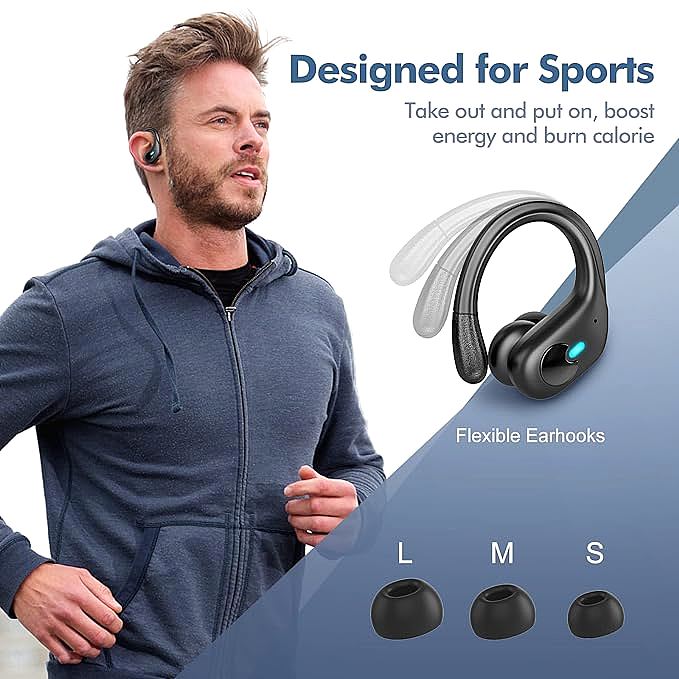
The defining physical feature is the over-ear hook. Each earbud has a flexible TPE, or thermoplastic elastomer, hook that loops over the ear, which keeps the housing stable during running and lifting in a way that a plain in-ear bud rarely matches. The hooks are paired with three sizes of silicone tips, and the fit guidance is simple: a tighter seal improves both the bass response and the passive noise isolation. A loose fit does not just sound thin; it actively undermines the earbud's two main jobs of staying put and delivering low end.
The earbuds carry an IPX7-style waterproof nano-coating. The practical meaning is resistance to sweat and rain, not submersion. The product documentation advises against showering or bathing with them, because pressurized water and steam can defeat a nano-coating that handles sweat and splashes. For running in the rain or a sweaty workout, however, the protection is genuinely useful and removes a real anxiety about moisture damage. The coating is a thin conformal layer rather than a mechanical seal, which is why it stops jets and splashes but cannot be relied on against sustained pressure.
Connectivity and controls
The radio is a Bluetooth 5.3 chipset. The version number does not directly improve sound quality; its real benefits are connection stability, lower power draw, and a faster handshake when the earbuds are removed from the case. The quoted wireless range is about 10 meters, which is standard for the protocol and sufficient for leaving a phone on a gym bench while you move between machines. In a crowded gym with many competing radios, the 5.3 connection holds more steadily than older chips, though it is not immune to the interference of a packed room.
Control is handled through touch surfaces rather than physical buttons. A tap handles play and pause, a press answers or rejects calls, and additional gestures adjust volume or summon a voice assistant. Touch controls are convenient when your hands are sweaty or gloved, though they lack the tactile confirmation of a physical button, which takes a short adjustment period. The listing notes one-touch pairing straight out of the case, which removes the usual fumbling with a pairing button and a phone's Bluetooth menu. Both earbuds can be used together in stereo or independently, which is useful when you want one ear free to hear traffic or a training partner.
How it compares
At $21.99, this model undercuts most name-brand true wireless earbuds by a wide margin, and the spec sheet reads like a much more expensive product. A direct comparison is instructive. A popular budget competitor, the Kaja Audio Go-To's earbuds (ASIN B0BWSDKK19), retails around $29 with a similar over-ear sport fit and touch controls, but without the same multi-day battery total or the numeric case display. The Kaja pair relies on smaller 6mm dynamic drivers with a 20Hz to 20KHz frequency response and a 6-20 hour playtime range across a 33 ft connection range, and carries only IPX4 water resistance rather than the IPX7 here. The older 80-hour sajawass earbuds that this model effectively replaces have been delisted from the retailer, which makes the 75-hour version the current pick for anyone chasing maximum endurance at minimum cost. The trade-off across all of these budget options is the same: you get battery and features, and you give up noise cancellation, premium codec support, and acoustic refinement.
The honest trade-offs
No review at this price is complete without naming what was given up. There is no active noise cancellation, only the passive isolation provided by a good tip seal, so a loud train or an open-plan office will bleed through. The audio codec support is standard rather than audiophile-grade, which caps how much detail can be transmitted wirelessly. And the batteries are sealed inside the housing, so once the cells degrade after a few hundred charge cycles, the earbuds become electronic waste rather than a repairable item. The low purchase price amortizes well over two years of daily use, bringing the effective cost to well under two dollars a month, but the environmental cost is fixed and real.
Who this is for
This is a specialist tool rather than a general-purpose audiophile instrument. It is the pair you keep in the gym bag, the one you wear on a long trail run in the rain, and the spare you hand to a friend who forgot theirs. If you shop for wireless earbuds for running and your priority is a secure fit, week-long battery life, and sweat resistance at a price that makes losing them a minor annoyance rather than a tragedy, the value proposition is hard to argue with. If you want noise cancellation, premium codec support, or a neutral sound signature, this is not the right device, and no amount of battery capacity will change that.

The sajawass Wireless Earbuds are an engineering exercise in solving two specific problems: endurance and stability. By sizing the battery for a week rather than a day, fitting a secure over-ear hook, and sealing the housing against sweat, they deliver exactly what a budget sports headphone should. They are not the best earbuds you can buy. For the runner who wants a cheap, dependable, rain-ready pair that can survive a week of training without a recharge, though, they may be exactly the right ones.
sajawass Wireless Earbuds
Related Essays

How IPX7 Sports Earbuds Hold Up Under Real Workouts

Why Wireless Earbuds Sound Flat: Physics of Tiny Speakers

Ear Hook Earbuds: 7 Tech Specs That Keep You Moving

How Sport Earbuds Stay Sealed and Stable While You Run

What ENC Noise Cancelling Really Does on a $17 Earbud

NANAMI X1 Earbuds: IPX7 Workout Sound With 15 Hours

80-Hour Wireless Sport Earbuds: Budget Bluetooth 5.3 With Wireless Charging

Why Open-Ear Headphones Are Safer for Outdoor Running

Boytond YYK580 Wireless Earbuds: Built for Long Runs

