The Bitrate Battlefield: Navigating the Era of High-Resolution Wireless Audio


SoundPEATS Air3 Deluxe HS Wireless Earbuds
SoundPEATS Air3 Deluxe HS Wireless Earbuds
The SoundPEATS Air3 Deluxe HS Wireless Earbuds combines solar charging technology with active noise cancellation, offering up to 80 hours of battery life on a single charge — and potentially infinite playtime in sunlight.
Priced at $135.99 for Midnight Black and $199.00 for Sand Gold, it targets outdoor commuters and travelers who want to eliminate cable anxiety.
The Bluetooth Bottleneck: Why Wires Ruled for So Long
To understand the significance of modern high-resolution wireless audio, we must first recognize the inherent limitations of Bluetooth technology. Originally designed for simple data transfer and voice headsets, Bluetooth was never intended to carry the heavy load of complex musical waveforms.
The Pipeline Problem
Imagine a fire hose trying to push water through a drinking straw. The fire hose represents the rich, data-heavy information contained in a CD-quality or high-resolution audio file. The straw represents the limited bandwidth of early Bluetooth versions. To get the audio from your phone to your earbuds, the data had to be aggressively squeezed—compressed—to fit through the pipe. This process, governed by "codecs" (compression/decompression algorithms), inevitably discarded parts of the audio data deemed "less important" by psychoacoustic models.
The Legacy of SBC
For years, the Sub-band Coding (SBC) codec was the mandatory standard. While functional, SBC prioritizes connection stability over audio fidelity. It operates at lower bitrates and often introduces muddy bass or harsh treble artifacts. This created a persistent stigma that Bluetooth could simply not compete with a wired connection.
Enter the High-Res Era: The Science of LDAC
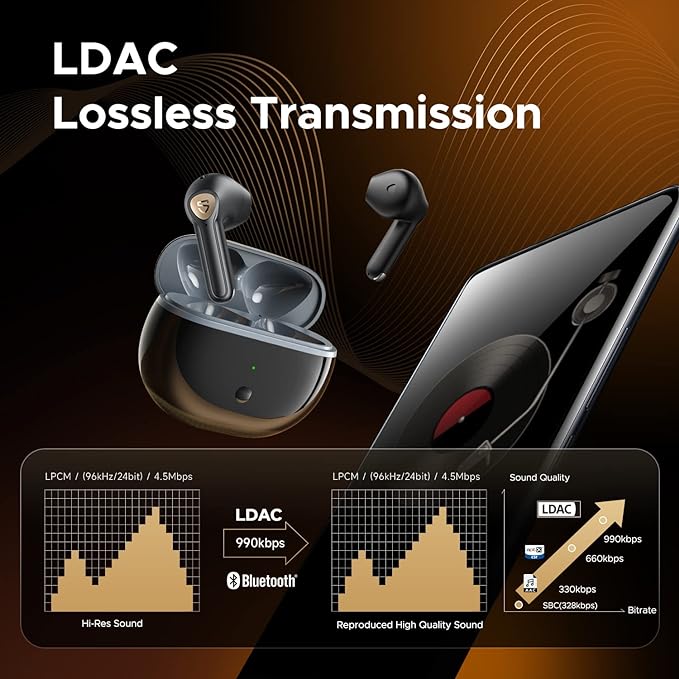
The industry's response to the bandwidth limitation was the development of advanced codecs designed to maximize the available Bluetooth pipeline. Among these, LDAC stands out as a significant milestone in wireless audio engineering.
Breaking the 990 kbps Barrier
Standard Bluetooth codecs typically transmit data at speeds ranging from 328 kbps to 576 kbps. While decent for streaming services like Spotify, this is insufficient for true high-resolution audio, which requires much more data to render the nuance of a recording. LDAC, developed by Sony, fundamentally changes this equation by supporting transfer rates of up to 990 kbps.
This near-doubling (or tripling) of bandwidth allows for the transmission of audio at 24-bit/96kHz quality. In practical terms, this means the "straw" has been widened significantly. While it is still not a purely uncompressed pipe like a copper wire, it is wide enough to allow significantly more musical information to pass through intact. The result is a sound signature that retains the texture of instruments, the decay of reverb tails, and the "air" around vocals.
The Certification Standard
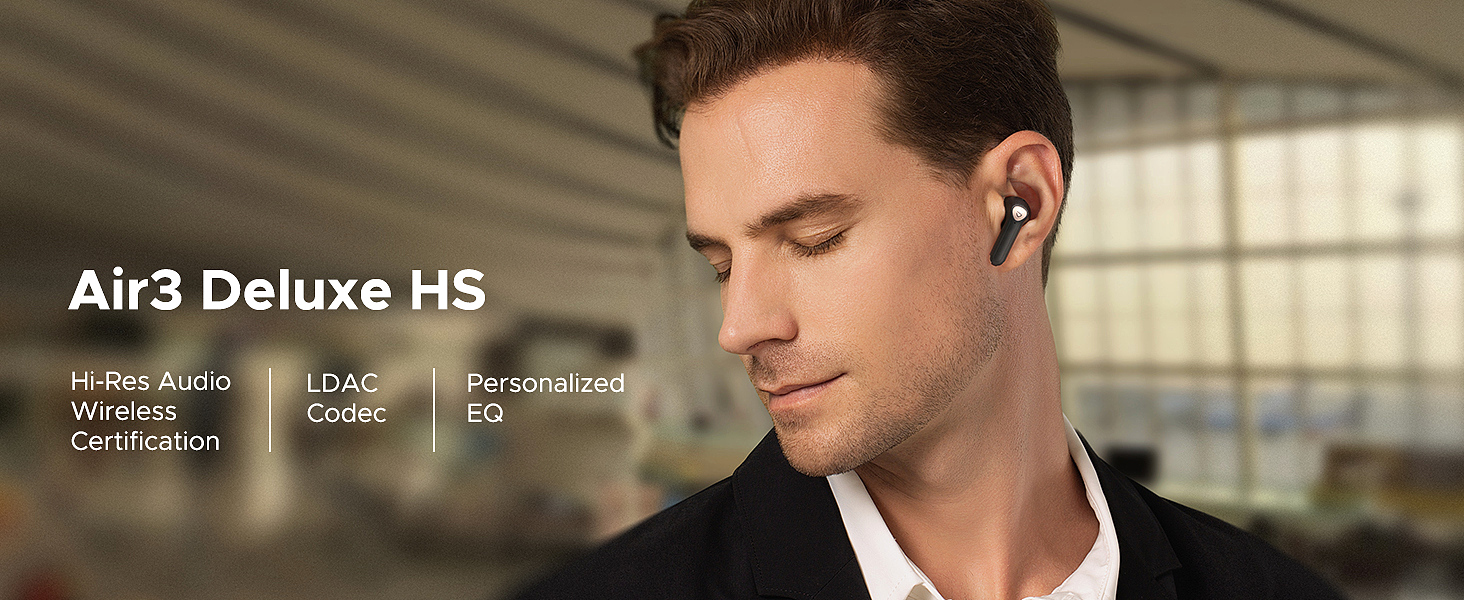
The "Hi-Res Audio Wireless" logo is not merely a marketing sticker; it is a technical validation. To earn this, a device must prove it can reproduce frequencies up to 40kHz (far beyond the standard 20kHz limit of human hearing, but relevant for harmonic reconstruction) and handle high-bitrate streams. When accessible devices like the SoundPEATS Air3 Deluxe HS achieve this certification, it signals a maturity in the market: high-fidelity is shifting from a luxury niche to a consumer standard.
The Hardware Equation: Why Drivers Still Matter
While codecs like LDAC solve the transmission problem, the reproduction problem remains. You can send the highest quality signal in the world to a speaker, but if that speaker is physically incapable of moving air accurately, the data is wasted. This brings us to the importance of driver architecture.
The Challenge of Miniaturization
In the world of earbuds, engineers are fighting a constant battle against physics. They need to create a speaker that fits inside the ear canal yet produces a full spectrum of sound. This is particularly challenging for bass frequencies, which require the movement of significant volumes of air.
The Large-Format Driver Solution
One approach to ensure that the high-resolution signal is translated into high-resolution sound is to maximize the driver surface area. A larger diaphragm can move more air with less excursion, resulting in lower distortion and deeper bass response. For instance, the 14.2mm bio-diaphragm dynamic driver found in the SoundPEATS Air3 Deluxe HS is significantly larger than the standard 6mm or 10mm drivers found in many TWS (True Wireless Stereo) earbuds.
This "oversized" driver architecture is crucial for realizing the potential of LDAC. The detailed high frequencies preserved by the codec need a responsive diaphragm to be heard, while the dynamic range requires a driver that can handle sudden shifts from quiet to loud without breaking up. The use of bio-cellulose materials further bridges the gap, offering the stiffness of metal with the natural damping of paper, smoothing out the harsh digital edge often associated with wireless audio.

Latency and Synchronization: The Temporal Dimension
High-resolution audio is not just about frequency response; it is also about temporal precision. In the wireless domain, latency—the delay between the source sending the sound and the earbud playing it—is a critical factor, especially for gaming and video consumption.
The Negotiation of Speed vs. Quality
Wireless transmission involves a constant negotiation between buffer size (stability) and speed (latency). High-bitrate streams like LDAC naturally require more buffering to prevent dropouts, which can increase latency. However, modern Bluetooth chipsets, such as those supporting Bluetooth 5.2, manage this balancing act with increasing efficiency.
Innovations in "Game Mode" or low-latency protocols allow devices to temporarily prioritize speed, dropping the latency to as low as 60ms. This ensures that the visual impact of a game or movie is perfectly synchronized with the auditory feedback, creating a cohesive sensory experience. It represents the versatility of modern wireless audio: the ability to shift gears from "Audiophile Mode" (high bitrate, higher latency) to "Performance Mode" (lower bitrate, ultra-low latency) on the fly.
Conclusion: The Future is Lossless
The trajectory of wireless audio is clear. We are moving away from the era of "good enough" compression and toward a future where the wireless link is transparent to the source material. The democratization of technologies like LDAC and large-format drivers signifies that high-fidelity audio is no longer the exclusive preserve of those willing to carry bulky amplifiers and wired headphones.
As streaming services increasingly offer lossless and high-resolution catalogs, the hardware in our pockets—and in our ears—is finally catching up. Whether through the expansive soundstage of a 14.2mm driver or the data-rich stream of an LDAC connection, devices like the SoundPEATS Air3 Deluxe HS are proof that the barrier between convenience and quality has effectively crumbled. We are now free to enjoy our music not just as it was compressed, but as it was created.
SoundPEATS Air3 Deluxe HS Wireless Earbuds
Related Essays

Single Dynamic Driver IEMs: Cone, Ferrofluid, and Rear Air Physics

The 93dB Paradox: Why the Final E5000 Demands Power to Deliver Perfection

How Hybrid Noise Cancellation Works in True Wireless Earbuds: The Redmi Buds 4 Pro in Context

Ceramic Diaphragm In-ear Monitors: The Stiffness and Damping Story

Denon RCD-N12: How to Use Pre-Outs to Build Your Ultimate Hi-Fi System

SoundPEATS Engine4: Hi-Res Audio with Coaxial Dual Drivers

Sony XBA-Z5: Three Drivers, One Mission in High-Resolution Audio

The Science Behind Miniaturized Audio Drivers and Active...
The Neckband Renaissance: Engineering Comfort and Fidelity...

