Why Your Earbuds Keep Falling Out: The Anthropometry and Engineering Behind Secure-Fit Design


JAYINE V8D Wireless Headphones
The Moment Everything Breaks
It happens at the worst possible time. You are mid-stride on a morning run, heart rate climbing past 160 beats per minute, the driving beat of your favorite playlist pushing you through the mental wall that separates a good workout from a great one. Then it happens. A micro-shift in your jaw. A bead of sweat traces a path down the curve of your ear. And suddenly, the right earbud is no longer in your ear. It is dangling from its cable, or worse, bouncing on the pavement behind you.
This scenario plays out millions of times every day across gyms, running trails, and city sidewalks worldwide. The frustrated glance downward. The awkward mid-stride retrieval. The ritual of pushing the silicone tip back into place, hoping this time it will hold. Sound familiar?
The question is not why earbuds keep falling out. The question is why we ever expected them to stay in.
Your Ear Was Not Designed for Audio
The Anthropometry Problem
Human ears evolved over millions of years for survival, not for streaming podcasts during a marathon. The external ear, known anatomically as the auricle or pinna, is a complex cartilage structure designed to collect and funnel environmental sounds toward the ear canal. Its shape is highly individual, determined by complex genetic variation that makes no two ears exactly alike, not even your left and right.
Anthropometry, the scientific measurement of human body dimensions, reveals something that fundamentally challenges the one-size-fits-all approach of most earbud manufacturers. Research published in Nature using high-resolution CT scans of human adult ears identified 14 distinct ear canal shape types, classified by critical point analysis including maximum diameter, minimum diameter, twist, writhe, translation, and rotation characteristics.
The ear canal itself is approximately 25 millimeters long in adults, but its shape is far from a simple cylinder. It is an S-shaped funnel with an elliptical cross-section that rotates and narrows as it approaches the eardrum. The opening diameter ranges from approximately 10 to 17 millimeters along the major axis and 3 to 6 millimeters along the minor axis. By the first bend, the cross-sectional area shrinks from roughly 97 square millimeters to about 53 square millimeters.
The Numbers That Break Universal Design
Here is where the math becomes devastating for universal-fit earbuds. Across the adult population, ear canal diameters range from approximately 5.5 millimeters to 10 millimeters. That is nearly a 2:1 ratio between the smallest and largest common measurements. Yet most earbud manufacturers offer tips in just three sizes: small, medium, and large.
If your ear canal measures 9 millimeters and the medium tip is designed for a 10-millimeter canal, you are relying entirely on the compressive force of the silicone to maintain the seal. Add a bead of sweat, which acts as a lubricant reducing the coefficient of friction between the silicone and your skin, and the physics begin working against you with remarkable efficiency.
Age compounds the problem. Studies using CT scans show that ear canal dimensions change significantly over a lifetime. Young adults (18-30 years) average a canal cross-sectional area of approximately 44 square millimeters at the first bend, while older adults (61-90 years) average 69 square millimeters. That represents a roughly 57 percent increase in canal area with aging. Tips designed for younger users may provide an inadequate seal for older listeners, and vice versa.
Sex-based differences add another layer. Research published in PMC demonstrates that ear canal openings are generally larger in males, and the depth of the first bend is greater. These are not trivial variations. They represent the difference between a secure acoustic seal and an earbud that slides out during your first set of burpees.
The Three Forces of Dislodgment
Understanding why earbuds fall out requires analyzing the physical forces acting on them during use. Three primary forces conspire to break the seal between your earbud and your ear canal.
Force One: Sweat and Moisture
Sweat is essentially a saline solution containing water, sodium chloride, potassium, and trace minerals. When it coats the surface of a silicone ear tip, it dramatically reduces the coefficient of friction between the tip and the skin of your ear canal. Silicone, which normally grips skin through a combination of mechanical interlocking with microscopic skin texture and van der Waals forces, loses much of its holding power when lubricated.
The physics is straightforward: friction force equals the coefficient of friction multiplied by the normal force (F = mu x N). When sweat reduces the coefficient of friction (mu), the friction force drops proportionally. The normal force, provided by the compressed silicone tip pushing against the ear canal wall, remains constant. But with reduced friction, the earbud can slide out under forces that would normally be negligible.
Force Two: Jaw Movement
The temporomandibular joint (TMJ), where your lower jaw connects to your skull, sits directly adjacent to the ear canal. Every time you open your mouth, chew, speak, or even clench your jaw during strenuous exercise, the surrounding tissues move, subtly deforming the shape of the ear canal.
This deformation is not theoretical. You can feel it right now by placing your finger in your ear and opening and closing your mouth. The canal changes shape with each movement. For an earbud relying on a precise friction fit, this constant reshaping is like trying to grip a balloon that keeps changing form. The seal that was perfect when your mouth was closed becomes compromised the moment you take a deep breath, speak to a training partner, or bite into an energy bar.
Force Three: Impact and Vibration
Running generates repeated impact forces that travel through your skeleton from foot to skull. Each footstrike produces a shock wave that propagates upward through your legs, spine, and eventually reaches your head. Studies of running biomechanics show that head acceleration during running can reach 2 to 4 G, meaning your head experiences forces two to four times the acceleration of gravity with every step.
These vibrations cause the earbud to shift incrementally. A single step might move it a fraction of a millimeter. But over thousands of steps during a typical run, these micro-movements accumulate. Combined with the reduced friction from sweat and the canal deformation from jaw movement, the earbud gradually works its way outward until the seal fails completely.
Why Standard Earbuds Fail: The Friction-Only Limitation
Most earbuds, from budget models to premium offerings, rely on a single mechanism to stay in your ear: friction. The silicone or foam tip compresses against the walls of the ear canal, and the resulting friction force resists the dislodgment forces we just discussed.
The problem is fundamental. Friction-only retention has no backup mechanism. When sweat reduces friction, there is no secondary anchor. When jaw movement breaks the seal, there is nothing to prevent progressive loosening. When impact vibrations cause micro-shifts, there is no restoring force to push the earbud back into position.
This is not a design flaw in any specific product. It is a physics limitation of the friction-only paradigm. No matter how perfectly shaped the silicone tip, no matter how many sizes are included in the box, friction alone cannot overcome the combination of lubrication, canal deformation, and vibration that active use generates.
The Open-Fit vs. Closed-Fit Trade-off
The earbud market has historically split into two design camps, each with inherent compromises.
Closed-fit earbuds use silicone or foam tips that insert into the ear canal, creating a physical seal that blocks external sound and enables proper bass response through what acousticians call the closed volume principle. When an earbud creates a proper seal, it forms a pressurized chamber in front of the driver, allowing low-frequency bass notes to develop with sufficient energy. Without this seal, bass response becomes weak and thin. However, blocking the ear canal produces an unwanted side effect called the occlusion effect, where internal body sounds like your own footsteps, chewing, and even breathing become amplified inside your head.
Open-fit earbuds rest in the outer ear, allowing air to move freely. This venting eliminates the occlusion effect and maintains awareness of your surroundings, which is critical for outdoor running safety. But the open design means there is no acoustic seal, so audio quality suffers. Bass frequencies, which require a pressurized environment to develop properly, are the first casualties.
Both approaches accept significant compromises, and neither solves the fundamental retention problem during physical activity.
The Engineering of Anchorage: Why Earhooks Work
The earhook design represents a fundamentally different approach to the retention problem. Instead of relying solely on friction within the ear canal, earhooks add a mechanical anchor that distributes retention forces across a larger area of the ear anatomy.
Load Distribution Physics
When a standard earbud experiences a dislodgment force, that force acts on the small contact area between the ear tip and the ear canal wall. The pressure at this contact point is the force divided by the area (P = F/A). With a small contact area, even modest forces generate high localized pressure that can overcome friction.
An earhook changes the equation entirely. It wraps around the posterior curve of the ear (the anti-helix and concha region), creating a second contact area that shares the retention load. When impact vibrations try to dislodge the earbud, the earhook resists by bearing against the sturdy cartilage of the outer ear. When sweat reduces friction in the ear canal, the earhook continues to hold the earbud in position through mechanical engagement rather than friction alone.
This is analogous to the difference between holding a book by pressing it between your palms (friction-only) and wrapping your fingers around its spine (mechanical anchorage). The latter is dramatically more secure and far less susceptible to environmental changes like moisture.
The Ergonomic Framework
Modern earhook design draws on anthropometric databases of ear geometry to optimize the hook shape for the widest possible range of users. The concha, the bowl-like depression of the outer ear that surrounds the ear canal inlet, has an average diameter of 15 to 20 millimeters and an average depth of approximately 13 millimeters. The earhook must be flexible enough to conform to this geometry across different ear sizes while maintaining sufficient spring force to hold its position.
Products like the JAYINE V8D employ flexible ear hooks made from a shape-memory polymer that can be gently adjusted to fit different ear geometries. Combined with three sizes of silicone ear tips, this dual-anchor system, mechanical engagement through the earhook and friction seal through the ear tip, addresses the retention challenge from two independent physical mechanisms.
Why Fit Affects Sound Quality: The Acoustic Seal Connection
The relationship between fit and audio quality is not intuitive for most listeners, but it is rooted in fundamental acoustic physics. When an earbud achieves a proper seal in the ear canal, it creates what acousticians call a closed volume, a sealed chamber of air between the driver and the eardrum.
Bass frequencies, with their longer wavelengths, require this pressurized environment to develop properly. When the seal is intact, the driver can build up pressure that the eardrum perceives as low-frequency energy. When the seal is compromised, even by a microscopic gap, low-frequency waves escape through the gap before they can build sufficient pressure. The result is a thin, tinny sound that lacks the warmth and impact of properly sealed bass.
This is why the earhook design has acoustic implications beyond mere retention. By keeping the earbud securely positioned in the ear canal, the earhook helps maintain the acoustic seal that is essential for full-range sound reproduction. A secure earbud is not just a comfort feature. It is an audio quality feature.
Material Science: Silicone vs. Memory Foam
The ear tip material itself plays a crucial role in both comfort and acoustic performance.
Silicone tips are made from medical-grade silicone polymers that provide flexibility, durability, and easy cleaning. They offer noise isolation of approximately 15 to 20 decibels and typically last 6 to 12 months. Their instant-seal characteristic makes them convenient, but they rely heavily on correct sizing.
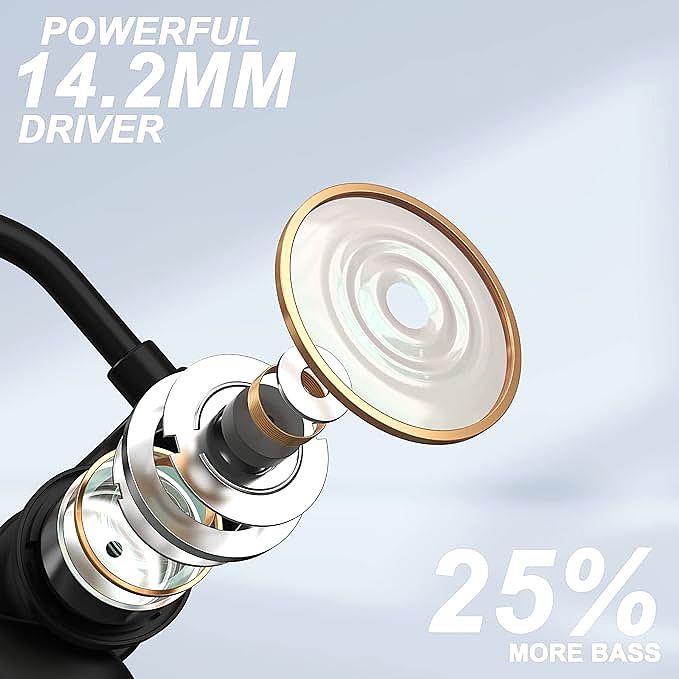
Memory foam tips use viscoelastic polyurethane that compresses when squeezed and slowly expands to fill the micro-gaps in the ear canal. This creates a superior acoustic seal providing 25 to 30 decibels of noise isolation. The material science behind foam tips involves acoustic impedance matching: the viscoelastic properties allow the foam to deform under body heat and fill microscopic gaps that silicone cannot reach. However, foam tips typically last only 2 to 3 months with daily use.
For active users, silicone generally outperforms foam because it maintains its shape when wet and provides more consistent friction during exercise. The JAYINE V8D includes two types of silicone ear tips, giving users the option to choose between a standard seal and a more aggressive fit for high-intensity activities.
Finding Earbuds That Stay In: An Engineer's shopping guide
Armed with an understanding of the physics and biology behind earbud retention, here is a practical framework for choosing earbuds that will stay in your ears during any activity.
Look for Dual-Anchor Design
Earbuds that combine an earhook with canal-sealing tips provide two independent retention mechanisms. If sweat defeats friction in the canal, the earhook maintains position. If jaw movement breaks the seal, the hook prevents the earbud from falling out entirely. Products with flexible, adjustable earhooks like the JAYINE V8D offer the most adaptable fit across different ear anatomies.
Prioritize Multiple Tip Sizes
Three sizes should be considered the minimum. The difference between a secure seal and a loose fit often comes down to a single millimeter of tip diameter. Try all included sizes systematically: start with the largest that fits comfortably and work down until you find the size that creates a seal without discomfort.
Consider Waterproof Rating for Active Use
An IP67 waterproof rating, which the JAYINE V8D carries, means the earbuds can withstand immersion in water up to 1 meter for 30 minutes. This is not just about surviving rain or accidental washing. The waterproof nano-coating also prevents sweat from degrading the internal components and the ear tip surface over time, maintaining friction performance throughout the product's life.
Evaluate Bluetooth Stability
Bluetooth 5.3, the version used in the JAYINE V8D, provides improved connection stability with fewer dropouts during movement. For active users, a stable wireless connection prevents the frustrating interruption of audio cutting in and out during exercise, which is a separate but equally annoying failure mode from physical dislodgment.
Battery Life Matters for Endurance Activities
If you run marathons, cycle centuries, or spend long days hiking, battery life directly affects your experience. The JAYINE V8D's 24-hour playtime means you can charge once and have reliable audio for an entire week of daily workouts.
The Future of Fit: Where Engineering Is Heading
The next frontier in earbud fit engineering is already emerging. MEMS (Micro-Electro-Mechanical Systems) technology enables microscopic acoustic vents that can open and close electronically, allowing a single earbud to switch between open-fit and closed-fit modes dynamically. This eliminates the fundamental trade-off between occlusion comfort and acoustic seal quality.
Finite Element Method (FEM) simulations, combining realistic 3D ear models with physics-based analysis, are already helping manufacturers like Bowers & Wilkins design earbuds that fit precisely across diverse ear anatomies before a single physical prototype is made. These simulations can identify comfort issues and optimize the contact pressure distribution across the ear surface, leading to designs that maintain secure retention with minimal discomfort.
Eartip fit measurement systems, using pressure sensors, acoustic leak detection, and fit scoring algorithms, are beginning to appear in premium earbuds. These systems can detect when the seal is imperfect and alert the user to try a different tip size, taking the guesswork out of achieving optimal acoustic performance.
These advances will eventually filter down to budget products, but the fundamental physics of retention remains the same. An earhook that mechanically anchors the earbud to the robust cartilage of the outer ear provides a retention advantage that no amount of tip engineering can fully replicate for active users.
The Bottom Line
The next time an earbud falls out during your workout, do not blame yourself. Blame the physics. Your ear canal is an S-shaped, variable-diameter funnel that changes shape when you move your jaw. Sweat is a lubricant that defeats friction. Running generates G-forces that shake everything loose. And most earbuds rely on friction alone to hold their position against all of these forces.
The engineering solution is elegantly simple: add a mechanical anchor. Earhooks distribute retention forces across a larger, more stable contact area, providing a backup mechanism that works even when friction fails. Combined with proper ear tip sizing and waterproof construction, this dual-anchor approach improves the earbud experience from constant readjustment to reliable, immersive listening.
Your ears were not designed for audio. But with the right engineering, they do not have to be. The JAYINE V8D and its flexible earhook design represent a practical application of these principles, delivering secure fit, acoustic seal quality, and durability at a price that makes the engineering accessible to everyone.
JAYINE V8D Wireless Headphones
Related Essays

JOYWISE Wireless Headphones: Immersive Sound, Uninterrupted Playtime

CioDat Q10 Open Ear Headphones: Stay Aware, Stay Safe, Stay Connected

Spmmmner Wireless Earbuds – A Seamless Listening Experience

ZTTW Blue Pods - Immersive Stereo and IPX7 Waterproof Bluetooth Earbuds

Masterplug Pods-12 Wireless Earbuds

Xmenha Over Ear Wrap Around Earbuds: Solid but Flawed

Renimer IT100 Bluetooth Earbuds 5.2 – A Comprehensive

XLEADER Sport3 Pro Sports Bluetooth Earbuds - Recommended for Active Lifestyles

Audiovance SPNT 301 - A Versatile Set of Wireless Headphones Bluetooth Earbuds

