When Inches Shrink: The Hidden Physics Behind Tiny Wireless Earbuds

SQRMINI X6 Mini Wireless Bluetooth Earbuds
Your wireless earbuds cut out when you slide your phone into a front pocket, not because of a defect, not because of poor manufacturing, but because you just walked into the laws of physics.
The same Bluetooth standard that delivers crisp sound in a pair of over-ear headphones sometimes falters inside a true wireless earbud no larger than a grain of rice. The difference is not firmware quality or chip selection. It is geometry.
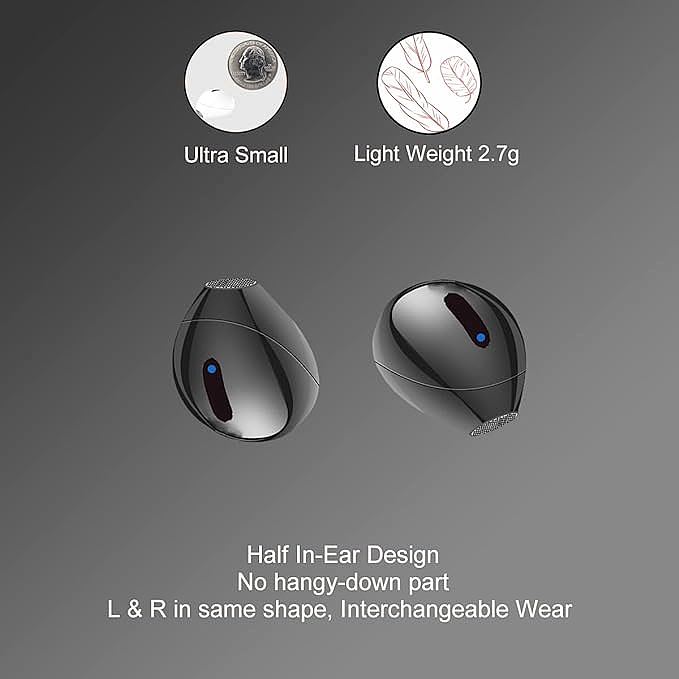
A compact earbud like the SQRMINI X6, measuring 1.3 centimeters and weighing just 2.7 grams, makes this tension visible. It sits at the edge of what miniaturization can achieve without asking the user to surrender something else. The question is not whether tiny earbuds can work. They do. The question is what physics demands as the price of their existence, and the answer involves electromagnetic theory, acoustic displacement equations, and the immutable laws of thermodynamics that govern every energy conversion in the device.
The Antenna Problem No One Talks About
Bluetooth operates at 2.4 gigahertz, and radio waves at that frequency have a wavelength of roughly 12.5 centimeters, which means an antenna works best when its dimensions are a meaningful fraction of that wavelength. A quarter-wave antenna for Bluetooth would be about 3 centimeters. An earbud that measures 1.3 centimeters across is simply too small to house one.
The result is a compromise embedded in the hardware itself, and manufacturers use printed circuit board antennas etched directly onto the earbud's internal circuit board to minimize space at the cost of bandwidth and radiation efficiency. These planar antennas sacrifice bandwidth and radiation efficiency in this space, but they occupy minimal space. The signal is weaker. The receiver must work harder to pull usable data from a noisier channel.
This weakness becomes obvious the moment your body enters the equation. Human tissue is approximately 60 percent water, and water absorbs electromagnetic energy at 2.4 gigahertz with notable efficiency. When your phone sits in your front pocket and the earbud sits in your ear, your torso forms a barrier between transmitter and receiver.
The phenomenon is called body blocking, and it is not a bug but the inevitable result of placing a compromised antenna behind a wall of water that absorbs electromagnetic energy with notable efficiency at 2.4 gigahertz.
Users report this exact behavior. Music stutters. Connections drop. The problem worsens when the phone is carried in a front pocket rather than held in hand or placed in a back pocket. The distance is roughly the same. The body blocking path is different. The difference is measurable and repeatable. It does not indicate poor quality. It indicates physics operating exactly as predicted.

How Small Drivers Meet the Bass Problem
Sound is mechanical. A driver converts electrical signals into physical vibrations that move air, and the air reaches your eardrum before your brain interprets that pressure change as sound.
Bass frequencies are long waves. A 50 hertz tone has a wavelength of nearly seven meters, which means producing audible bass requires moving enough air to create meaningful pressure variation. The volume of air a driver moves depends on two factors: the surface area of the diaphragm and the distance it travels, known as excursion.
An 8 millimeter driver used in a compact earbud has a surface area of approximately 50 square millimeters. A 40 millimeter driver found in many over-ear headphones has a surface area of roughly 1,250 square millimeters, creating a 25-fold difference in diaphragm area that directly translates to 25 times more air moved at the same excursion depth. Bass response drops accordingly. Not because the electronics are inferior. Not because the Bluetooth codec is wrong. Because 50 square millimeters cannot displace the volume of air required to produce sub-bass frequencies at audible levels.
The problem compounds with form factor. Half-in-ear designs that do not seal the ear canal lack the acoustic advantage of silicone tips. Silicone tips create an acoustic seal that traps bass pressure inside the canal. Without that seal, low-frequency energy escapes around the earbud before it can contribute to what you hear. The result is a sound signature that emphasizes clarity in the midrange and treble while accepting a thinner bass response as an unavoidable trade-off.
Material Science in Sub-Centimeter Form
The drivers inside ultra-compact earbuds use composite diaphragms that layer multiple polymers. The objective is to achieve stiffness where it matters for treble clarity and flexibility where it matters for midrange warmth. A single material cannot optimize both properties simultaneously. Layering different polymers at different points on the diaphragm creates a graded response that approaches the ideal without requiring any one material to be perfect.
A triple-layer composite architecture follows a consistent pattern found across manufacturers: a stiff central region that handles high-frequency vibration, a flexible outer ring that manages excursion, and an intermediate layer that dampens unwanted resonance. The result is a driver that performs reasonably well outside its optimal frequency range. It is a practical application of material grading, the same principle used in turbine blades and ballistic armor.
The microphone presents a similar engineering puzzle. Earbuds with no visible boom must capture voice clearly from a distance of approximately two centimeters. The solution is a MEMS microphone, a micro-electro-mechanical system etched onto silicon using fabrication techniques shared with semiconductor manufacturing.
A MEMS microphone contains a diaphragm measured in micrometers, and sound waves cause this diaphragm to vibrate, changing the capacitance between it and a fixed backplate before that capacitance change is converted into an audio signal by integrated circuitry packaged within the same chip. The technology compresses an entire transducer system onto a silicon die smaller than a fingernail. It is not a shortcut. It is a direct application of principles developed for aerospace and medical devices, scaled down for consumer electronics.
The Weight of Every Millimeter
Miniaturization follows a pattern that repeats across every product category. Each millimeter removed from a device requires a decision about what to sacrifice. Audio quality. Battery life. Durability. Repairability.
A compact earbud that prioritizes size and weight above all else radiates consequences through every other specification it offers. The 2.7 gram form factor becomes the defining characteristic around which everything else is optimized or sacrificed.
IPX5 waterproofing demonstrates that some constraints can be satisfied simultaneously. Waterproofing does not require additional volume if the sealing strategy is baked into the manufacturing process from the start. Gaskets, adhesives, and nano-coatings can be applied during assembly without adding bulk. An IPX5 certification on a device this small is not a miracle. It is evidence that the engineering team prioritized sealing from day one rather than retrofitting it as an afterthought.
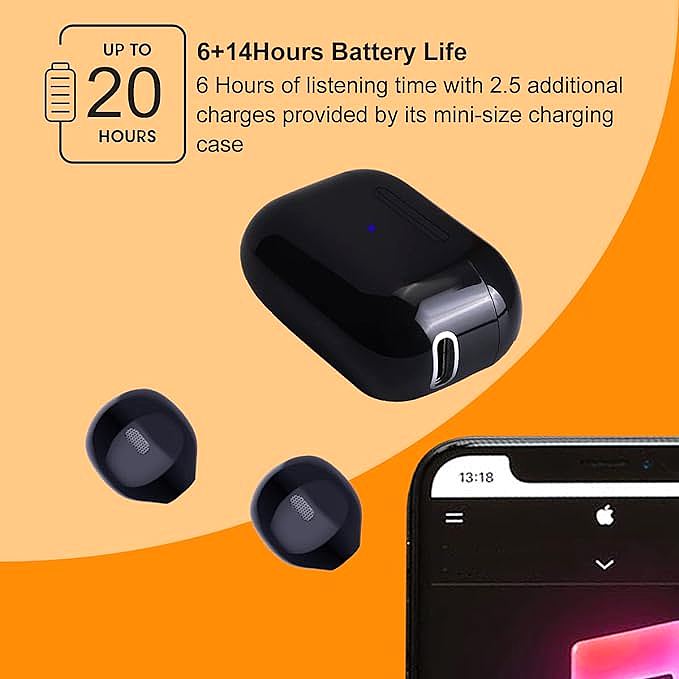
Battery life follows the geometry constraint with mathematical precision. A lithium-polymer cell small enough to fit inside a 1.3 centimeter earbud can store a limited amount of energy. The Bluetooth 5.0 chip operates with low energy consumption by design. The BLE protocol on Bluetooth 5.0 reduces power draw relative to earlier versions. The combination of an efficient radio and a small but adequate battery delivers approximately six hours of playback. That number is a direct product of the physics involved, not a marketing figure.
The Geometry of Compromise
Every wireless earbud represents a set of engineered compromises. Over-ear headphones deliver bass because they have volume. In-ear monitors with silicone tips isolate sound because they seal the canal. True wireless earbuds with large drivers connect reliably because they have space for proper antennas.
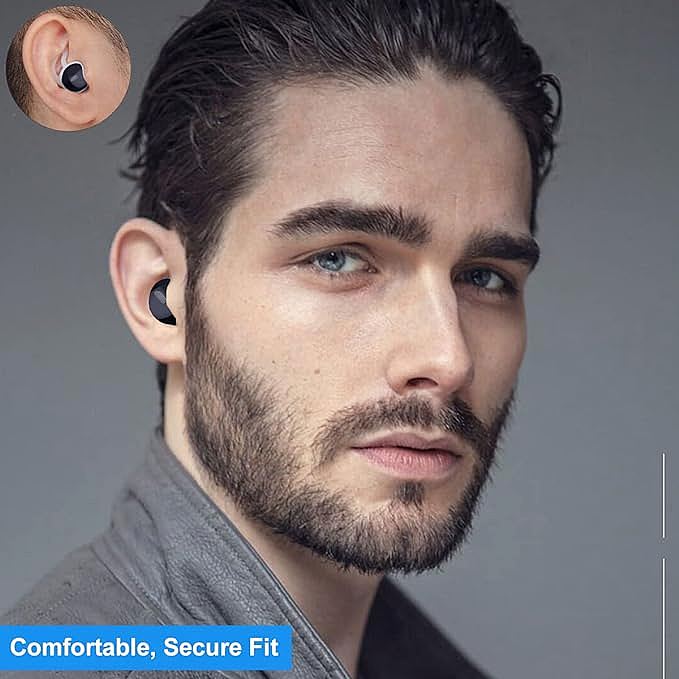
A device that shrinks to 1.3 centimeters chooses a different point on the trade-off surface. It accepts limited bass response in exchange for a form factor that sits nearly invisibly in the ear. It accepts occasional Bluetooth interruption when the body blocks the path in exchange for a device so light that extended wear causes no discomfort. It accepts a lower maximum volume than a sealed earbud in exchange for situational awareness.
None of these choices are wrong. They are all consequences of the same constraint: size matters. The physical universe does not negotiate. Antenna theory, acoustic displacement, and battery chemistry all follow equations that do not change based on product positioning or marketing strategy.
The most useful way to evaluate an ultra-compact earbud is not to ask whether it performs well on paper. It is to ask what the engineering team decided to prioritize and whether that priority matches the user's actual needs. Someone who values complete discretion and all-day comfort will find a compact design aligns with their priorities. Someone who demands deep bass in a portable form will find the same device underwhelming.
Neither person is wrong. The physics simply produces different outcomes depending on which variables are held constant and which are allowed to vary. Miniaturization is the act of choosing what to vary. The earbud that shrinks to 1.3 centimeters does not fail because bass suffers. It succeeds because size was the variable worth protecting.
The next time your wireless earbud cuts out because your phone is in your pocket, remember: you are not experiencing a malfunction. You are experiencing the 2.4 gigahertz spectrum interacting with human tissue inside a space too small for an ideal antenna. The device did not break. The physics held you to the terms it agreed to from the beginning.
SQRMINI X6 Mini Wireless Bluetooth Earbuds
Related Essays

Why Your Earbuds Sound the Way They Do: The Physics Inside a 10-Millimeter Driver

The Physics of Cheap Sound: How Budget Audio Gear Punches Above Its Weight
