The Ultrasonic Edge: Why Hi-Res Audio Matters Beyond Human Hearing
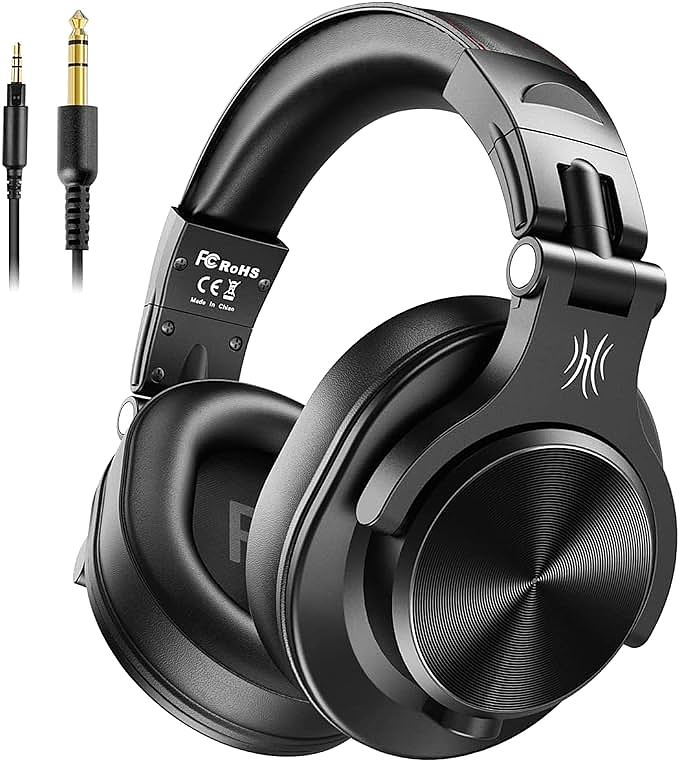
OneOdio A71 Hi-Res Studio Recording Wired Headphones
Human hearing is finite. Biology dictates that the average adult cannot perceive frequencies above 20,000 Hertz (20kHz). Yet, in the world of high-fidelity audio, the gold standard is Hi-Res Audio—a certification that requires equipment to reproduce sounds up to 40kHz or higher.
Why build a machine to play sounds we cannot hear? Is it marketing snake oil, or is there valid science behind the ultrasonic curtain? The answer lies in the complex domain of psychoacoustics and the mathematics of wave theory. Devices like the OneOdio A71 Hi-Res Studio Headphones bring this capability to the masses, inviting us to explore the subtle, "invisible" layer of sound that defines realism.

The Physics of the "Square Wave"
To understand why 40kHz matters, we must look at how sound waves are constructed. A pure sine wave at 20kHz is indeed inaudible to most. However, music is rarely made of pure sine waves. It is made of complex waveforms—the sharp attack of a snare drum, the pluck of a guitar string, the square wave of a synthesizer.
According to Fourier Theory, any complex wave can be constructed by adding together a series of sine waves at different frequencies (harmonics). * The Fundamental: The pitch we hear (e.g., A4 at 440Hz). * The Harmonics: Multiples of that frequency (880Hz, 1320Hz, etc.) that give the sound its character.
Crucially, to create a sharp "edge" or transient—like the instant a stick hits a drum—you need high-frequency harmonics that extend far beyond the fundamental. If you cut off the frequency response at 20kHz, you round off these edges. The sound loses its snap. It becomes "smeared" in time.
By extending the frequency response to 40kHz, headphones like the A71 can reproduce these ultrasonic harmonics. While we don't hear them as tones, our brain perceives their effect on the lower frequencies. The result is a tighter, faster transient response. The drum sounds like a drum, not a thud.

The "Air" and Spatial Cues
Another phenomenon associated with ultrasonic frequencies is the perception of "air" or "space." In a concert hall, high-frequency reflections off walls and ceilings carry information about the size of the room. These micro-cues are often encoded in the upper registers.
When a playback system truncates these frequencies, the soundstage can collapse. It feels closed-in. Hi-Res Audio aims to preserve this spatial information. By maintaining linearity well into the ultrasonic range, the phase relationships of the lower audible frequencies are preserved. This leads to better imaging—the ability to pinpoint exactly where an instrument is located in the stereo field.
The Neodymium Engine
Achieving this bandwidth requires a specific type of driver. A standard heavy diaphragm cannot vibrate 40,000 times a second without distorting. It has too much inertia.
The OneOdio A71 utilizes 40mm dynamic drivers with neodymium magnets. Neodymium is a rare-earth material that creates a powerful magnetic field in a compact size. This allows for a lighter voice coil, which in turn reduces the moving mass of the diaphragm. * Low Mass: A lighter diaphragm can accelerate and decelerate faster. This is essential for tracking high-frequency waveforms. * High Control: The strong magnetic flux holds the voice coil in a vice-like grip, preventing unwanted wobbling (distortion) at high speeds.
This combination of lightweight materials and powerful magnetics is what allows a reasonably priced headphone to reach the technical benchmarks of Hi-Res Audio.

Conclusion: Hearing the Whole Picture
Hi-Res Audio is not about hearing dog whistles. It is about hearing the completeness of the music. It is about preserving the timing, the texture, and the space that the artist created.
When we listen through devices capable of ultrasonic reproduction, we are not just listening to frequencies; we are listening to better engineering. The requirement to reach 40kHz forces manufacturers to build faster, lighter, and more precise drivers. And that precision benefits every note, from the deepest bass to the highest shimmer. The OneOdio A71 serves as a testament that this level of fidelity is no longer an elitist pursuit, but a standard accessible to anyone with ears to hear.
OneOdio A71 Hi-Res Studio Recording Wired Headphones
Related Essays
