The Air Tube Solution: A Scientific Look at EMF Concerns and the Engineering of Safer Headphones


ibrain Air Tube Headphones
In our increasingly wireless world, we are surrounded by a constant, invisible hum of technology. Our headphones, once simple analog devices, are now sophisticated electronics pressed against or placed inside our ears for hours each day. This intimate proximity has given rise to a growing conversation around a complex topic: electromagnetic fields (EMF) and personal health.
While major health organizations like the WHO maintain that exposure from these devices falls within safe limits, a segment of consumers operates on a "precautionary principle," seeking ways to minimize exposure wherever possible. This has created a fascinating niche in the audio market for innovative designs that directly address these concerns. One of the most compelling is Air Tube technology. To understand its value and its inherent compromises, we must objectively deconstruct the science behind it, using a dedicated product like the ibrain Air Tube Headphones as our engineering model.
The Core Principle: Relocating the Source
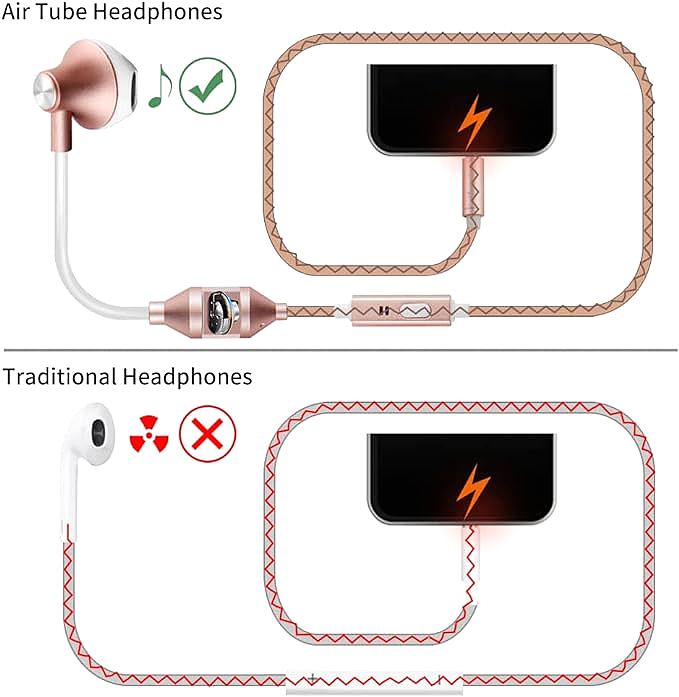
The fundamental premise of air tube technology is elegantly simple and rooted in basic physics. A conventional earbud houses a tiny speaker, or driver, directly in the earpiece. This driver, which contains a magnet and a voice coil, is the component that generates a small electromagnetic field as it converts electrical signals into sound.
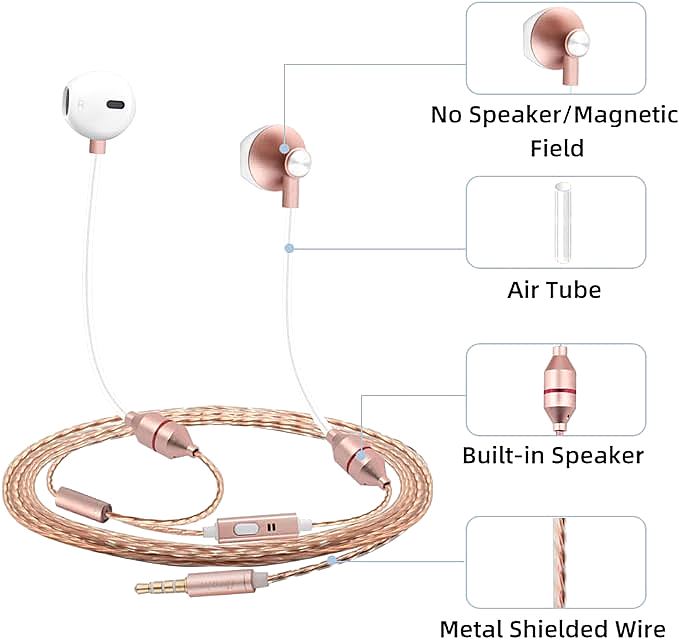
Air tube headphones completely re-architect this design. They relocate the drivers away from the head, moving them much further down the cable. The sound generated by these drivers is then channeled to the ears through a pair of hollow, non-metallic tubes.
The scientific principle at play is the inverse-square law. This law states that the intensity of a field radiating from a point source is inversely proportional to the square of the distance from that source. In simpler terms, doubling the distance from an EMF source reduces the exposure to just one-quarter of its original intensity. By moving the drivers several inches away from the sensitive tissues of the ear and brain, this design dramatically reduces the EMF exposure at the head. The earpiece itself, now containing only a passive acoustic port, is essentially electronically inert.
The Acoustic Pathway: Sound on Air
Transmitting sound through a hollow tube is a concept as old as the stethoscope. The air inside the tube acts as the medium, carrying the pressure waves (sound) from the driver to the ear canal. The challenge for engineers is to do this without significantly degrading the audio quality.
The length, diameter, and material of the air tube create an acoustic system with its own resonant properties. A poorly designed tube can muffle high frequencies or introduce unwanted coloration to the sound. Manufacturers like ibrain, which claim over two decades of specialization in this technology, aim to mitigate these effects through careful engineering of the tube's dimensions and the acoustic design of the earpiece. They assert that their "advanced stereo speakers offer high fidelity acoustic sound," though this brings us to the technology's primary trade-off.
Engineering Trade-Off #1: Audio Fidelity
While the concept is brilliant for EMF reduction, transmitting sound through a column of air is inherently less precise than transmitting an electrical signal down a copper wire directly to a driver in the ear. The air tube itself can act as an acoustic filter, and some loss of high-frequency detail and transient speed is a potential physical limitation of the design. This is reflected in some user feedback, where sound is described as "muffled." For a user whose primary concern is precautionary health, this may be an acceptable compromise. For a discerning audiophile, it might not be. It is a classic engineering trade-off: signal purity at the source vs. proximity of the driver to the ear.

Engineering Trade-Off #2: Structural Durability
The second major challenge is mechanical. The connection points where the soft, flexible air tubes join the rigid earpiece and the driver housing are potential points of failure. User reviews for this category of product frequently highlight durability issues, with reports of tubes detaching or earpieces separating.
This represents a significant engineering hurdle. The materials must be lightweight and flexible for comfort, yet robust enough to withstand the pulling, twisting, and snagging of daily use. While features like a metal-shielded wire for the lower portion of the cable can enhance durability there, the unique vulnerability lies in the acoustic tube junctions. For consumers, this means that while the EMF-reduction concept is sound, the physical longevity of the product may require more careful handling than a conventional, robustly constructed wired earbud.
The Supporting Case: Why It Still Appeals
Despite these trade-offs, the appeal of air tube technology is undeniable for a specific user. The lightweight and ergonomic design, free from the mass of magnets and coils in the earpiece, can offer exceptional long-term comfort. For individuals who wear headphones for many hours a day for work calls or media consumption, this can be a significant benefit.
Furthermore, the wired connection provides absolute reliability. There are no batteries to charge, no Bluetooth pairing issues, and no latency, making them a simple and dependable tool. A single in-line button for call and media control provides basic, foolproof functionality.

Conclusion: An Informed Choice for the Mindful Listener
Air tube headphones represent a fascinating and thoughtful niche in the vast audio market. They are not designed to compete with high-fidelity audiophile IEMs on pure sound quality, nor with mainstream wireless buds on convenience. Instead, they offer a unique value proposition centered on the precautionary principle.
For the user whose primary goal is to minimize EMF exposure at the head, the science behind driver relocation is sound and offers a demonstrable physical separation. Devices like the ibrain Air Tube Headphones are a direct manifestation of this design philosophy. However, this benefit comes with clear and important engineering trade-offs in potential audio fidelity and structural durability.
Understanding this balance is the key to making an informed decision. If you are a health-conscious individual who prioritizes minimizing EMF exposure and values the absolute reliability of a wired connection for calls and daily listening, the trade-offs may be entirely worthwhile. It is a specialized tool for a specific, and growing, mindset—a reminder that in technology, there is rarely a single "best" solution, only the best solution for an individual's unique set of priorities.
ibrain Air Tube Headphones
Related Essays

Bluetooth 4.1 in the Modern Era: Deconstructing the RLX Wireless Headphone Architecture

Soundcore P20i True Wireless Earbuds: Super Long Battery with HiFi Sound for Budget Buyers

ibrain FC12 Air Tube Headphones: A Healthier Listening Experience

ibrain Air Tube Headphones: Exploring Air-Conducting Earbuds for a Different Listening Experience

ibrain FL02 Air Tube Headphones: Safe Listening in a Wireless World

Planar Magnetic Drivers in In-Ear Monitors: Engineering Constraints and Performance Variability

SoundPEATS TrueFree2 Wireless Earbuds: The Budget Kings of True Wireless

Navigating the Intersection of Biomechanics and RF Propagation

The Science of Vocal Alchemy: How Digital Pitch Correction Transformed Home K...

