Ergonomics of Endurance: The Critical Role of Weight and Simplicity in Institutional Audio
Update on Jan. 30, 2026, 9:36 a.m.
In the evaluation of audio equipment, the conversation often begins and ends with sound quality. However, for devices intended for extended use—whether in educational institutions, libraries, or prolonged work sessions—the primary metric of success shifts from acoustic fidelity to ergonomic endurance. A headphone that sounds pristine but induces cervical strain or “hot spots” on the cranial ridge within thirty minutes is functionally useless for a three-hour lecture or a workday.
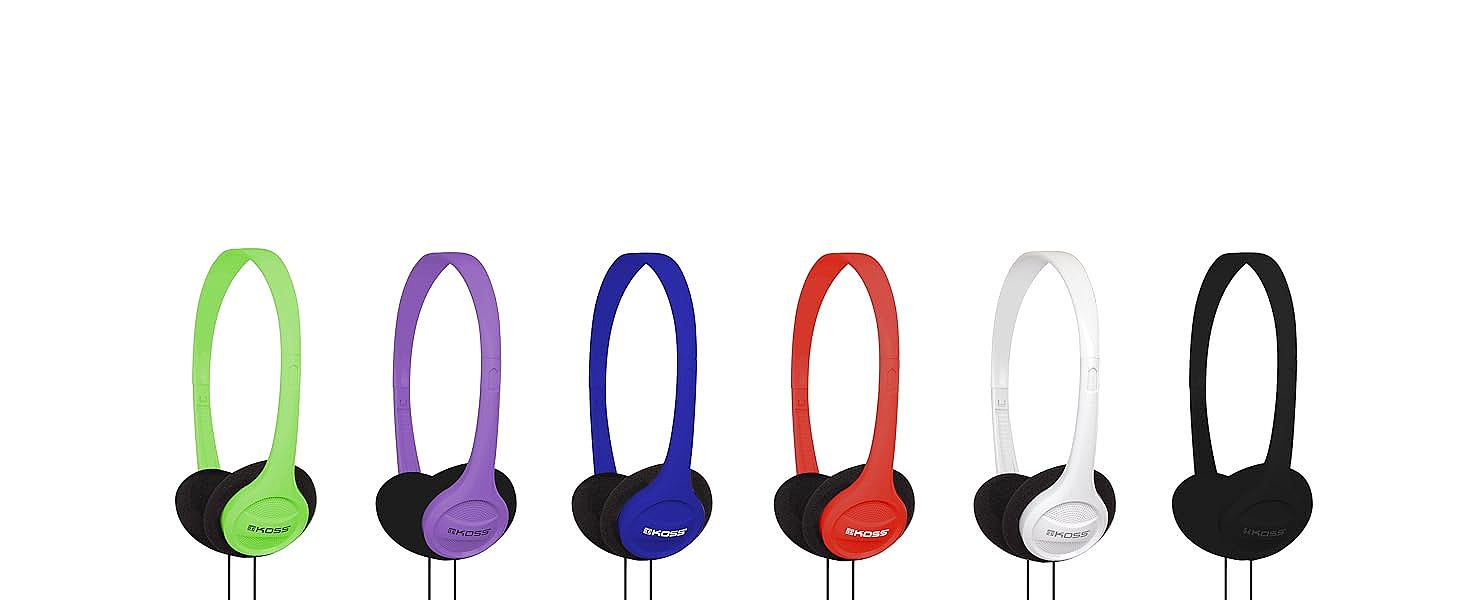
The engineering challenge, therefore, is to minimize the physical footprint of the device while maintaining structural integrity. This balance is particularly evident in the “featherweight” class of supra-aural headphones. By analyzing the structural choices in devices like the Koss KPH7, we can understand how mass reduction and simplified mechanics contribute to long-term usability and deployment reliability.

The Physics of Wearable Mass
The human neck musculature is constantly working to stabilize the head, which weighs approximately 10-11 pounds. Adding a heavy peripheral creates a cantilever effect, increasing the moment arm and the torque applied to the cervical spine. While premium over-ear headphones often weigh between 300g and 500g, ultra-lightweight designs target a different specification.
The Koss KPH7 registers a mass of approximately 0.15 pounds (68 grams). From a biomechanical perspective, this weight is negligible. It sits below the threshold of sensory distraction for most users. This reduction is achieved through the exclusive use of thermoplastic polymers for the headband and chassis. Unlike metal or heavy composite structures, these polymers provide sufficient tensile strength to hold the shape without adding unnecessary grams.
The distribution of this mass is equally critical. In heavy headphones, a padded headband is required to distribute the vertical load. In an ultra-lightweight design, the vertical load is so low that the headband serves primarily as a tensioning spring rather than a load-bearing arch. This eliminates the need for thick padding, further reducing weight and heat retention across the top of the scalp.
Clamping Force and the Supra-Aural Interface
“Clamping force” refers to the lateral pressure exerted by the ear cups against the head to keep the headphones in place. Too little, and the device slides off; too much, and it causes headaches and jaw pain.
Supra-aural (on-ear) headphones present a specific challenge because they rest directly on the pinna (outer ear) rather than encircling it. To prevent cartilage fatigue, the clamping force must be carefully calibrated. The design utilizes the flexibility of the polymer headband itself to act as the spring. This creates a linear force curve that accommodates a wide range of head widths without requiring complex hinges or tension adjustment mechanisms. The foam cushions serve as the compliance layer, compressing to conform to the irregular surface of the ear and distributing the lateral force over a wider surface area to minimize pressure points.
The Reliability of the Analog Connection
In institutional and educational environments, equipment failure is a logistical nightmare. Wireless headphones introduce multiple points of failure: battery degradation, Bluetooth pairing issues, and firmware glitches. The reliance on a simple, wired connection offers a significant advantage in these contexts.
The 3.5mm TRS (Tip-Ring-Sleeve) connector is a purely analog interface. It requires no handshakes, no software drivers, and no charging infrastructure. The signal transmission is immediate and robust. * No Battery Anxiety: A passive wired headphone like the KPH7 has an indefinite shelf life. It is always ready to deploy, regardless of how long it has sat in a storage drawer. * Universal Compatibility: The 3.5mm standard remains ubiquitous in legacy hardware, desktop computers, and audio labs, ensuring backward compatibility that USB-C or Bluetooth cannot guarantee.
Deployment and Longevity
The minimalist construction also aids in durability through the reduction of moving parts. Complex folding mechanisms, swivels, and volume control circuits are often the first components to break under mechanical stress. By eliminating these features, the structural weak points are removed. The result is a utilitarian tool designed for functionality. In scenarios where audio is a utility—such as language labs, standardized testing, or transcription work—the combination of negligible weight and analog simplicity provides a user experience that prioritizes focus and endurance over features and flair.