Sculpting Acoustic Waves: Aerodynamics and Electromagnetism in Modern Transducers
Update on March 7, 2026, 8:56 a.m.
The reproduction of high-fidelity audio is fundamentally a battle against the laws of physics. To recreate the complex harmonic structure of a symphony orchestra or the aggressive transient attack of a synthesized bassline, an electroacoustic device must manipulate the atmospheric pressure of the air with absolute precision. For over a century, the engineering focus has remained on moving a physical mass to compress and decompress this air. However, as measurement equipment became more sophisticated, the acoustic anomalies introduced by the very components generating the sound became impossible to ignore.
The pursuit of zero-distortion audio playback has forced modern engineers to look beyond traditional speaker mechanics, heavily borrowing principles from material science, fluid dynamics, and electromagnetism. By deconstructing the physical behaviors of moving membranes and the aerodynamic obstacles placed in their path, we can understand how modern acoustic architecture seeks to trick the human brain into perceiving a live acoustic event.
Why Do Traditional Cones Deform Under Pressure?
To appreciate the necessity of advanced acoustic structures, one must first understand the mechanical failure modes of the industry’s default standard: the dynamic driver. The vast majority of audio equipment relies on this electrodynamic principle, which utilizes a central voice coil immersed in a permanent magnetic field. When an alternating electrical current representing the audio signal passes through the coil, it generates an oscillating electromagnetic field. This field reacts against the stationary magnet, violently pushing and pulling the coil.
Because this voice coil is glued directly to the center of a conical diaphragm (often made of paper, plastic, or treated fabric), the cone is forced to move, displacing the surrounding air. In a theoretical environment, this conical surface would act as a perfect, infinitely rigid piston. It would move uniformly, pushing a flat wall of air toward the listener’s ear.
However, in the physical realm, no material is infinitely rigid. When the central voice coil initiates a rapid movement—such as the sharp attack of a snare drum—the force is applied exclusively at the apex of the cone. This kinetic energy must physically travel outward through the material of the diaphragm to reach the outer edges. Because this mechanical propagation takes a fraction of a millisecond, the outer perimeter of the cone always lags slightly behind the center.
This temporal delay creates a severe failure mode known as “modal breakup” or “cone breakup.” As the frequency of the audio signal increases, the diaphragm is asked to reverse direction thousands of times per second. The center of the cone may begin pulling backward while the outer edges are still rippling forward from the previous impulse. The surface of the cone essentially begins to act like a disturbed pool of water, with different zones vibrating entirely out of phase with one another.
When these out-of-phase zones push air, the resulting pressure waves collide, causing localized constructive and destructive interference. To the human ear, this modal breakup manifests as harsh, ringing distortion, particularly in the upper midrange and treble frequencies. The audio loses its pristine clarity, obscured by the mechanical ringing of a material pushed beyond its structural limits. Resolving this physical bottleneck required an entirely different approach to force distribution.
From Heavy Coils to Suspended Membranes
The historical response to the limitations of conical dynamic drivers was the development of planar magnetic (or orthodynamic) technology. The fundamental premise was to abandon the localized central force of the voice coil entirely. Instead of pushing a cone from a single point, the engineering goal shifted toward distributing the electromagnetic force evenly across the entire surface of the air-moving medium.
Early experiments in the 1970s laid the groundwork. Engineers took a thin, flat sheet of flexible plastic film and bonded a labyrinthine pattern of highly conductive metal foil (usually aluminum or copper) directly onto its surface. This continuous, flat trace effectively became the voice coil, but instead of being a tightly wound cylinder, it was unrolled and spread across a two-dimensional plane.
This conductive membrane was then suspended tightly between two parallel arrays of permanent bar magnets. The stators (the static magnetic structures) were carefully aligned so that the magnetic flux lines intersected the conductive traces on the membrane at precise, right angles.
When the amplifier’s electrical current passed through the flat traces, the entire surface of the membrane experienced an electromagnetic push simultaneously. Because the driving force was distributed across the entire area of the film rather than centralized, the problem of modal breakup was virtually eliminated. The entire membrane moved forward and backward as a single, cohesive unit. This distributed force architecture allowed for drastically lower distortion metrics, marking a pivotal shift in transducer design.
The Dragonfly Wing in a Magnetic Storm
If distributing the electromagnetic force solved the structural deformation problem, the next frontier was maximizing the speed of the transducer. In acoustics, speed is measured by “transient response”—the ability of a moving mass to accelerate from a resting state to maximum velocity instantaneously, and subsequently brake to an absolute stop the moment the electrical signal ceases.
The Physics of Inertia
Transient response is strictly governed by Newton’s First Law of Motion. An object at rest stays at rest, and an object in motion stays in motion, unless acted upon by an external force. The resistance to this change in motion is dictated by the object’s mass. A heavy, traditional dynamic voice coil and paper cone possess significant inertia. When asked to reproduce a sudden, sharp sound—like the snap of a castanet or the pluck of a guitar string—the heavy driver struggles to start moving quickly enough, blunting the leading edge of the sound. Worse, once moving, its momentum prevents it from stopping immediately, resulting in a “smearing” or “overhang” of acoustic energy that masks subtle background details.
To achieve perfect transient response, the moving mass of the transducer must be reduced to an absolute minimum. In advanced planar magnetic architectures, this is achieved through extreme material science. The base film of the diaphragm is manufactured from specialized polymers stretched to microscopic tolerances.
In devices pushing the boundaries of this technology, the diaphragm thickness is measured not in millimeters or microns, but in nanometers. A nanometer-thickness diaphragm is so unfathomably thin that it possesses a lower mass than the volume of air it is tasked with displacing. It behaves more like a localized atmospheric boundary layer than a physical object.
Uniform Phase Delivery
Driving this nearly weightless membrane requires massive electromagnetic force. The interaction is defined by the Lorentz force equation:
$$ \mathbf{F} = I \int (d\mathbf{l} \times \mathbf{B}) $$
Where $\mathbf{F}$ is the magnetic force, $I$ is the current flowing through the conductive traces, $d\mathbf{l}$ is the length of the conductor, and $\mathbf{B}$ is the magnetic field generated by the stators.
Because the nanometer diaphragm has virtually zero inertia, the moment the current ($I$) spikes, the Lorentz force accelerates the film instantly. The moment the current drops, the film stops. There is no mechanical overshoot. The resulting acoustic wave is delivered to the ear with perfect phase coherence. Every frequency arrives exactly when the mastering engineer intended, revealing a microscopic level of detail—the intake of a vocalist’s breath, the shuffling of sheet music in an orchestra pit, the precise decay of a reverb tail—that is completely lost in the inertial smearing of heavier drivers.
When Generating Power Destroys the Output
Despite the theoretical perfection of a massless diaphragm driven by uniform force, a brutal paradox haunted planar magnetic designs for decades. The intense magnetic field ($\mathbf{B}$) required to execute the Lorentz force necessitates the use of large, powerful permanent magnets. In a traditional planar array, these magnets are thick, rectangular bars of ferrite or neodymium arranged in parallel rows.
The paradox lies in their physical placement. To maximize the magnetic flux density acting upon the diaphragm, these bar magnets must be positioned millimeters away from the moving film. However, this means that the magnets sit directly between the diaphragm and the listener’s ear.
When the diaphragm moves, it generates a perfectly flat, pristine plane wave of sound. Almost immediately, this wave crashes directly into the array of rectangular magnets. Here, the laws of fluid dynamics and wave mechanics take over. According to the Huygens-Fresnel principle, every point on a wavefront acts as a source of secondary spherical wavelets.
When the flat acoustic wave hits the sharp, 90-degree edges of the rectangular bar magnets, the wave fractures. It is forced to squeeze through the narrow gaps between the magnets, resulting in extreme acoustic diffraction. The sound waves bend, scatter, and reflect off the hard, flat surfaces of the stators.
These reflected waves bounce back toward the diaphragm, colliding with the forward-moving waves. This creates severe turbulence and phase cancellation within the microscopic acoustic chamber. The original, pristine signal is butchered before it ever leaves the headphone enclosure. This diffraction acts as a high-frequency comb filter, introducing artificial peaks and dips in the treble response and destroying the brain’s ability to accurately locate sounds in three-dimensional space. The very components generating the acoustic power were simultaneously destroying the acoustic fidelity.

Sculpting the Stator for Acoustic Transparency
Resolving the diffraction paradox required abandoning traditional magnetic geometries and borrowing principles from aeronautical engineering. If a blunt, rectangular object creates massive turbulence when passing through a fluid medium, the solution is to alter its aerodynamic profile.
Air, in the context of acoustic wave propagation, behaves as a compressible fluid. To allow the sound wave to pass through the magnetic stator array without fracturing, the magnets themselves had to be reshaped to minimize their acoustic cross-section.
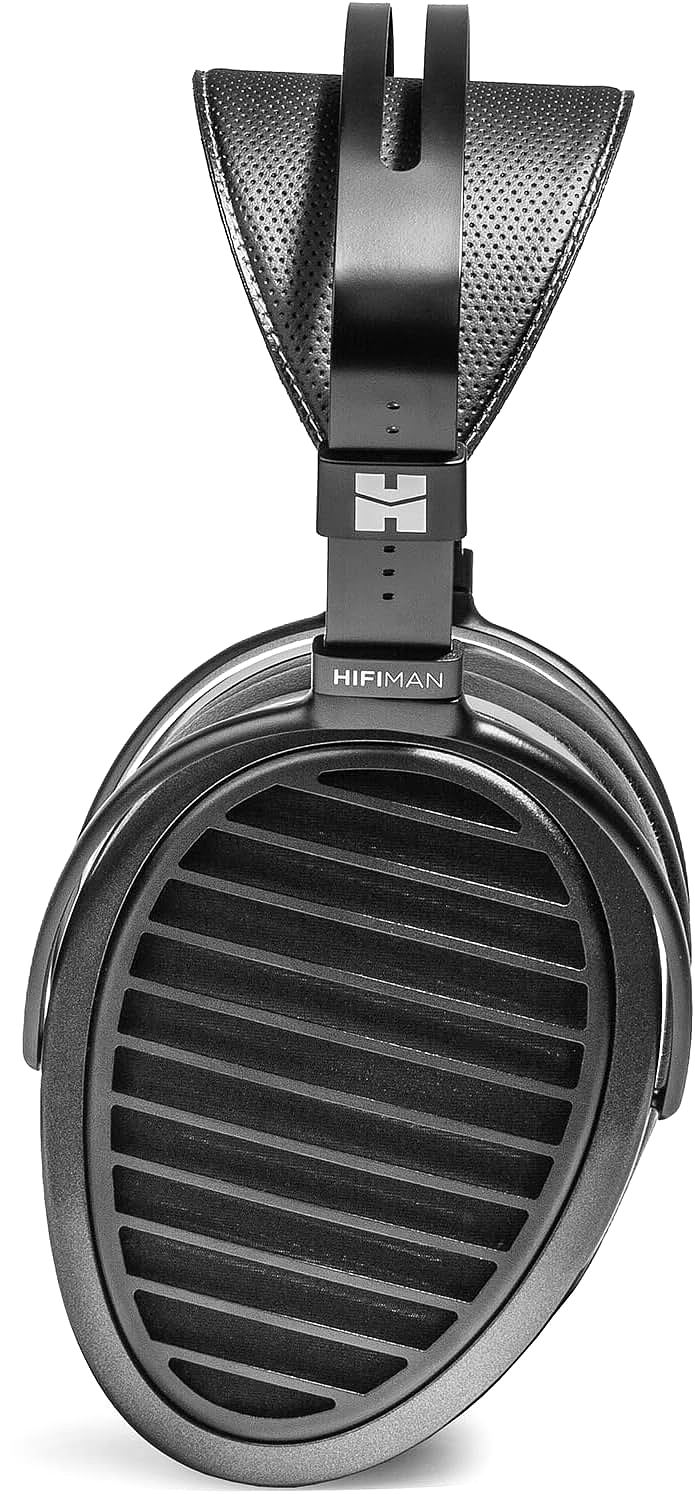
This engineering approach is heavily utilized in high-end implementations, acting as a defining characteristic of advanced hardware. A prime example is the HIFIMAN Arya Stealth Magnet Version. Rather than utilizing block magnets, the device employs highly customized stators with a rounded, teardrop-like cross-section.
When the flat acoustic wave generated by the nanometer diaphragm encounters these “Stealth Magnets,” it does not hit a flat wall. Instead, the wave smoothly glides over the curved leading edge of the magnet and re-converges seamlessly on the trailing edge. Because the aerodynamic shape prevents the wave from shearing, it virtually eliminates the secondary reflections and comb filtering associated with traditional stators.
By rendering the magnet array “acoustically invisible,” the hardware achieves a dual victory. It maintains the massive magnetic flux required to grip the low-mass diaphragm with iron-fisted control, yet it allows the resulting acoustic energy to flow outward unimpeded. This acoustic transparency is verifiable in the hardware’s technical specifications, yielding an exceptionally wide frequency response of 8Hz to 65kHz and a highly stable 32Ω impedance. The reduction in wave diffraction turbulence preserves the integrity of the high-frequency harmonics, resulting in a soundstage that feels vast, holographic, and completely untethered from the physical drivers.
Boundless Soundstage vs. Environmental Isolation
Once the sound wave successfully navigates the magnet array, it must be managed within the larger enclosure of the headphone chassis. At this juncture, engineers face a critical tradeoff: acoustic isolation versus acoustic purity.
In a closed-back headphone design, the rear of the transducer is sealed by a solid cup of plastic, wood, or metal. This is excellent for isolating the listener from environmental noise—perfect for a loud subway commute or a noisy recording studio where microphone bleed is a concern. However, closing the back of the cup traps all the rearward-firing acoustic energy.
When the diaphragm pushes outward toward the ear, it simultaneously pulls backward, generating an inverted sound wave that fires into the rear of the cup. In a closed design, this massive acoustic energy strikes the hard internal wall and reflects directly back onto the delicate diaphragm. This reflected energy creates standing waves, structural resonances, and severe timing errors that muddy the lower midrange and create a claustrophobic, “cuppy” sonic presentation.
To achieve maximum acoustic purity, advanced planar magnetic architectures almost universally employ an open-back design. Devices engineered strictly for critical listening completely expose the rear of the driver to the outside air.
This requires sophisticated mechanical baffling to protect the fragile nanometer film while remaining acoustically inert. Systems like the patented “Window Shade” grill utilized on specific high-end models address this by providing a rigid metallic scaffold that shields the internal components without presenting a flat surface for sound to reflect against.
By allowing the rear-firing acoustic wave to dissipate harmlessly into the room, the diaphragm operates without any pneumatic resistance or reflected back-pressure. The acoustic impedance is perfectly matched to the surrounding atmosphere. The tradeoff is absolute: the listener hears everything happening in the room, and everyone in the room hears the music. However, this lack of boundary is exactly what allows the brain to perceive the audio as existing in an open, limitless space, rather than being trapped inside a tiny plastic chamber pressed against the skull.

Recreating a Symphony Hall in a 400-Gram Frame
The final stage of acoustic delivery relies entirely on human anatomy. The pinna—the outer, visible part of the human ear—is an intricate biological antenna designed to filter and funnel sound waves into the ear canal. The specific ridges and folds of the pinna act as a complex equalizer, altering the frequency response based on the angle and origin of the sound. This biological filtering is known as the Head-Related Transfer Function (HRTF), and it is the sole reason humans can determine whether a sound is coming from above, below, or behind them.
When a headphone driver is perfectly flat and pressed parallel against the side of the head, it bypasses much of the pinna’s natural filtering. The sound is injected directly into the ear canal in an unnatural manner, leading to the “in-the-head” localization that plagues many traditional headphones.
To trick the brain into perceiving a live acoustic event, the hardware must physically interact with the ear in a manner mimicking a loudspeaker placed in a room. This is achieved through asymmetric ear cup design. By shaping the physical enclosure to follow the natural, oblong contour of the human ear, and critically, by slightly angling the massive planar drivers forward, the sound wave strikes the pinna at a natural angle of incidence.
The sound hits the outer folds of the ear before entering the canal, engaging the listener’s HRTF. This subtle geometric manipulation—housing a 400-gram array of metal, plastic, and nanometer film—forces the brain to decode the spatial cues naturally. The instruments cease to exist as isolated points of data injected into the skull; they materialize as physical entities occupying a defined acoustic volume in the room.
As material science pushes further into the sub-micron realm, and fluid dynamic modeling allows for even greater aerodynamic optimization of internal chassis components, the boundary between the recording and reality will continue to blur. The modern planar magnetic transducer stands not merely as an electronic accessory, but as a highly refined scientific instrument dedicated to the exact manipulation of electromagnetic forces, proving that the most profound emotional connections to music are often born from the most rigid adherence to the laws of physics.