The Interface of Anxiety: Why Digital Displays Matter in TWS


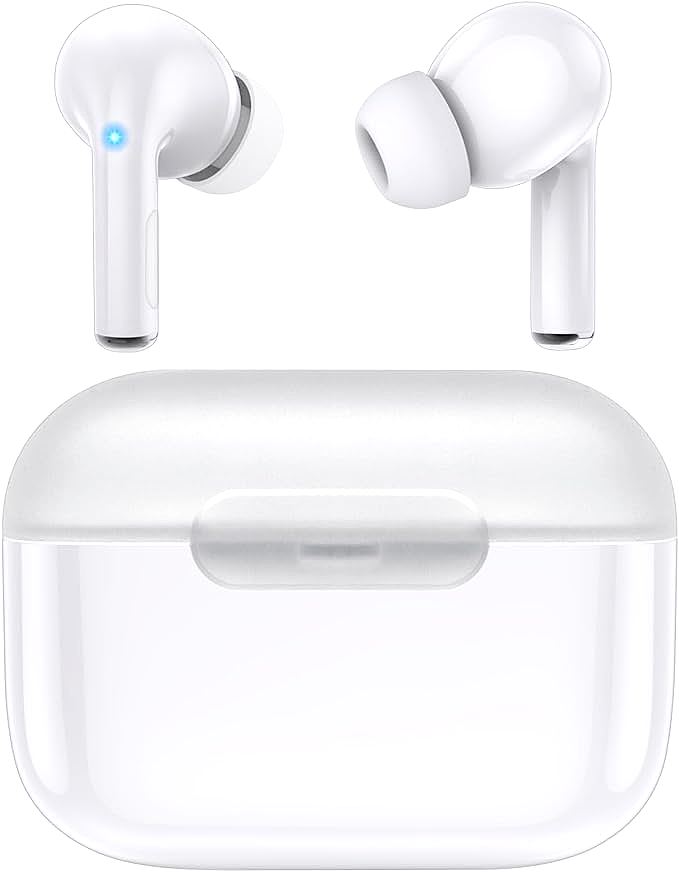
XIAOWTEK 03 Wireless Earbuds
In the psychology of modern technology, few things trigger as much subtle stress as a blinking red light. It is an ambiguous warning, a signal of impending failure without a timeline. For users of True Wireless Stereo (TWS) earbuds, the "dead battery surprise" is a common frustration. You open the case, expecting music, and find silence.
The XIAOWTEK 03 Wireless Earbuds address this cognitive friction with a feature that is surprisingly rare even in premium models: a Smart LED Digital Display. By quantifying energy, it transforms anxiety into management. Coupled with 43 hours of playtime and Bluetooth 5.3, this device represents a shift towards "transparent technology"—gadgets that communicate their status clearly. This article explores the psychology of user interfaces, the chemistry of long-life batteries, and the connectivity protocols that bind them.
The Psychology of the Digital Display
Why is a number better than a light? This question touches on Human-Computer Interaction (HCI) principles. * Ambiguity vs. Certainty: A standard LED indicator usually has three states: Green (>80%), Orange (20-80%), Red (<20%). The "Orange" zone is a vast abyss of uncertainty. Does it have enough charge for a 2-hour run, or will it die in 10 minutes? * Cognitive Load: The XIAOWTEK's display shows the exact percentage (e.g., "87%"). This removes the cognitive load of estimation. The user knows exactly how much fuel is in the tank. This transparency empowers the user to make informed decisions—to charge now or wait another day. It turns the charging case from a "black box" into a precision instrument.
The Real-Time Fuel Gauge
The display creates a feedback loop. By seeing the percentage drop after a charge cycle, the user gains an intuitive understanding of their usage patterns and the device's efficiency. It visualizes the invisible flow of electrons, making the energy economy of the device tangible.
The Energy Architecture: 43 Hours of Freedom
The claim of 43 hours of total playtime is significant. It places the XIAOWTEK 03 in the upper echelon of endurance, competing with devices ten times its price. How is this achieved in a budget footprint?
Lithium Energy Density
The earbuds provide 7 hours on a single charge. This suggests a highly efficient internal architecture. * Battery Chemistry: The cells are likely Lithium-Ion Polymer, chosen for their ability to be molded into the specific shape of the earbud housing to maximize volume utilization. * The Charging Case: The case acts as a reservoir. To provide ~5-6 additional full charges (reaching 43 hours total), the case battery must have a capacity of roughly 400-500mAh, assuming typical conversion losses. The digital display is wired directly to the Battery Management System (BMS) of this cell, reading the voltage curve to calculate the remaining capacity.
Power Management IC (PMIC) Efficiency
The longevity is also a result of the PMIC. In budget devices, leakage current (self-discharge) can be an issue. The XIAOWTEK likely employs a low-quiescent current PMIC that puts the system into a deep sleep when the lid is closed, preserving that "43 hours" potential for weeks of standby.
Bluetooth 5.3: The Efficiency Multiplier
The energy equation is incomplete without considering consumption. The radio chipset is a primary consumer of power. The XIAOWTEK 03 utilizes Bluetooth 5.3, the latest iteration of the standard available at the time of its release.
Low Energy (LE) Optimization
Bluetooth 5.3 introduces refinements to LE Audio protocols. * Duty Cycle: It optimizes how often the radio needs to "wake up" to check for signals. By reducing this duty cycle during idle periods (e.g., silence in a track), it saves milliwatts that add up to hours. * Signal Stability: The "Leading Pairing Technology" mentioned relies on 5.3's improved Channel Selection Algorithm. By hopping to cleaner frequencies faster, the radio avoids the need for packet re-transmission (which costs energy), thereby extending battery life in noisy RF environments like gyms or offices.
Transmission Speed and Latency
The description highlights "greatly improves transmission speed." While Bluetooth 5.3 doesn't drastically increase raw throughput compared to 5.0, it improves effective throughput by reducing overhead. This contributes to the "low latency listening experience," ensuring that the audio buffer is filled quickly and efficiently, minimizing the lag between a video frame and its sound.
Conclusion: The Value of Transparency
The XIAOWTEK 03 proves that good design is not just about expensive materials; it is about solving human problems. The problem of battery anxiety is real. By solving it with a simple, inexpensive LED display and backing it up with solid battery engineering and efficient Bluetooth 5.3 protocols, XIAOWTEK offers a user experience that is arguably superior to many "blind" premium earbuds.
It is a triumph of functionalist design: every feature, from the display to the chip version, serves the utilitarian goal of keeping the music playing without worry.
XIAOWTEK 03 Wireless Earbuds
Related Essays

Defying Gravity: The Biomechanics of Earhooks and Large-Driver Acoustics
Breaking the Acoustic Barrier: Material Science and Electromagnetism in Miniature Audio

The Physics of "Good Enough": Bluetooth 5.3 and the Commoditization of Audio

The Algorithm of Clarity: How Environmental Noise Cancellation (ENC) Redefined Personal Communication

Size Matters: The Acoustics of 10mm Drivers and the Efficiency of Bluetooth 5.3

The Aesthetics of Clarity: Why Transparent Tech Design Endures
The Physics of "Un-Listening": Why Air Conduction Beats Bone Conduction at $30

