Wireless Earbuds for Small Ears: Inside the $16 Renimer Q13

Renimer Q13 Wireless Earbuds
Budget true wireless earbuds have settled into a formula: Bluetooth 5.3, a dual LED case display, an IP rating, and a battery claim. The formula does not solve fit, and fit is the first thing a small ear notices. The Renimer Q13 Wireless Earbuds sit at the bottom of the price ladder at $15.99, and the reason they are worth a second look is not the spec sheet. It is a 13 mm driver, a 3 g shell, and a rating pool of 1,367 buyers who keep describing the same thing: the buds stay in, and they do not hurt. This piece works through the small-ear fit problem, the parts that decide it, and the two failure modes the low reviews name.
Why small ears make fit the hardest part of any earbud
The canal of a small ear is a real constraint, not a comfort preference. A pod-style bud with a wide body and a full silicone seal can press against the concha and the tragus the moment the tip seats, and the pressure builds within minutes. People with small canals report exactly this: the buds that hold a medium ear comfortably are the ones that hurt a smaller one. Weight stacks on top of geometry. A bud that is light enough to forget weighs roughly 3 g each, which is the weight figure the Q13 shares with most half-in-ear stick designs. That mass is small enough that the seal rests in the canal without the shell pushing the outer cartilage back. The result is that a thin, low-mass stick shape is often the only silhouette that stays put in a small canal without pain, which is why wireless earbuds for small ears is its own search habit and not just a filter on any earbud list.
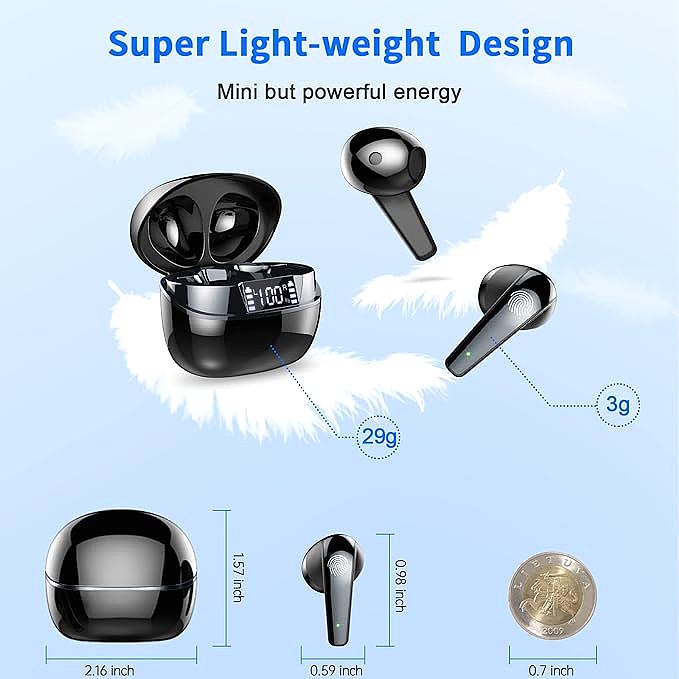
The fit question is also a seal question. A small canal gives less surface area for a silicone tip to grip, so a loose seal leaks bass and lets room noise in. The semi-in-ear half-insert design trades a tight seal for a light touch, and in exchange it avoids the pressure that seals hard. Buyers with small ears in the captured reviews describe the fit as the deciding factor: one small-eared listener calls the seal nice and perfect and adds that tiny is usually the hard case, and another confirms they feel comfortable in the ears while others hurt after a few minutes. That comfort line is the anchor for the rest of this build.
A 13 mm driver that does not belong at this price
The sound score is the anomaly. Across the captured rating set the sound axis reads 4.3, which is not what a $15.99 pair is expected to post. The reason is the driver. The listing describes a 13 mm dynamic driver with a bio-carbon fiber composite diaphragm, which is a large, stiff moving part for a shell this small. A bigger diaphragm moves more air, and that is the physical source of the deep, clean low end the reviewers keep naming: very deep and clean bass with mids and highs described as balanced and crisp.
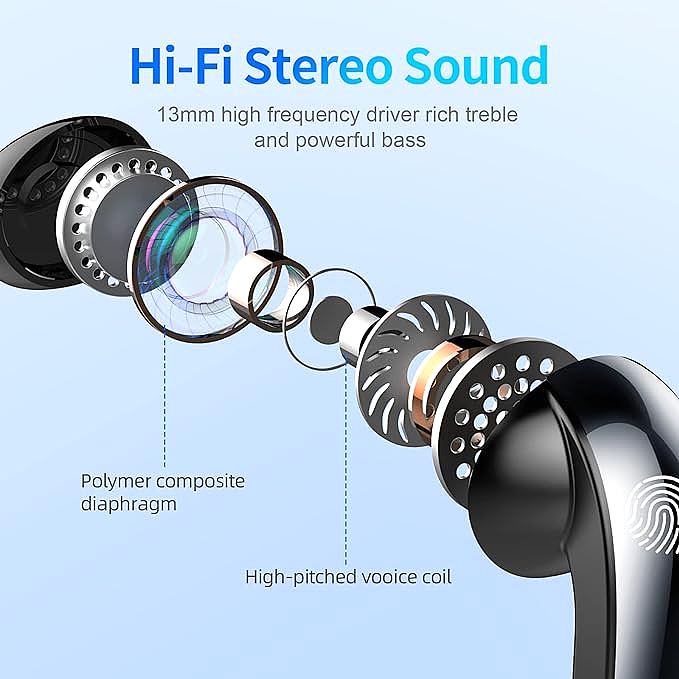
The material is the second half. A thin plastic film, the standard in this price band, starts to break up and deform when it is driven fast, which is what turns cheap low end into a muddy smear. A carbon layer adds stiffness relative to mass, so the same diaphragm can track fast passages without deforming. That combination is what produces the full and textured midrange the top reviews cite, and it is the build element the price does not usually pay for. The driver size and the diaphragm material are the two choices that separate this pair from the rest of the $15.99 shelf.
How the pairing and the latency line work
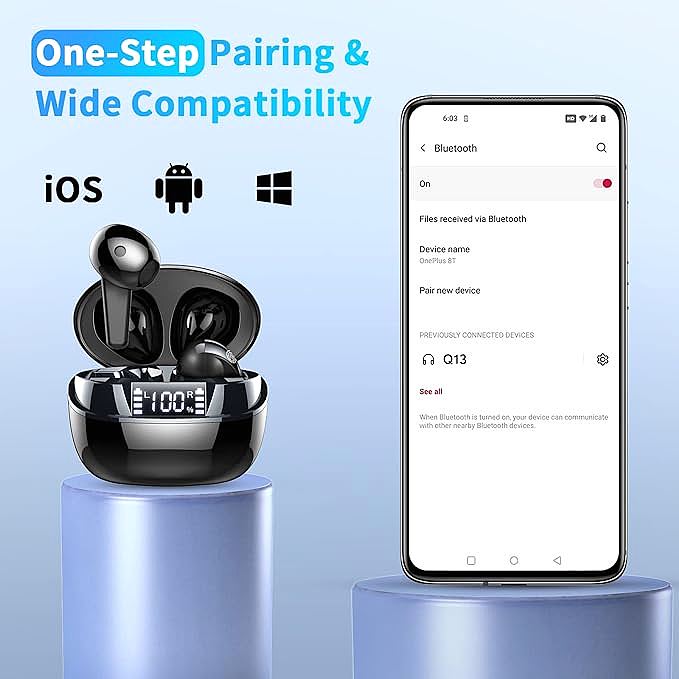
The radio is the quiet part of the build. The listing carries Bluetooth 5.3 with one-step pairing, which means the buds resume the last paired device the moment the case lid opens. That cuts the two most annoying moments of a cheap pair: the re-pairing ritual and the first-connect silence. Bluetooth 5.3 also carries the latency story. The marketing language leans on low latency for video and games, and the honest read is that 5.3 keeps the audio in step with a phone stream for music and calls, which is what the captured reviews describe as a connection that does not drop at distance.
The range comment in the top reviews is the useful one: a listener moved rooms in an apartment with the phone left on a charger and kept the signal, which is the practical test that matters more than the printed spec. It is worth naming the limit too, because one buyer had to unpair and restart Bluetooth before each use. The radio is where a budget pair shows its cost, and the Q13 is no exception.
The battery line and how it is measured
The listing states a total of 35 hours with the charging case and over 7 hours on a single charge of the buds, with USB-C on the case. The battery feature axis also reads 4.3. Those two numbers set the expectation for a day of heavy use plus a reserve. The longer the case reserve, the more the buds survive a week of commutes before the case needs a wall charge. A useful check is the single-charge figure, because a 7 hour per-charge number means the buds clear a full workday of intermittent listening without returning to the case, which is where most case-total marketing claims quietly hide a 3 or 4 hour bud figure. The 35 hour total is what the two add up to, so the per-charge number is the honest one to plan around.
What the charging case adds
The case is where the convenience sits. It carries the 29 g shell, the USB-C input and a dual LED display that shows the remaining power of the buds and of the case, so a quick glance tells you whether the reserve is full or near empty. That display is the small feature a $12.99 neckband does not have, and it is the reason the 35 hour total is usable instead of a number on a page. The case is also where the charging contacts live, and the captured listing notes the one maintenance point that keeps the whole system working: the magnetic contacts oxidize over time, and an alcohol wipe on the contacts fixes a bud that will no longer seat and charge. That one line is worth keeping, because a dead bud that will not charge is the most common false failure in this price band.
What the IP7 water claim covers
The spec sheet lists IP7 with a nano-coating on the earbuds, which in the class framing means resistance to sweat, rain and the kind of water contact a workout produces. The captured listing text also carries the small print: the manual notes a wipe-dry instruction after water contact. So the IP7 label covers sweat and rain in the way the marketing states it, and the wipe note is the honest limit. That matters for the small-ear buyer, because many small-eared listeners use the buds for running and gym, and the water line is part of the fit decision. A quick comparison keeps it honest: the captured competitor set includes an IPX4 magnetic neckband at $12.99, which is a splash rating, and a $21.99 pair with an IP7 claim plus earhooks for a secure sport fit. The water rating is one axis, and the seal geometry is the one that decides whether a small ear keeps the bud in at all.
Where it lands on the live price ladder
A live pull of the budget catalog puts a clear ladder under the small-ear shopper, and the Q13 sits in the bottom two rungs of it. An iJoy neckband lands at $12.99 with an IPX4 splash rating and a magnetic band rather than a stick shape. The Q13 is the next rung up at $15.99 with the 13 mm driver and the 35 hour case total. A Rolosar pair at $21.99 moves to Bluetooth 5.4, a 14.2 mm double-layer driver and IP7 with earhooks. A TOZO set at $19.99 is the direct small-ear rival, built around 3.7 g buds and marketed as designed for small ears, with 32 hours in the case. Further up, a Tecno set claims around 100 hours of total playtime at $34.90, and a QCY open-ear clip sits at $40.99.
Read as a ladder, the gap is the battery and the driver. At $15.99 the Q13 carries the 13 mm driver and the 35 hour case figure the $12.99 neckband does not, and the Rolosar one rung up adds the 14.2 mm driver and the newer 5.4 radio. That is the honest comparison: the Q13 is not the biggest driver or the newest radio on the ladder, it is the point where the driver size and the battery first clear the $15.99 line. The TOZO is the pair to weigh against it if small-ear fit is the whole reason for the search.
What the one-star cluster is really about
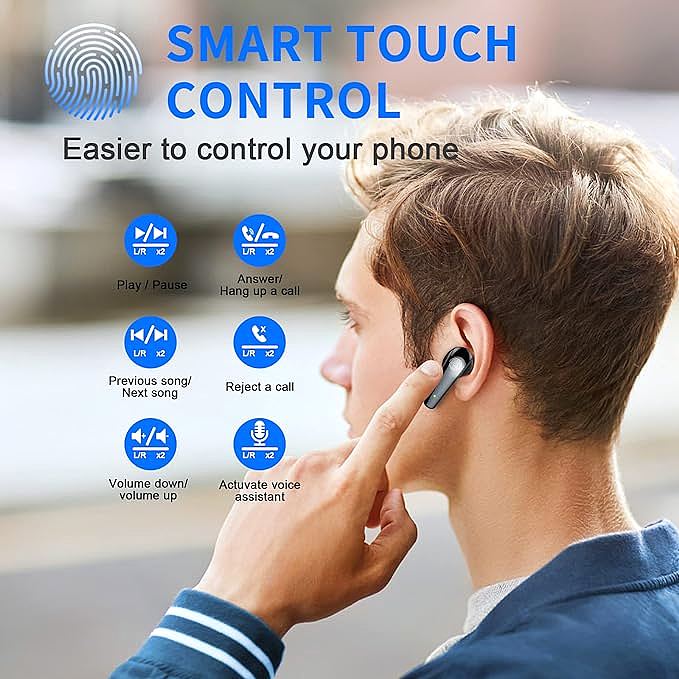
The spread across those 1,367 ratings is the clearest signal of where the compromise lands: 62 percent five stars, 17 percent four, 10 percent three, 5 percent two and 6 percent one. The one-star and two-star cluster is not about the sound. Two recurring failure lines dominate it. The first is the touch layer: the control surface is a light-touch sensor, and several reviewers report that a brush of hair or a collar answers and ends calls by accident. A physical button costs more to build and to waterproof, so the cheap sensor is the trade.
The second is durability: the captured low reviews describe one bud dying after two to four months, with the other still working. That pattern points to a solder or contact failure on a single side, which is exactly what a budget that went into the driver and the battery, and not into durable internal parts, would produce. The 4.2 overall across 1,367 ratings is the arithmetic result of that split: most units sound and fit well for the price, and a minority die early on one side.
What to check before buying for small ears
Pull the four numbers that decide a small-ear fit. The mass, which should be in the 3 g class per bud so the seal does not press the cartilage. The driver, because a 13 mm diaphragm with a stiff composite layer is what produces the clean low end at this price instead of a smear. The battery split, because the per-charge figure, not the case total, is what a workday uses. And the water line, because a sweat rating is the real expectation for a gym or run. Match those against the two failure modes, the touch sensor and the single-side longevity, and the 4.2 across 1,367 ratings becomes a predictable outcome: strong sound and fit for the price, with a small early-death tail to plan around. That is the whole case for the pair, and it is the case for the small-ear buyer who is choosing among wireless earbuds for small ears rather than defaulting to the most-reviewed name on the page.
Renimer Q13 Wireless Earbuds
Related Essays

Why Cheap Wireless Earbuds Punch Above Their Price

What IP7, Bluetooth 5.3, and 140H Battery Actually Mean for Your Earbuds

Budget Wireless Earbuds That Actually Perform: PHILIPS TAT1219 vs Three Real Alternatives

Sajawass BX35 Earbuds: 13mm Drivers and 50H Battery

How to Pair and Master Wireless Earbuds Touch Controls

DOBOPO A20-1 Wireless Earphones: A Sweat-Proof Battery Beast for Workouts

Decoding the $20 Best-Seller: How the iLuv myBuds Nails the "Anti-Anxiety" Essentials

The Science Behind Budget Wireless Earbuds: OYIB RS7 Deep Dive

The Biomechanics of Beat: Analyzing Sport Audio Design and Durability

