How Your Skull Became a Speaker: The Physics and...

Wireless Earbuds
The Night the Deaf Composer Heard the Impossible
On May 7, 1824, in Vienna's Theater am Krntnertor, something extraordinary unfolded. A man stood at the front of the stage, his back to a roaring audience, conducting an orchestra he could not hear. When the Ninth Symphony reached its final thundering chord, he didn't hear the applause. He didn't hear the stamping feet, the cheering, the weeping. A soloist had to physically turn him around so he could see what his ears refused to give him.
Ludwig van Beethoven was completely deaf. He had been losing his hearing since his late twenties, and by the time he composed what many consider the greatest piece of music ever written, he heard virtually nothing at all. Yet he wrote every note.
His method was an improvised piece of engineering that predated modern bone conduction technology by nearly two centuries. He took a wooden rod, placed one end against his piano, and clenched the other between his teeth. When he struck the keys, the vibrations traveled not through the air to his damaged ears, but through the wood, into his jaw, through his skull bones, and directly to his inner ear — bypassing the broken machinery of his ear canal entirely.
He had discovered, through necessity and desperation, a secret pathway that physics had always known about but that science was only beginning to understand.
Why the Standard Hearing System Is a Fragile Machine
To appreciate what Beethoven stumbled upon, you first need to understand what he was working around — the remarkable, efficient, and surprisingly fragile mechanism of ordinary air conduction hearing.
Sound begins as a disturbance in air molecules, a pressure wave rippling outward from its source at approximately 340 meters per second. This wave enters your ear canal, travels down its length, and strikes the tympanic membrane — the eardrum — causing it to vibrate. So far, so simple. But here's where things get complicated.
The inner ear, the cochlea, is filled with fluid. Fluid has a fundamentally different acoustic impedance than air. If sound waves in air were to hit cochlear fluid directly, physics dictates that approximately 99.9 percent of the acoustic energy would simply bounce back, reflected at the boundary like light off a mirror. Only a tiny fraction would get through.
Evolution's solution was to insert a mechanical lever system between the two media: the three ossicles of the middle ear — the malleus, incus, and stapes, the three smallest bones in the human body. Together they function as an impedance improveer, amplifying force while reducing displacement, efficiently driving acoustic energy across the air-to-fluid boundary that would otherwise reject it almost entirely.
The system is elegant. It is also impressively vulnerable. Ear wax buildup, a ruptured eardrum, middle ear infection, fluid accumulation behind the eardrum, otosclerosis (the progressive calcification of the stapes) — any single failure in this chain interrupts the sound pathway completely. The cochlea may be perfectly healthy, yet remain unable to receive any signal from the outside world.
This is the hearing that most people take for granted. And this is the hearing that Beethoven lost.
The Secret Pathway — When Vibration Skips the Middleman
Bone conduction does not politely enter through the ear canal. It does not negotiate with the eardrum. It ignores the ossicles entirely. Instead, it arrives at the front door of the inner ear.
When a vibrating object makes contact with the skull — whether that's a wooden rod between the teeth, a transducer pressed against the cheekbone, or a hand resting on a vibrating surface — the mechanical vibrations travel through bone directly to the cochlea.
The physics here are counterintuitive. Sound travels at approximately 340 meters per second through air. Through the dense cortical bone of the human skull, it travels between 800 and 3,000 meters per second, depending on bone density and the frequency of the vibration. Bone is rigid and dense — not despite these properties but because of them, it is an notablely efficient medium for mechanical vibration transmission.
Research identifies three distinct modes by which skull vibration reaches the cochlea:
Inertial bone conduction dominates at lower frequencies. The entire skull vibrates as a largely rigid unit, moving back and forth in space. But the ossicles inside the middle ear are suspended from the skull walls by delicate ligaments — they do not perfectly follow the skull's motion. Their mass creates inertia; they lag behind. This relative motion between the skull and the ossicles produces the same mechanical effect as if the stapes were being actively driven. The cochlea responds identically to what it would experience from conventional air conduction.
Compressional bone conduction takes over at higher frequencies, roughly above 800 Hz. At these frequencies, the skull stops behaving as a rigid object and begins to deform — different sections compressing and expanding at slightly different phases. This compression directly squeezes the bony capsule surrounding the cochlea — the otic capsule, made from the petrous portion of the temporal bone, which is the hardest bone in the human body. Since cochlear fluid is essentially incompressible, the squeeze forces fluid movement, which deflects the basilar membrane and activates the hair cells.
Osseotympanic bone conduction is a secondary effect: the vibrating skull shakes the cartilaginous walls of the ear canal, creating air pressure oscillations inside the canal that then strike the eardrum from within. This is why plugging your ears while humming makes your own voice seem louder — you're trapping this secondary air-conducted signal inside the canal, a phenomenon called the Occlusion Effect.
Five Roads to the Inner Ear — Stenfelt's Model
The scientific community spent much of the 20th century debating exactly how bone-conducted vibrations reach the cochlea. The answer turned out to be: not through one pathway, but five simultaneously.
Professor Stefan Stenfelt at Linkping University in Sweden, one of the world's leading researchers in bone conduction biomechanics, has extensively modeled these pathways through experiments, cadaveric studies, and computational models. His work identifies five distinct routes that bone-conducted sound uses to reach the cochlea:
- Ear canal compression: The vibrating skull walls shake the cartilaginous portion of the ear canal, creating air movement that drives the eardrum from within
- Middle ear ossicle inertia: The ossicles' mass causes them to lag behind skull motion, creating the relative displacement that drives cochlear fluid
- Cochlear space compression: Direct deformation of the bony otic capsule squeezes the cochlea and drives fluid displacement
- Cochlear fluid inertia: The fluid inside the cochlea itself lags behind the motion of its bony shell, creating internal relative motion that deflects the basilar membrane
- Secondary fluid pathways: Connections between the inner ear and the cranial cavity through the cochlear and vestibular aqueducts create additional pressure equalization paths
Stenfelt's computational modeling, published in the AIP proceedings of the International Workshop on the Mechanics of Hearing (2015), determined that pathways 2 and 4 — ossicle inertia and cochlear fluid inertia — dominate hearing sensation across most of the audible frequency spectrum. Pathway 3 (compressional) becomes increasingly important above approximately 5.9 kHz. The practical implication: bone conduction hearing is not simple brute-force vibration of the skull. It is a sophisticated multi-pathway system that the brain integrates into unified auditory experience.
The Cochlea as a Living Fourier Analyzer
All five of these pathways lead to the same destination: the cochlea, arguably the most sophisticated mechanical sensor ever produced by biological evolution.
The cochlea is a fluid-filled tube, coiled approximately 2.5 turns into a snail-like spiral, embedded in the petrous temporal bone. Running along its length is the basilar membrane, a strip of tissue that varies systematically in width and stiffness from one end to the other. At the base (closest to the oval window), the membrane is narrow and stiff; it responds maximally to high-frequency vibrations. At the apex (the innermost point of the coil), the membrane is wide and flexible; it responds maximally to low frequencies.
This arrangement — known as tonotopy — means the cochlea performs a continuous mechanical frequency analysis on every sound it receives. Different regions of the basilar membrane resonate at different frequencies, effectively decomposing complex sound waves into their constituent frequencies simultaneously. Engineers would recognize this as an analog Fourier improve, executed in biological tissue at biological speeds.
Resting on the basilar membrane is the organ of Corti, containing approximately 15,500 hair cells arranged in precise rows. These are not hair cells in any conventional sense — they are specialized mechanoreceptors equipped with stereocilia, bundles of protein filaments that can detect displacements as small as a few nanometers. When the basilar membrane moves, the stereocilia bend, opening mechanically gated ion channels. Potassium ions rush in, the cell membrane depolarizes, neurotransmitters are released at the cell's base, and the auditory nerve fibers (cranial nerve VIII) fire electrical signals that travel to the brainstem and ultimately to the auditory cortex.
Here is the critical insight that makes bone conduction philosophically remarkable: the brain cannot distinguish whether the vibrations that activated those hair cells arrived via air conduction or bone conduction. Both pathways produce the same electrochemical signal. The brain receives identical neural firing patterns regardless of which route the sound took. The ear canal is just one way in. The bone is another. The cochlea doesn't care which door you used.
Five Centuries of Applications — From Doctors to Soldiers to the Deep Ocean
Girolamo Cardano, the Italian physician, mathematician, and philosopher, documented bone conduction in his controversial 1550 publication De Subtilitate. He observed that sound could be transmitted through a rod held between the teeth, and theorized that this offered a pathway to hearing independent of the outer ear. He couldn't explain why — the anatomy of the cochlea wouldn't be understood for another century — but he had empirically confirmed the effect.
By the 19th century, physicians had turned bone conduction into a diagnostic instrument. The Rinne test, developed by German otologist Heinrich Adolf Rinne in 1855, used a vibrating tuning fork placed on the mastoid bone (the prominent bump of bone behind the ear) and then held near the ear canal. By comparing which position sounded louder, clinicians could distinguish between conductive hearing loss (damage to the outer or middle ear, where bone conduction exceeds air conduction) and sensorineural hearing loss (damage to the cochlea or auditory nerve, where neither pathway performs normally). These tests remain in daily clinical use more than 170 years after their invention.
Military engineers in the Second World War confronted a problem that battlefield medics would have recognized immediately: ambient noise in combat environments — gunfire, explosions, engine noise — overwhelmed conventional microphone technology. Their solution was the bone conduction throat microphone: a transducer pressed against the larynx or mastoid bone, picking up the vibrations of the speaker's voice directly from the skull, ignoring the surrounding acoustic chaos. The principle that Cardano noted in his physician's practice was now keeping soldiers alive.
Swedish surgeon Anders Tjellstrm brought bone conduction into modern surgical medicine in the 1970s. His bone-anchored hearing aid (BAHA) involved surgically embedding a titanium implant into the mastoid bone. A sound processor would clip onto the exposed abutment, converting environmental sound into mechanical vibration delivered directly to the skull, completely bypassing the outer and middle ear. For patients with conductive hearing loss, chronic ear infections preventing conventional hearing aids, or congenital conditions such as aural atresia (absent or malformed ear canal), the BAHA improveed quality of life.
Nature, meanwhile, had been using bone conduction for millions of years before any of this.
Whales and dolphins have no external ear canals. Sound in water enters their bodies through the lower jaw — the mandible contains a specialized fat body (the acoustic fat, or mandibular fat pad) that channels vibrations directly to the middle ear bones. This jawbone hearing pathway is the primary auditory mechanism of all cetaceans; the external ear is vestigial or entirely absent in most species.
Elephants can detect infrasound — vibrations below 20 Hz — transmitted through the ground from sources hundreds of kilometers away. The vibrations travel through the elephant's feet and skeletal structure to the inner ear, allowing early detection of herd movements, water sources, and potential threats at distances far beyond any air conduction system's capability.
Snakes, lacking external ears entirely, press their jawbones against the ground. The quadrate bone in the snake's skull transmits ground vibrations directly to the inner ear, allowing them to detect approaching prey or predators before those animals come within visual range.
The phenomenon Beethoven exploited with desperation, Cardano documented with curiosity, and Tjellstrm deployed with surgical precision — nature had already been running that solution for hundreds of millions of years.
The Wired Argument — When Analog Physics Meets Practical Silence
Bone conduction transducers can be implemented in both wireless and wired configurations. The choice between them is not merely a matter of cable management — it's a matter of physics and priorities.
An analog signal transmitted over a 3.5mm wired connection travels at effectively zero latency. The electrical signal propagates through the conductor at near the speed of light, limited only by cable length and parasitic capacitance — practical propagation delays are measured in nanoseconds. By contrast, Bluetooth audio (standard SBC/AAC codecs) introduces 80 to 200 milliseconds of latency from encoding, packetization, transmission, and decoding. Even the fastest proprietary 2.4GHz wireless protocols add 15 to 25 milliseconds.
For most casual listening, this is irrelevant. For a cyclist needing real-time correlation between a vehicle sound and its visual position, or for a runner whose safety depends on undelayed spatial audio, or for a musician monitoring their own voice, 100 milliseconds of audio delay is not a minor inconvenience — it's the difference between what happened and what's happening now.
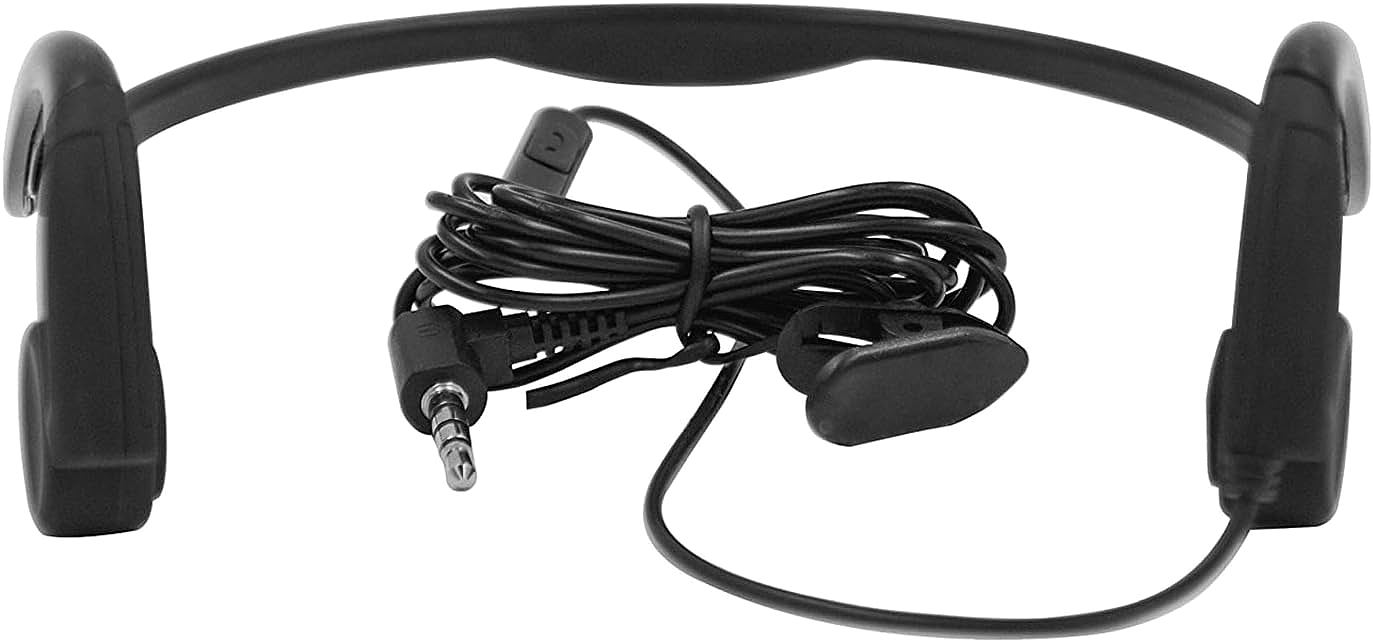
A wired bone conduction device such as the GZCRDZ C630, operating through a passive 3.5mm connection, adds no transmission latency, requires no battery (eliminating the mid-run power failure scenario), and transmits no radio frequency signals whatsoever. The signal that leaves the source device is the signal that arrives at the transducer, unchanged and instantaneous.
The open-ear architecture of bone conduction compounds this advantage. Because the ear canal remains physically open, ambient environmental sound enters via normal air conduction simultaneously with the bone-conducted audio signal. The listener hears both streams at once — music without sacrificing the car horn, the warning shout, the trail runner approaching from behind.
The Skull Was Never Just a Container
Beetoven's wooden rod was a crude but perfect bone conduction transducer. It required no battery, no Bluetooth, no codec. It required only contact, vibration, and the extraordinary conducting properties of the human skull.
For centuries, we have thought of the skull primarily as a container — a protective vault for the brain, armor against the physical world. But it is also, and perhaps more fundamentally, a transmitter. It receives vibrations from the surfaces it touches and channels them, through its rigid and resonant structure, to the most sophisticated frequency-analysis organ that biology has produced.
Every time you place your hand on a vibrating surface and sense the buzz of it, every time you feel bass notes as pressure in your chest, every time you hum with your mouth closed and hear your own voice rich and round inside your head — you are experiencing bone conduction. The pathway Cardano described, that Beethoven exploited, that Tjellstrm surgically harnessed, and that whales have been using since before mammals had ears in the modern sense.
The cochlea doesn't care which road the signal took. It just listens.
And in that indifference lies something quietly profound: the destination was always the same. We just took five centuries to understand all the roads that lead there.
Wireless Earbuds
Related Essays

From Ear Trumpets to Brain-Mimicking: The Evolution of Hearing Assistance
Bone Conduction: How Your Skull Became a Speaker

Open-Ear Audio: How Bone Conduction Is Reshaping Our Relationship with Sound

The Earbuds That Would Not Die: Value Engineering in Budget Audio

That Hum in Your Headphones: What It Actually Is and How to Silence It
