The Durability Equation: Why Connector Design Determines Headphone Lifespan

Panasonic RP-TCM125-K ErgoFit Wired Earbuds
Your earbuds stop working. One channel goes silent, then the other. You wiggle the cable near the jack, and sound flickers back for a moment before cutting out again. If this sounds familiar, you have experienced the frustration of cable connector failure, one of the most common reasons headphones become unusable long before their drivers should worn out. This is not random failure. This is physics.
The point where your headphone cable meets the connector is a battlefield of mechanical stress. Every time you plug in, unplug, wrap the cord around your phone, or stuff the earbuds into a pocket, forces concentrate at this junction. The design of that junction determines whether your headphones last six months or three years.

The Physics of Cable Failure
When a straight headphone jack experiences lateral force, something predictable happens that engineers have long studied and attempted to mitigate through various design approaches. The force travels down the length of the connector and concentrates at the solder joints inside, which represent the most vulnerable point in the entire assembly because they are rigidly bonded to the connector housing yet must also maintain electrical continuity with the flexible cable that experiences constant movement. Think of it as a lever: the longer the lever arm, the greater the torque applied to the fulcrum. In a straight connector, that lever arm measures roughly 14 to 15 millimeters, the distance from the tip to where the cable exits.
The stress formula is straightforward: stress equals force multiplied by lever arm divided by cross-sectional area. A 10-newton pull on a straight jack with a 15-millimeter lever arm generates 150 newton-millimeters of torque at the internal connection point. That torque repeats with every use, accumulating damage through metal fatigue.
Metal fatigue follows a predictable pattern. Repeated bending causes microscopic cracks to form in the copper conductors. These cracks grow with each stress cycle until the wire eventually breaks. The IEEE standard for 3.5-millimeter TRS connectors rates them for 5,000 to 10,000 insertion cycles, but that rating assumes ideal conditions with no lateral stress. Real-world usage with bending, pulling, and pocket storage reduces that lifespan dramatically.
Why L-Shaped Connectors Change the Equation
An L-shaped connector repositions where stress concentrates. Instead of transmitting force to the internal solder joints, the L-shape creates a bend at the cable exit point. The lever arm shrinks from 15 millimeters to approximately 3 millimeters, the radius of the bend.
That same 10-newton force now generates only 30 newton-millimeters of torque, an 80 percent reduction. The stress that would have damaged internal connections instead dissipates into the flexible cable jacket at the bend point. The cable can absorb this stress through elastic deformation, returning to its original shape when the force is removed.
Testing data reveals the practical difference. The IEEE standard for 3.5-millimeter TRS connectors rates them for 5,000 to 10,000 insertion cycles under ideal laboratory conditions with perfectly aligned plugs and no lateral forces whatsoever, but that theoretical lifespan collapses rapidly when users handle cables in real-world scenarios involving bending, pulling, wrapping, and pocket storage. Testing data reveals the practical difference between connector types under identical conditions, with straight connectors showing contact resistance increases of 300 to 500 percent after only 1,000 insertion cycles with simultaneous lateral stress, while L-shaped connectors demonstrate remarkably stable resistance increases of only 15 to 30 percent under the exact same testing protocol. The IEC failure threshold of 200 percent of initial resistance represents a point beyond which audio quality degrades noticeably and connector reliability becomes unacceptable for most users, which straight connectors reach well before L-shaped designs under any significant stress conditions. For a user who plugs and unplugs headphones five to ten times daily, a straight connector typically reaches failure in six to twelve months of normal use, whereas an L-shaped connector can last twenty-four to thirty-six months under the exact same usage pattern, representing a threefold improvement in service life. The fatigue lifecycle numbers tell a similar story with straight jacks typically beginning to show contact issues after only 2,000 to 5,000 stress cycles while L-shaped designs can endure 8,000 to 15,000 cycles before similar degradation appears, making the choice of connector geometry one of the most significant durability factors users can evaluate before purchase.. Straight connectors subjected to 1,000 insertion cycles with simulated lateral stress show contact resistance increases of 300 to 500 percent. L-shaped connectors under identical conditions show increases of only 15 to 30 percent. The IEC failure threshold is 200 percent of initial resistance. Straight connectors reach this threshold; L-shaped connectors remain within acceptable limits.
The fatigue lifecycle numbers tell a similar story. Straight jacks typically begin showing contact issues after 2,000 to 5,000 stress cycles. L-shaped designs endure 8,000 to 15,000 cycles before similar degradation appears. For a user who plugs and unplugs headphones five to ten times daily, a straight connector reaches failure in six to twelve months. An L-shaped connector lasts twenty-four to thirty-six months under the same usage pattern.
The Material Science Behind Cable Longevity
Connector geometry is only part of the durability equation. The materials inside the cable matter equally.
Oxygen-free copper, or OFC, conducts electricity at 101.5 percent of the International Annealed Copper Standard. More importantly for durability, OFC resists fatigue more effectively than many alternatives commonly used in budget cables. Copper-clad aluminum, or CCA, offers lower cost but conducts at only 60 to 65 percent IACS. The aluminum core fatigues faster than pure copper, leading to earlier conductor failure.
The cable jacket material also affects lifespan. Thermoplastic elastomer, TPE, provides good flexibility and moderate durability. Braided nylon exteriors offer superior abrasion resistance and reduce tangling, which itself causes stress. PVC costs less but hardens over time, especially with temperature cycling, eventually cracking at stress points.
Strain relief structures bridge the rigid connector and flexible cable. Molded rubber boots at the cable entry point create a graduated transition zone. Instead of an abrupt change from stiff to flexible, the strain relief provides intermediate stiffness that distributes bending forces over a longer section of cable. Internal spring mechanisms serve a similar function, absorbing tensile stress before it reaches the solder joints. Strain relief structures bridge the rigid connector and flexible cable by creating a graduated transition zone that distributes bending forces over a longer section of cable rather than concentrating them at the abrupt junction where the hard plastic housing meets the softer cable jacket.
Molded rubber boots at the cable entry point prevent the kind of stress concentration that leads to premature failure by providing intermediate stiffness between the rigid connector body and the flexible cable, allowing the cable to absorb repeated bending stress through elastic deformation rather than transmitting it directly to the internal solder joints.
Internal spring mechanisms embedded within the connector housing serve a similar stress-absorption function by taking up tensile stress before it reaches the most vulnerable internal components, effectively extending the usable lifespan of the connector assembly under real-world usage conditions involving frequent plugging and unplugging.
Ergonomics and the Human Ear
Durability means nothing if the earbuds hurt to wear. The International Ergonomics Association defines three dimensions of human factors: physical, cognitive, and organizational. In-ear headphone design primarily addresses the physical dimension, specifically how the device interfaces with the variable geometry of the human ear canal.
Ear canals are not circular. They are roughly elliptical, with significant variation between individuals. A circular nozzle creates pressure points where it contacts the ear canal walls. An elliptical nozzle distributes pressure more evenly, reducing fatigue during extended wear.
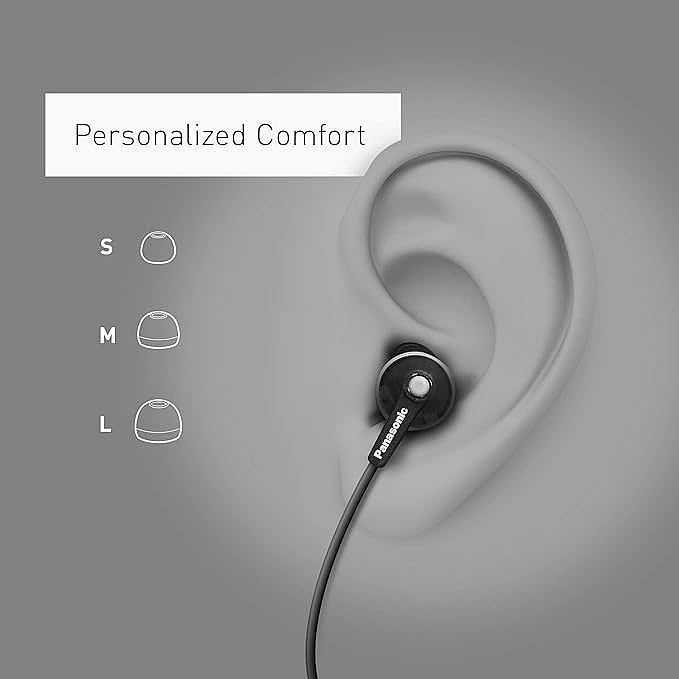
The Panasonic ErgoFit design uses this elliptical nozzle approach combined with three earpad sizes. Small, medium, and large options accommodate the range of ear canal dimensions found across the population. The ErgoFit material itself uses ultra-soft silicone that deforms under pressure, further distributing load and reducing peak stress on ear tissues.
This ergonomic approach connects to durability in an unexpected way. Comfortable earbuds get used more carefully. Users who experience discomfort tend to adjust fit frequently, creating additional stress on the cable-to-earbud junction. A stable, comfortable fit reduces this manipulation.
Five Practices That Extend Headphone Life
Understanding the engineering helps, but applying that knowledge matters more. Specific habits can double or triple headphone lifespan regardless of connector type.
First, unplug by gripping the connector body, not the cable. Pulling on the cable transmits tensile stress directly to the internal connections. The connector housing is designed to withstand handling forces; the cable is not.
Second, avoid wrapping cables tightly around devices. This creates sustained bending stress at the connector entry point. If you must coil the cable, use a loose figure-eight pattern that distributes curves along the entire length rather than concentrating them at one point.
Third, store earbuds in a case when not in use. Pocket storage subjects cables to compression, bending, and friction against other objects. A rigid case eliminates these stressors entirely.
Fourth, inspect the connector root monthly. Look for thinning of the cable jacket, discoloration from friction heating, or visible deformation. These signs indicate stress concentration that will lead to failure if usage patterns do not change.
Fifth, recognize the warning signals of impending failure. Audio that cuts out at specific angles indicates internal conductor damage. One channel becoming quieter than the other suggests resistance increase from partial conductor fracture. Cable noise when bending, often called microphonics, can indicate insulation breakdown. Addressing these symptoms early, by reducing stress on the affected area, can prevent complete failure.
The Engineering Philosophy of Designed Durability
The choice between straight and L-shaped connectors reflects a deeper design philosophy. A straight connector prioritizes simplicity and lowest manufacturing cost. It works adequately for applications where the cable remains stationary after connection. Desktop speakers, for instance, rarely experience the lateral forces that kill headphone jacks.
An L-shaped connector accepts slightly higher manufacturing complexity in exchange for dramatically improved real-world durability. It acknowledges that users will bend, pull, and compress the cable during normal use. Rather than fighting these forces, the design redirects them to where they cause less damage.
This principle, designing for actual rather than ideal usage, extends beyond connectors. The elliptical nozzle shape accepts the reality of ear canal geometry. Multiple earpad sizes accept the reality of human variation. Strain relief structures accept the reality that cables will bend. Each decision trades theoretical simplicity for practical resilience.
The next time you replace a pair of earbuds because one channel stopped working, consider what failed. The drivers probably still function. The magnets have not demagnetized. The diaphragms have not torn. The failure occurred at the point where mechanical stress concentrated, where the design allowed force to damage the electrical connection. That failure was not inevitable. It was engineered, or rather, not engineered against.
Understanding why headphones fail changes how you evaluate them. Specifications like driver size, frequency response, and sensitivity describe sound quality. Connector type, cable material, and strain relief design describe lifespan. Both matter. A headphone that sounds excellent but fails in six months costs more per month of use than one that sounds adequate and lasts three years.
The durability equation has variables you can observe before purchase and variables you control after purchase. Connector geometry and cable materials are fixed. Usage patterns and storage habits are choices. Optimizing both sides of the equation maximizes the return on your investment, measured not in initial price but in months of reliable service.
Panasonic RP-TCM125-K ErgoFit Wired Earbuds
Related Essays

V-MODA Crossfade 2 Wireless: Stylish and Durable Bluetooth Headphones

USB-C Audio Explained: Why Wired Headphones Still Matter in 2026

The Reliability of Simplicity: Engineering for the Real World

Avantree TR504 IPX5 Sweat Resistant Sport Earbuds - Excellent Wired Earbuds for Workouts and Small Ear

Logitech H540 USB Headset - An Ideal Headset for Work and Play

Open Back Headphones: Why They Sound Different

Balanced Armature vs Dynamic Driver: 2026 IEM Engineering Truths

Coaxial Audio and the Point Source Paradox: Why Perfect...

The Studio Vocal Chain: What Every Singer Needs to Know
