Titanium-Coated Drivers Explained: Stiffness, Damping, and Open-Back Acoustics

Koss KTXPRO1 Titanium Portable Headphones
Ask a search engine for the best budget audiophile headphones and you get lists of specs, prices, and ratings. What you rarely get is an explanation of why the drivers differ, or whether any of the engineering words in the listings mean anything. The pattern is familiar to anyone who has shopped for headphones under twenty-five dollars. The listings promise bass, clarity, studio sound. The units that arrive deliver a thin plastic shell, a driver that breaks up at high volume, and a closed chamber that makes every recording sound as if it were played inside a shoebox. So when a model in this bracket specifies a titanium-coated diaphragm, a 60-ohm voice coil, and a semi-open shell, the honest response is doubt. Low-cost parts, low-cost sound. The engineering record tells a different story, and the Koss KTXPRO1, a seventeen-dollar on-ear headphone with a lifetime warranty and a 4.4 average across more than 3,300 ratings, is the clearest case study of why.
What a Driver Moves, and Why Weight Is Not the Enemy
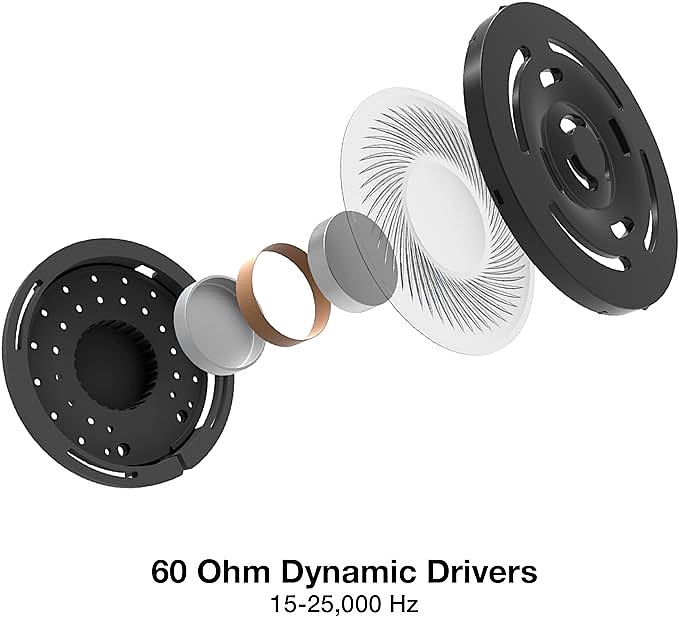
A headphone driver is a linear motor. Current from the amplifier runs through a coil of wire suspended inside the field of a permanent magnet. The field pushes on the current, the coil moves, and the diaphragm attached to it moves with it. The diaphragm pushes air. Pressure ripples travel outward, and that is sound. The whole mechanism is governed by a single relationship: force equals mass times acceleration. To reproduce a 15 kHz tone, the diaphragm must reverse direction 15,000 times every second. At the top of the range, 25,000 times. Each reversal costs force, and force costs current.
Engineers therefore chase low mass. A light diaphragm accelerates faster, starts and stops more abruptly, and preserves the leading edge of transients, the attack of a snare drum, the pluck of a string. That pursuit pushed the industry toward thin plastic films. A PET diaphragm weighs a fraction of what a paper or metal cone weighs, and rare-earth magnets such as neodymium alloys pack a stronger field into a smaller volume, returning more force per gram of driver. But lightness has a failure mode, and it appears exactly where music carries the most detail: the top of the frequency range.
When a Diaphragm Stops Behaving Like a Piston
Below a few kilohertz, a well-behaved diaphragm moves as one piece, like a piston. Every point on its surface travels the same distance at the same time. Above a certain threshold, the material stops keeping up. Think of a flag in a stiff wind. The flag does not move as a rigid board. Waves ripple across its fabric, and different regions flap in different directions at the same instant. A flexible diaphragm does the same thing at high frequencies. The center can be pushing forward while the rim is still recovering from the previous cycle. These are breakup modes. Each one radiates its own partial sound, and the result is peaks and dips in the response, a metallic grain, sibilance that grates over long listening sessions. Female vocals, cymbals, acoustic guitar, and orchestral strings live in exactly this band, which is why soft diaphragms punish those recordings first.
The property that resists breakup is stiffness, and the engineer's measure of stiffness is Young's modulus, the ratio of stress to strain in a material. PET, the polyester film used in most inexpensive drivers, sits around 2 to 4 gigapascals. Titanium sits near 116 gigapascals in standard materials references, roughly thirty to sixty times stiffer. Exact figures vary by alloy and measurement method, which is why the order of magnitude, not the third decimal, is what matters here. A diaphragm made entirely of titanium would hold its shape beautifully, but it would also be heavy, and heavy diaphragms are slow. So materials engineers borrow a trick from loudspeaker tweeters, where metal domes have been standard for decades: deposit a thin layer of titanium onto a light plastic core. The coating, often only a few hundred nanometers thick, adds negligible mass while stiffening the skin, pushing breakup modes far above the audible band. Metal stiffness at plastic weight. That is the entire idea behind titanium coated headphones.
The same trick scales upward with rarer films. Beryllium offers an even higher stiffness-to-mass ratio than titanium, and in high-end drivers an extremely thin layer of it is coated onto a substrate diaphragm made of another material, PET or titanium itself, so the core donates lightness while the film donates rigidity. The recipe is identical; only the price of the film changes. Newer materials are already queueing behind the metals: replacement drivers with fifty-millimeter graphene diaphragms are sold at the component level today, an early sign that the stiffness-versus-weight problem will get a carbon answer next.
Damping: The Second Half of the Story
Stiffness alone is not enough. A stiff structure rings. Strike a titanium rod and it keeps singing long after the strike. A diaphragm must stop the moment the signal stops, or every transient is followed by a ghost of itself, a smear that dulls the attack and muddies quiet passages. The counterweight to stiffness is damping.
In a dynamic driver, much of the damping is electromagnetic. When the coil moves inside the magnetic field, that motion induces a voltage, and the induced voltage opposes the motion. The stronger the coupling between coil and magnet, the more firmly the driver is held to the signal. More turns of finer wire on the coil strengthen that coupling, and more turns mean higher impedance. That is the origin of the 60 ohm question. The convention in this price bracket is 16 to 32 ohms. A 60-ohm voice coil is a deliberate departure, and shoppers who see the number reasonably ask whether their phone can drive it.
Impedance says how much current flows for a given voltage. It does not say how loud a headphone plays. Loudness is governed by sensitivity, the sound pressure delivered per milliwatt, and a 60-ohm design with adequate sensitivity runs fine from a phone, perhaps asking for a slightly higher volume step. Studio headphones rated at 250 or even 600 ohms pair with dedicated amplifiers because of sensitivity and power targets, not merely impedance. What the higher impedance buys is control. The Koss KTXPRO1 is a useful reference here: it plays from a phone without strain, while the extra coil turns hold its diaphragm on a shorter leash, reducing the ringing that shows up as distortion on transients.
The Enclosure Decides Half of What You Hear
A driver radiates in two directions. The front wave goes to the ear. The rear wave goes into the shell behind the driver, and what the shell does with it decides a large share of the final sound. In a closed shell, the rear wave bounces. Reflections accumulate into standing waves at frequencies whose wavelengths match the chamber dimensions, adding peaks and dips. At low frequencies the chamber acts as a Helmholtz resonator, coloring the 200 to 500 Hz region with the familiar boxiness. And every reflection that returns to the diaphragm arrives out of phase, subtracting from clarity. Closed designs accept these costs because they buy isolation, which commuters and open offices require.
Open-back designs throw the rear wave away. The shell contributes almost nothing, the chamber artifacts disappear, and the sound opens up. Instruments sit in space instead of inside the head, which is why open designs have dominated recording studios and high-fidelity listening rooms for decades. The bill for that airiness is isolation, and it is zero in both directions: the listener hears the room, and the room hears the headphones. Semi-open designs take a middle position, venting part of the rear wave while retaining some enclosure. They keep most of the openness and give up most of the privacy. Listeners who want natural dialogue, wide staging, and no boxiness, and who listen in quiet rooms, are the audience this middle path was made for.
This is also why printed frequency response numbers deserve skepticism. An IEEE technical standard for loudspeaker and headphone response measurement defines how these ranges are captured, but a single range like 15 to 25,000 Hz is captured under standardized conditions and says little about the combination of driver, enclosure, pads, and the listener's own ear. Two drivers with identical published ranges can sound nothing alike.
What a Ratings Archive Actually Records
Long-term rating data is less a measure of sound quality than a record of where products fail. A model that has accumulated more than 3,300 ratings and settled at 4.4 out of 5, with about two-thirds of raters giving five stars and roughly 8 percent leaving negative feedback, is telling a durability story. The negative fraction clusters in predictable places, and it is almost never about the driver. It is about the pads and the pressure. On-ear designs press the pads against the pinna, and after several hundred hours, foam compresses and leatherette flakes under friction and skin oil. Cables and hinges take the mechanical strain.
 The transducer itself, the magnet, coil, and diaphragm, is typically the last component to fail.
That pattern explains why serviceability matters more than warranty length, and why a lifetime parts-and-labor warranty is a statement about expected failure modes. If the only consumable is a pair of pads that swaps out in seconds without tools, for about five dollars, the manufacturer can guarantee the driver indefinitely, because history says the driver will outlive the pads several times over. The arithmetic is instructive. A seventeen-dollar headphone with five-dollar pad replacements every three years or so costs roughly five to six dollars per year over five years. A sealed model with a one- or two-year warranty at a similar price tends to need replacing inside three years, pushing its annual cost toward ten dollars or more, and noise-canceling designs at three to five times the price carry annual costs of twenty to thirty dollars once their batteries age and their warranties lapse. Repairability, not the sticker price, drives the lifetime number. Replaceable pads also quietly reduce electronic waste, which matters a little more each year.

Where Open, Light Designs Belong
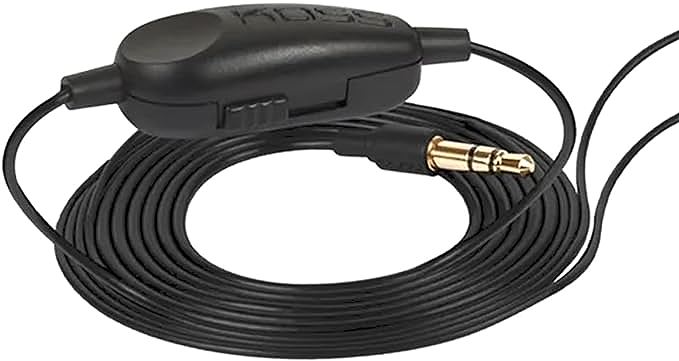
The design choices described so far map cleanly onto listening situations. An open or semi-open design wants a quiet room. It is at its best at a desk, on a couch, or in front of a television, where a long cable and an inline volume slider remove the need to reach for a remote, and where the absence of isolation is a feature rather than a flaw: two people can share one headphone through a splitter, or a parent can keep half an ear on the household. Listeners who use wired headphones for television are describing exactly this fit, and dialogue benefits from a shell that adds no chamber coloration.
The same design is wrong for other situations. Commutes demand isolation, and an open shell provides none while leaking sound onto the train. Open-plan offices punish both the wearer and the neighbors. Voice chat and gaming need a microphone, which wired audiophile-leaning designs omit. Exercise needs clamping stability that light on-ear models do not aim to provide.
Comfort follows the same logic. On-ear designs concentrate pad pressure on the pinna and the surrounding cartilage, while over-ear designs spread the load around the ear. Most on-ear wearers feel pressure points after three or four hours, and eyeglass wearers feel them sooner, because the frame gets pressed between pad and temple. Mass matters too: a headphone in the 113-gram range, roughly half the weight of typical over-ear models, reduces the load on top of the skull, and a suspension-style headband with a soft inner sling distributes what weight remains instead of concentrating it at two hinge points. These are not defects to be forgiven. They are the tradeoffs baked into the design, and they show up in the rating data long before anyone opens the box.
Why the Coating Costs Almost Nothing
One last puzzle. Titanium is an expensive-sounding material, so how does a titanium-coated diaphragm appear in a seventeen-dollar product? Because titanium as a thin film costs almost nothing. Thin-film deposition, the family of processes that includes sputtering and evaporation, lays down a metallic layer measured in hundreds of nanometers in a matter of seconds. The material cost per driver is a fraction of a cent. The technique is old and well understood; metal-dome tweeters have used it at every price level for decades.
If the coating is nearly free and audibly useful, why is it rare below a hundred dollars? Because the expensive part of audio engineering was never the bill of materials. It is the design decisions, and the willingness to deviate from a safe recipe. The safe recipe at the low end is PET film, a closed shell, 32 ohms, no serviceable parts, a one-year warranty. That recipe is proven, easy to copy, and safe to market. Deviating from it costs measurement time, tuning, validation, and a company willing to stand behind a product for decades rather than a season. The titanium layer is a signal, not a feature. It says someone made a decision, and the lifetime warranty says the same person expected the decision to hold. For anyone sorting through the budget audiophile category, that signal carries more information than any spec line.
For all that, the coating has a known sonic signature of its own. Long-running forum consensus among owners describes titanium-coated diaphragms as occasionally harsh or bright in the treble, a slight edge that flatters aggressive material but flinches from it in classical repertoire, where strings and massed violins can turn glassy. Rock and metal, which live on attack, tend to profit from the same ridginess. None of this is a flaw so much as a flavor, and it is worth knowing before you buy.
What This Says About Cost and Sound
Step back and the pattern is consistent. A headphone that sounds right at seventeen dollars gets there by removing problems, not by adding features. Breakup modes are pushed out of hearing range by a titanium skin. Ringing is tamed by electromagnetic damping. Chamber resonance is vented away. Planned replacement is designed out with serviceable pads and a lifetime warranty. Subtraction is the expensive skill.
That reframing answers the price question. When a model costs ten times more, some of the premium is real: comfort that survives eight-hour sessions, isolation, materials that feel good in the hand, integrations that save time. Some of it is fashion, and some of it is a brand absorbing the cost of its own past decisions. But the gap between the two price points is not explained by sound alone. The evidence is a seventeen-dollar headphone that has stayed on the market for years, carrying a standing promise to repair it for life.
The next time you lift a pair of headphones and wonder what the price tag pays for, remember this: the expensive part was never the material. It was knowing which problems to remove.
Koss KTXPRO1 Titanium Portable Headphones
Related Essays
