Anchoring Sound in Motion: Overcoming Kinetic Friction in Acoustic Wearables


Orancu A12 Wireless Headphones
The intersection of extreme physical exertion and high-fidelity audio reproduction presents one of the most hostile engineering environments imaginable for consumer electronics. A device tasked with delivering pristine acoustic waves must simultaneously survive severe kinetic shock, highly corrosive biological fluids, and constant thermal fluctuation, all while maintaining a continuous radio frequency link through a medium—the human body—that naturally absorbs electromagnetic radiation.
For years, the consumer electronics industry attempted to solve these problems through incremental miniaturization, often sacrificing acoustic stability for aesthetic minimalism. However, when a runner hits the pavement, aesthetics do not prevent an earbud from becoming a ballistic projectile. The modern approach to athletic audio requires a fundamental shift from treating earbuds as passive speakers to treating them as structural, biomechanical implants that integrate with human anatomy.
By examining specific hardware architectures—such as the over-ear hook anchoring systems and dual-battery power loops found in devices like the Orancu A12—we can decode the complex physics, chemistry, and engineering required to keep sound anchored to a body in perpetual motion.
When Gravity and Sweat Conspire on a Treadmill
To understand why standard audio wearables fail during exercise, we must first examine the violent biomechanics of a human footstrike. When a runner weighing 75 kilograms strikes the ground at a moderate pace, the deceleration generates a transient shockwave that travels upward through the tibia, the femur, the spinal column, and ultimately into the skull. This shockwave creates an immense vertical acceleration force on any object attached to the head.
Traditional in-ear monitors (IEMs) rely almost exclusively on a principle known as static friction to remain in place. The silicone tip creates a slight outward pressure against the walls of the external auditory meatus (the ear canal). As long as the static friction coefficient multiplied by the normal force exceeds the downward force of gravity and the kinetic shock of running, the earbud stays put.
However, biological reality quickly destroys this delicate mathematical balance. As physical exertion increases, the apocrine and eccrine glands in the skin begin secreting sweat—a complex mixture of water, sodium chloride, urea, and trace minerals. In the context of physics, sweat acts as a highly effective mechanical lubricant.
The moment sweat enters the ear canal, the coefficient of static friction between the silicone tip and the epithelial tissue plummets. The ear canal is also not perfectly cylindrical; it is a dynamic, shifting tunnel that changes shape slightly with every jaw movement and heavy breath. With friction compromised, the downward shockwaves of the runner's stride easily overcome the anchoring force. The earbud breaks its seal, ruining the low-frequency bass response via acoustic leakage, and ultimately falls out. Relying on friction alone in a lubricated, high-impact environment is a fundamental engineering failure.
The Architectural Cantilever Around Your Auricle
Solving the kinetic dislodgment problem requires abandoning friction as the primary stabilizing force and adopting principles of structural engineering. Instead of relying on the internal pressure of the ear canal, engineers must utilize the external geometry of the ear itself—specifically the pinna and the auricle—as load-bearing anchor points.
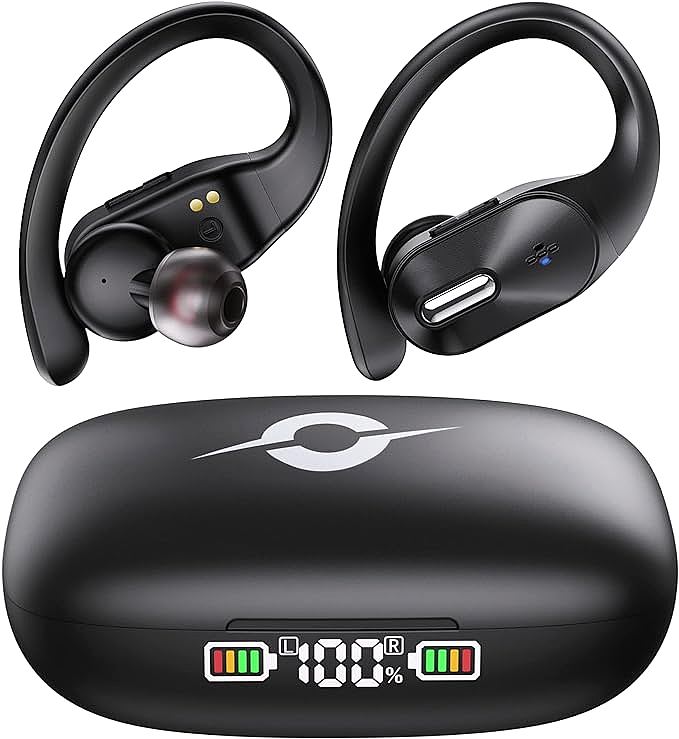
This is the mechanical foundation of the over-ear hook design. From an architectural standpoint, an ear hook functions as a suspension cantilever. By wrapping a flexible, structural polymer over the top of the ear and securing it behind the auricle, the center of mass of the headphone is fundamentally shifted.
When a downward kinetic shockwave occurs, the force is no longer acting directly against the weak friction of the ear canal. Instead, the force is distributed across the broad surface area of the ear hook and transferred to the sturdy cartilage of the outer ear. The silicone tip inside the canal is relieved of its structural duties and relegated purely to an acoustic role—maintaining the air seal necessary for pressure-wave transmission.
In hardware like the Orancu A12, the material science of this cantilever is critical. The hook cannot be rigid plastic, as the human ear varies wildly in size and angle; a rigid structure would create severe pressure points, leading to tissue fatigue and pain within twenty minutes of wear. The material must possess a specific Shore A hardness—usually a specialized thermoplastic elastomer (TPE) or memory silicone—that allows it to deform and wrap around the user's specific anatomy while retaining enough structural memory to snap back and provide a secure, locking tension.
By distributing the kinetic load across the external cartilage, the acoustic chamber remains perfectly suspended within the ear canal, completely isolated from the violent mechanical shocks occurring throughout the rest of the skeleton.
Why Does Water Destroy Electronics Instantly?
Securing the device physically is only the first phase of survival. The second, and arguably more difficult, challenge is chemical. The human body is a mobile saltwater generator, and saltwater is the natural enemy of microelectronics.
To understand why sweat is so destructive, we must look at the process of galvanic corrosion. An audio wearable contains a printed circuit board (PCB) packed with microscopic copper traces, resistors, capacitors, and a battery delivering a direct current. Pure distilled water is actually a poor conductor of electricity. However, human sweat is packed with free-floating ions, specifically sodium ($Na^+$) and chloride ($Cl^-$).
When a drop of sweat breaches the plastic casing of an earbud and bridges the gap between two copper traces carrying different voltages, it creates an instant electrolytic cell. The electrical current begins flowing through the sweat, stripping metal atoms from the positive trace (the anode) and depositing them on the negative trace (the cathode). This process, known as dendritic growth, can form microscopic metallic "bridges" that permanently short-circuit the board in a matter of minutes. Furthermore, the oxygen in the water reacts with the copper to form copper oxide, a non-conductive layer that ruins connections.
Protecting against this requires rigorous sealing protocols, categorized globally by the Ingress Protection (IP) rating system. A rating of IPX5, common in dedicated athletic gear like the Orancu A12, indicates that the device has survived a standardized test where a 6.3mm nozzle sprays water at 12.5 liters per minute from a distance of 3 meters for at least 3 minutes, from all possible angles.
Achieving this rating involves multiple layers of defense. Physical gaskets made of hydrophobic rubber are compressed around the seams of the plastic acoustic chamber. More importantly, the internal PCBs are often treated with a conformal coating—a microscopic layer of specialized polymer (like Parylene) applied in a vacuum chamber. This nano-coating fundamentally alters the surface tension of the internal components. It makes the surface highly hydrophobic, causing the contact angle of any intruding water droplet to exceed 90 degrees. Instead of spreading out and pooling across the circuitry, the liquid is forced to bead up and roll off harmlessly, completely neutralizing the threat of galvanic corrosion.
From Heavy Backpack Batteries to Micro-Lithium Cells
Providing sufficient electrical power to these ruggedized acoustic chambers is a battle against volume and mass. In the early days of portable audio, users were tethered to tape decks or CD players powered by massive, heavy alkaline AA batteries. The transition to truly wireless audio was gated entirely by the limitations of energy density.
The breakthrough that enabled modern wearables was the commercialization of the lithium-ion battery. Lithium is the lightest metal on the periodic table and possesses a highly reactive nature, allowing it to store a massive amount of electrochemical energy relative to its mass. Inside a modern earbud battery—which is often no larger than a thick coin—lithium ions physically move back and forth between a graphite anode and a lithium cobalt oxide cathode through a liquid electrolyte.
However, cramming a battery, a Bluetooth antenna, an audio digital-to-analog converter (DAC), and a speaker driver into a chassis that must weigh less than 10 grams leaves very little room for battery volume. A typical high-end earbud battery might hold around 50 to 60 milliampere-hours (mAh) of charge, yielding roughly 7 to 9 hours of continuous audio playback. For endurance athletes or users operating away from the power grid, this is insufficient.
The engineering solution was to decouple the primary power source from the wearable component, resulting in the dual-battery ecosystem: the charging case.
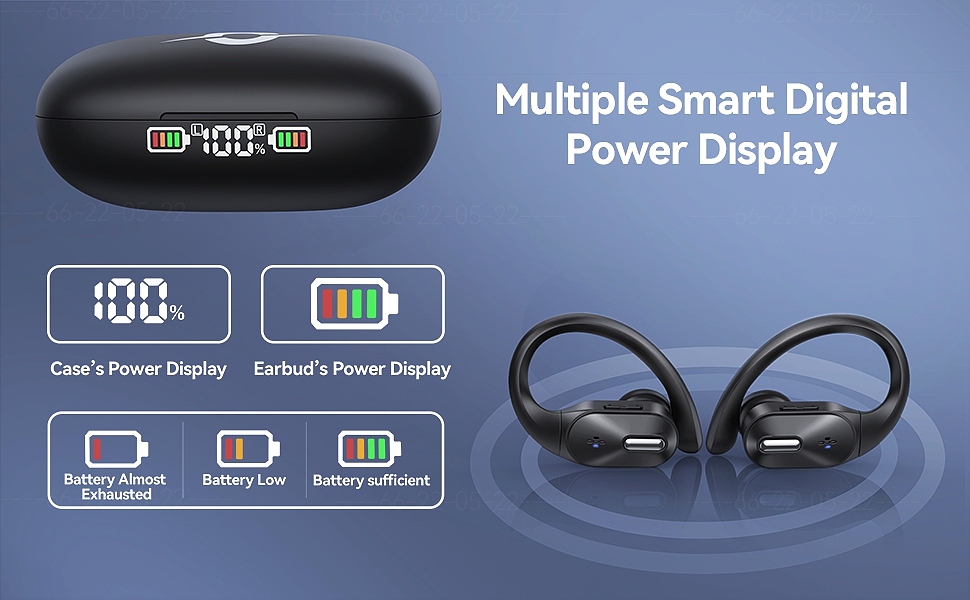
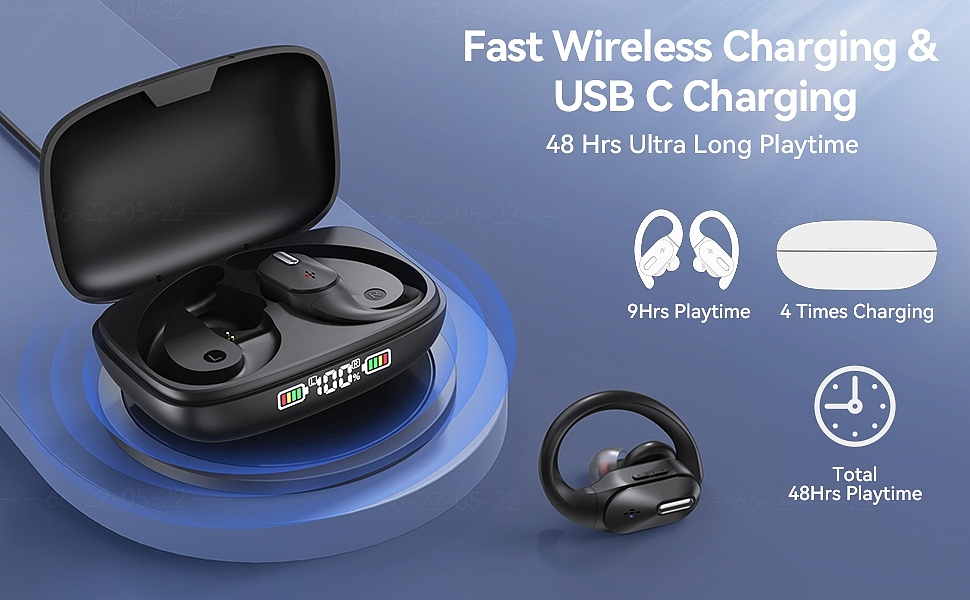
The charging case acts as a stationary power reservoir, housing a much larger lithium-ion cell (often 500mAh or more). When the earbuds are docked, the case utilizes a localized trickle-charge protocol to replenish the micro-cells inside the earbuds via exposed pogo-pin contacts. This architecture allows devices to claim massive aggregated playback times—such as the 48-hour total lifecycle seen in the Orancu A12 framework. The case becomes the logistical supply line, ensuring the kinetic front-line units (the earbuds) remain light and unencumbered while still having access to sustained, multi-day power. Modern iterations even integrate digital LED telemetry to monitor the exact voltage drop across these internal cells, translating analog electrochemical depletion into precise, human-readable percentages.
Adding More Antennas Won't Fix Your Connection
Perhaps the most frustrating failure mode of wireless audio during exercise is signal dropout—the sudden stutter or loss of music in the middle of a heavy lift or a sprint. Many consumers assume this is due to a "weak" transmitter, believing that adding more power or larger antennas would solve the problem. This fundamentally misunderstands the physics of radio frequency (RF) propagation in a biological context.
Bluetooth operates in the 2.4 GHz Industrial, Scientific, and Medical (ISM) radio band. This frequency was chosen globally because it does not require a license, but that freedom comes at a terrible cost: absolute chaos. The 2.4 GHz spectrum is densely crowded with Wi-Fi routers, microwave ovens, baby monitors, and countless other competing devices, all shouting over each other.
Worse still is the physical environment. The human body is composed of roughly 60% water. Water molecules are uniquely efficient at absorbing radiation at 2.4 GHz (this is exactly how a microwave oven heats your food). When a user places their smartphone in their left pocket and puts a primary receiving earbud in their right ear, there is no direct line of sight. The radio waves must either bounce off surrounding walls (multipath propagation) or attempt to travel directly through the dense, watery mass of the human torso. This biological barrier causes massive signal attenuation, sapping the RF energy before it can reach the receiver.
Modern protocols, like Bluetooth 5.1 and beyond, solve this not by brute-forcing higher wattage (which would drain the micro-batteries instantly), but through highly sophisticated mathematical evasion. They utilize a technique called Adaptive Frequency Hopping (AFH).
The 2.4 GHz band is sliced into 79 distinct channels. The transmitter (the phone) and the receiver (the earbud) agree on a cryptographic hopping sequence. They switch channels up to 1,600 times per second. If the earbud detects that Channel 37 is experiencing heavy interference from a nearby Wi-Fi router or is being absorbed by the user's torso, it instantly flags that channel as "bad" and dynamically rewrites the hopping algorithm to avoid it in the future.
Furthermore, True Wireless Stereo (TWS) technology has evolved. Early iterations sent the entire stereo signal to the right earbud, which then acted as a relay, transmitting the left channel through the user's brain to the left earbud—a highly unstable setup. Modern architectures utilize independent simultaneous transmission, where the smartphone beams discrete, synchronized packets to both the left and right earbuds independently. This drastically reduces latency and prevents the "cross-head" signal attenuation that plagued early sports headphones.
Tactile Feedback vs. Voice Commands in High-Stress Environments
The interface between the human and the machine must adapt to the physiological realities of the user. In a sedentary environment, navigating a touchscreen or utilizing a capacitive touch panel on the side of an earbud is effortless. However, during intense cardiovascular exercise, the user experiences a sympathetic nervous system response.
Blood is diverted away from the extremities and toward the major muscle groups. Breathing becomes rapid and shallow. The skin's surface becomes coated in a highly conductive layer of sweat. In this state, the fine motor skills required to perfectly tap a sensitive capacitive surface degrade significantly. A sweaty finger attempting to lower the volume on a touch-sensitive earbud often results in skipping the track entirely or accidentally hanging up a phone call. The conductive nature of sweat confuses the capacitance sensors, leading to phantom touches or unresponsiveness.
Similarly, voice commands—while heavily marketed by technology companies—are often functionally useless during a heavy workout. Eliciting a calm, perfectly enunciated "Volume Down" command while sprinting at 16 kilometers per hour or grinding through a heavy deadlift is biologically prohibitive. The user lacks the breath control required for voice recognition algorithms to accurately parse the acoustic data.
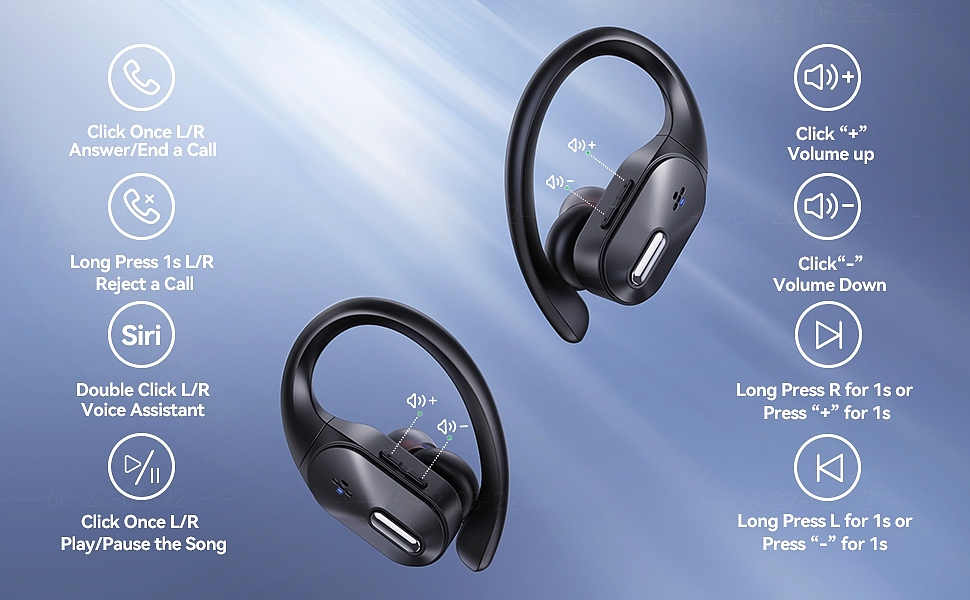
This engineering conflict necessitates a return to mechanical, tactile interfaces for high-stress applications. Hardware designed specifically for athletic use, such as the separated volume control arrays on the Orancu A12, prioritize physical buttons with distinct actuation points.
Mechanical switches provide immediate haptic feedback. A distinct "click" registers in the user's finger, confirming the action through the somatic nervous system without requiring visual confirmation or complex auditory parsing. Furthermore, assigning dedicated, independent buttons for volume up and down on each separate earpiece eliminates the need for complex, multi-tap Morse code sequences (e.g., "tap three times for volume up"). By reducing the cognitive load and accommodating the degradation of fine motor skills, tactile hardware interfaces remain the most reliable method of control when the body is under physical duress.

The Next Frontier of Biometric Audio Interfaces
The engineering principles required to anchor an acoustic device to a moving body and protect it from biological fluids have largely been solved. The cantilever designs, conformal coatings, and lithium-ion power loops discussed above represent the maturation of the wireless audio category. However, the future trajectory of these devices points away from mere audio reproduction and toward comprehensive physiological monitoring.
The external ear canal is an exceptionally data-rich location on the human body. It is heavily vascularized, located incredibly close to the brain's thermoregulatory center (the hypothalamus), and is relatively shielded from external environmental light and temperature fluctuations.
Because engineers have already successfully stabilized hardware in this exact location to deliver music, the earbud is perfectly positioned to become the ultimate biometric sensor. Future iterations of sports wearables will inevitably integrate photoplethysmography (PPG) sensors into the silicone tips to track heart rate and blood oxygen saturation with far greater accuracy than wrist-based monitors, which suffer from motion artifacts caused by arm swinging. Micro-thermistors will measure core body temperature in real-time to warn athletes of impending heat stroke.
The audio output will transition from passive entertainment to active, real-time physiological coaching, dynamically adjusting the tempo of the music to perfectly match the user's target cardiovascular zone. The sports earbud is evolving from a fragile accessory into an indispensable, ruggedized biological interface. By mastering the hostile physics of the human body in motion, audio engineering has unlocked a pathway directly to the core of athletic performance optimization.
Orancu A12 Wireless Headphones
Related Essays

BJ J8 Wireless Earbuds: Crystal-Clear Sound and All-Day Battery Life
Unleashing the Freedom of Sound: A Deep Dive into Orancu A12 Wireless Earbuds and Bluetooth Technology

Anchoring Audio in Motion: The Mechanics of Athletic Wearables

Why Does One Earbud Stop Working? A Guide to TWS Durability

The Anatomy of a $50 Miracle: How to Decode Wireless Earbud Specs and Find True Value

KENKUO K68 Wireless Gaming Earbuds: Immerse Yourself with ANC & Low Latency

Osdfono U5 Wireless Earbuds: Stay Connected and Enjoy Deep Bass on the Go

Dascert Q38 Wireless Earbuds: Your Gateway to Uninterrupted Audio Bliss

Yunerz U-ProE wireless earbuds: The Budget-Friendly Noise Cancelling Earbuds

