Air Conduction vs. Bone Conduction: The Science Behind Open-Ear Audio


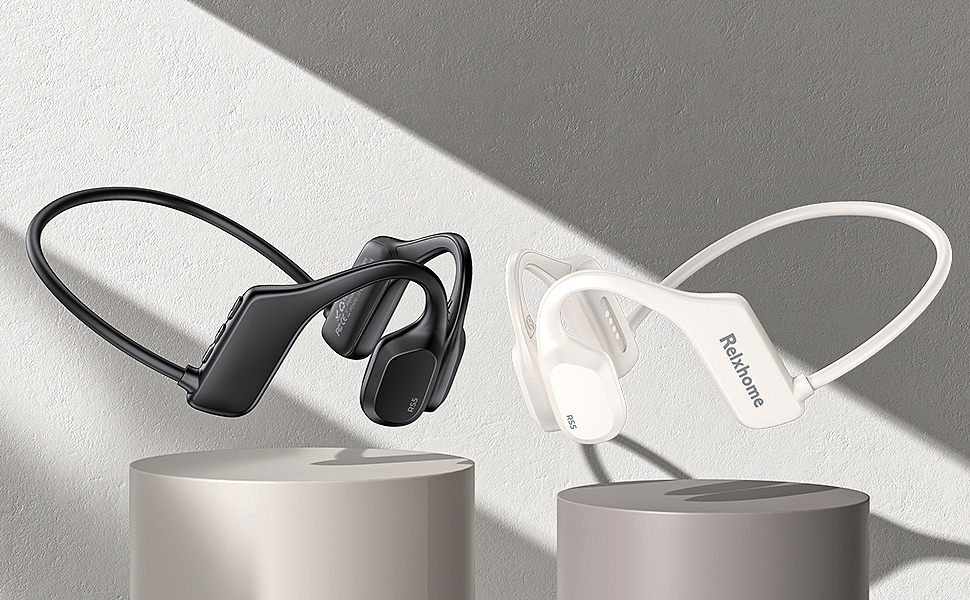
Relxhome RS5 Open Ear Headphones
The audio market is witnessing a quiet revolution. As we become increasingly aware of the dangers of total isolation in urban environments and the discomfort of long-term ear canal occlusion, "Open-Ear" headphones are surging in popularity. However, this category is often misunderstood. A common point of confusion arises from the visual similarity between two distinct technologies: Bone Conduction and Air Conduction.
Devices like the Relxhome RS5 often get mistaken for bone conduction headphones due to their wraparound titanium frames and ear-hook design. Yet, they operate on a fundamentally different principle. To make an informed choice about your personal audio gear—especially for sports and long-term wear—it is essential to understand the physics of how sound reaches your brain.

The Physics of Propagation: Air vs. Bone
The human hearing system is a marvel of biological engineering that can receive input via two primary pathways.
Bone Conduction works by bypassing the outer and middle ear entirely. Transducers rest on the cheekbones and vibrate, sending waves directly through the skull to the cochlea. While effective for those with certain types of hearing loss or for underwater use, it often suffers from a "tickling" sensation at high volumes and a restricted frequency range, particularly in the bass/treble spectrum.
Air Conduction, utilized by the Relxhome RS5, is the natural way we hear. It involves sound waves traveling through the air, being collected by the pinna (outer ear), and funneling down the ear canal to vibrate the eardrum. * The Mechanism: Instead of vibrating your skull, the RS5 uses miniature, directional speakers positioned just outside the ear canal. * The Benefit: This approach typically results in a more natural soundstage and higher fidelity compared to bone conduction, as it utilizes the ear's natural acoustic resonances. Crucially, it eliminates the uncomfortable vibration on the cheekbones that plagues many bone conduction users.
The Acoustic Challenge: Fighting Physics with DSP
While Air Conduction offers better fidelity potential, it faces a significant hurdle: Low-Frequency Dissipation. Bass waves are long and omnidirectional; without a seal to trap them in the ear canal, they tend to scatter into the environment, leading to a "tinny" sound. This is a known trade-off in open acoustic design.
To counteract this, modern open-ear devices employ Digital Signal Processing (DSP). The RS5, for instance, touts a "3RD-SAVD digital sound enhancement." While manufacturers often use proprietary terms, the engineering goal is universal: to psychoacoustically boost specific low-mid frequencies to compensate for the lack of a physical seal. * Reality Check: Users moving from sealed in-ear monitors (IEMs) to open-air designs will inevitably notice a reduction in sub-bass impact. This isn't a defect; it's physics. The goal of devices like the RS5 isn't to rattle your skull with bass, but to provide clear, balanced audio that floats alongside ambient sounds.

Ergonomics: The Role of Titanium in Stability
Since open-ear headphones cannot rely on the friction of an ear tip inside the canal to stay in place, the headband becomes the critical anchor. This is where material science plays a pivotal role. The use of Titanium Memory Alloy in frames like the RS5 is not merely a cosmetic choice; it is an ergonomic necessity.
- Clamping Force: The frame must exert just enough inward pressure to keep the drivers aligned with the ear without causing headaches. Titanium's high elasticity allows the frame to flex and return to its original shape, accommodating various head sizes better than rigid plastic.
- Weight Distribution: At approximately 3.94 ounces, the distribution of weight over the ear hook (the "tragus" area) is vital. A well-balanced frame prevents the device from bouncing during high-impact activities like running.
However, "universal fit" is a myth in ergonomics. As noted in user feedback, fixed-frame designs can sometimes press on the tops of the ears or feel loose on smaller heads. Unlike adjustable over-ear headphones, the "one-size-fits-all" nature of wraparound frames requires a compromise between stability and adjustability.

Situational Awareness: The Safety Imperative
The primary driver for the adoption of open-ear technology is safety. In audio engineering, we talk about "Auditory Masking"—when a loud sound (your music) completely obscures a quieter sound (a car approaching). Sealed earbuds are designed to maximize masking (isolation). Open-ear headphones are designed to minimize it.
For cyclists, runners, and urban commuters, this "transparency" is a safety feature. It allows the brain to process two auditory streams simultaneously: the entertainment stream (music/podcast) and the environmental stream (traffic/hazards). * Air vs. Transparency Mode: While some high-end earbuds offer "Transparency Mode" using microphones to pipe outside sound in, Air Conduction headphones like the RS5 achieve this naturally, with zero latency and zero battery drain dedicated to processing external sound. It is an analog solution to a digital problem.

The Budget Engineering Landscape
When analyzing budget-friendly entries in this category, one must understand where the costs are cut. While the RS5 utilizes Bluetooth 5.2—a modern standard offering efficient power consumption and stable connectivity—compromises often appear in peripheral interfaces. * Charging Mechanisms: Proprietary magnetic charging cables are often used to improve water/sweat resistance (by eliminating the USB cavity), but they introduce a point of failure: if you lose or break the specific cable, the device becomes useless. * Control Logic: Physical buttons vs. touch controls is an ongoing debate. In budget devices, tactile buttons are often preferred for reliability, though their implementation can vary in responsiveness.

Conclusion: Choosing Your Open-Ear Path
The Relxhome RS5 serves as a clear illustration of the Air Conduction philosophy. It is not a bone conduction headphone, nor does it try to be. It is a device engineered for those who find bone vibration uncomfortable or in-ear buds intrusive.
Understanding the distinction between these technologies empowers you to make the right choice. If you need waterproof audio for swimming, bone conduction remains superior. But for runners and cyclists seeking a natural listening experience that keeps them connected to the world, Air Conduction offers a compelling, comfortable alternative that respects both the physiology of the ear and the physics of sound.
Relxhome RS5 Open Ear Headphones
Related Essays

Air Conduction Technology Explained: The Physics Behind Open-Ear Audio

Air Conduction Audio: Why Open-Ear Headphones Change Everything

The Open-Ear Paradox: Deconstructing the TEDATATA Z18 and the Evolution of Air Conduction

The Runner's Dilemma: Decoding the Science of Open-Ear Headphones

Kargebay P-Q1: Experience Open-Ear Comfort and Safety with These Wireless Earbuds

CVILUX K1 Headphones: Open-Ear Listening, Not Bone Conduction

LIVALL LTS21 Open-Ear Headphones: Safe, Comfortable, and Immersive Sound for Your Active Life

HAYLOU 100 PurFree Bone Conduction Headphones - Open-Ear Bluetooth 5.2 Sport Headphones

Masterplug Pods-12 Wireless Earbuds

