The Physics of Imperfect Silence: Why Stronger Noise Cancellation Often Means Worse Sound
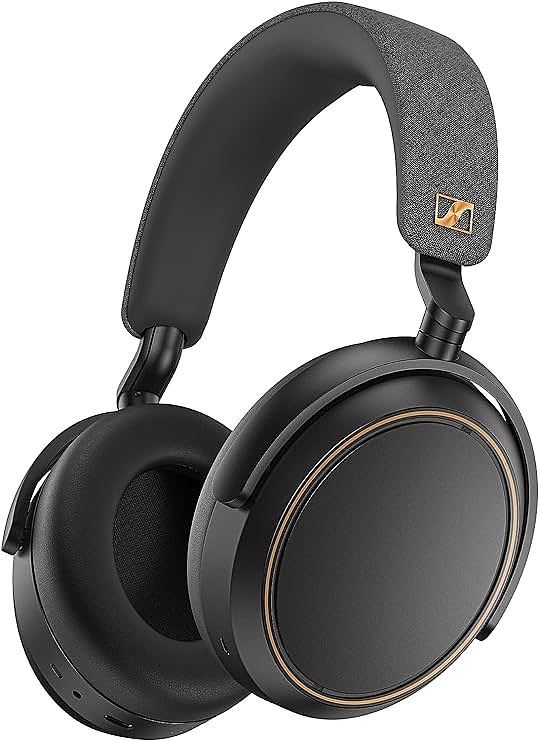
Sennheiser Consumer Audio M4 AEBT SE Momentum 4 Wireless Headphones
Your ears adjust to the drone of an airplane engine. Then someone taps your shoulder and the cabin noise rushes back in like a wave. That moment of contrast reveals something fundamental about how human hearing works: it is not a passive recorder. It is an active system that calibrates constantly to whatever sound is present.
This calibration mechanism explains why the noise cancellation in your headphones can never be truly perfect, and more importantly, why attempting to achieve perfect silence can actually degrade the sound quality you hear. The physics of acoustic transducers and the constraints of active noise cancellation create a hard trade-off that every headphone engineer must navigate. Some brands choose to push noise cancellation to its physical limits. Others, like the German company that has spent eight decades refining how people hear music, choose a different path.

The Physics of the Driver: Why Size Matters
When a headphone driver pushes air to create sound, two fundamental measurements determine what you ultimately hear: the physical size of the diaphragm and how far it must move to produce a given volume. These are not independent variables. They are linked by basic acoustics in a relationship that favors larger drivers for one specific reason: distortion.
A driver with a 42-millimeter diameter has a diaphragm area of approximately 1385 square millimeters. A driver with a 30-millimeter diameter, a common size in competing flagship models, has an area of roughly 707 square millimeters. The difference is a factor of nearly two. This matters because moving the same amount of air requires the smaller driver to displace a greater volume per unit time, which means its diaphragm must travel farther with each oscillation.
Greater excursion distance is the problem. When a diaphragm moves farther from its resting position, the magnetic field acting on the voice coil becomes non-uniform. The coil leaves the optimal zone of the magnet. Material stiffness varies with position. The result is harmonic distortion: the driver produces frequencies that were not in the original recording. These are not musical overtones. They are artifacts that muddy the sound.
The measurement that captures this is Total Harmonic Distortion, or THD. Under standardized test conditions, larger-diaphragm drivers consistently show lower THD at equivalent volume levels. A specification of less than 0.1 percent THD at 1 kilohertz and 100 dB SPL is achievable with a 42-millimeter driver. Achieving the same distortion level with a 30-millimeter driver requires either more powerful amplification or accepting higher distortion.
Low-frequency reproduction is where this effect becomes most audible. Deep bass requires moving a substantial column of air. A large diaphragm accomplishes this with relatively small excursions. A small diaphragm must work harder, pumping faster and farther, which introduces nonlinearity precisely where accuracy matters most. For anyone who values bass definition and sub-bass resolution, this is not a minor consideration. It is the difference between hearing the texture of a kick drum and hearing a vague thump.
What Happens Inside the Silencing Machine
Active noise cancellation operates on a principle borrowed from physics: opposing waveforms cancel. When an external microphone detects incoming noise, a digital signal processor calculates the inverse waveform, and the driver generates sound that destructively interferes with the unwanted noise. In theory, this produces silence. In practice, it produces a compromise, because the physics of cancellation creates side effects that engineers must manage.
The first side effect is the noise floor. The electronic circuitry that performs the detection and generation analysis produces its own sound. This is not silence. It is a low-level hiss that becomes audible precisely when the external noise has been suppressed. Users often describe this as a sense that the headphones are producing a thin, artificial quiet rather than true silence. In an anechoic chamber, this noise floor is measurable. In a quiet room, it can be audible.
The second side effect is cabin pressure. Strong anti-waves require significant driver excursion. The air pressure inside the ear cup changes as the driver pushes and pulls against the sealed volume. This pressure acts on the eardrum, creating a sensation of fullness or even discomfort. Users sensitive to this describe it as a feeling of their ears being pushed inward. The sensation varies from person to person, but it is a real physical effect that accompanies aggressive noise cancellation.
The third side effect is wind. An external microphone detects air turbulence as noise and attempts to cancel it. This creates a feedback loop where wind generates constant cancellation signals that may not correspond to any actual ambient noise worth eliminating. The result is distortion, pumping artifacts, and in some implementations, complete ANC failure. Many headphones include a wind mode that disables the external microphone entirely, recognizing that in breezy conditions, attempting noise cancellation produces worse results than simply turning it off.
These three effects are not engineering failures. They are physical consequences of the cancellation principle. Managing them requires either accepting weaker overall cancellation or accepting the side effects. There is no configuration that maximizes noise reduction while eliminating noise floor, pressure sensation, and wind sensitivity simultaneously.

The Design Choice That Defines a Product
Every manufacturer that builds headphones with active noise cancellation makes an implicit decision about where to position their product on the trade-off curve. Some optimize for maximum decibel reduction, accepting higher distortion, more pressure sensation, and greater wind sensitivity. Others optimize for sound quality, accepting weaker noise cancellation in exchange for lower distortion and fewer side effects.
The second approach requires conviction. It means reading user reviews that say the noise cancellation is not as strong as the competition and deciding that this is an acceptable trade-off for the sound quality philosophy the product represents. It means explaining to consumers that weaker noise cancellation is not a weakness but a deliberate design choice aligned with a specific set of priorities.
This is the choice that separates the products in this category. When two headphones from different manufacturers are compared and one achieves 35 decibels of low-frequency noise reduction while the other achieves 25 decibels, the difference is not primarily a matter of engineering capability. It is a matter of which set of trade-offs each company decided to accept. The 25-dB product did not fail to achieve 35 dB. It chose not to, because achieving 35 dB would have required accepting distortion and side effects that contradict the sound quality goals.
The technical implementation that enables this balanced approach is called adaptive hybrid ANC. Rather than applying maximum cancellation across all frequency ranges at all times, the system monitors the acoustic environment and adjusts its strategy dynamically. In quiet environments, it reduces processing to conserve power and minimize noise floor. In moderately noisy environments, it applies targeted cancellation that addresses the most intrusive frequencies without overdriving the driver. In very loud environments, it increases processing but still maintains boundaries to prevent the pressure sensation and distortion that accompany maximum cancellation.
This adaptive behavior is not visible in specification sheets. The headline numbers for noise reduction performance capture only peak capability, not the nuanced way a system manages its resources across different acoustic situations. A user who listens in an office environment, a coffee shop, and a subway platform experiences three different acoustic challenges, and a well-designed adaptive system responds differently to each.
The Wireless Problem: Getting Data to the Driver
Sound quality in wireless headphones depends on more than the acoustic driver. It depends on the data that reaches the driver, which in turn depends on the wireless link between the source device and the headphones.
Bluetooth audio transmission uses codecs, which are algorithms that compress audio data for wireless transmission and decompress it on the receiving end. The standard codec used by most Bluetooth audio products, SBC, has a maximum bitrate of 345 kilobits per second. This is sufficient for compressed audio but is far below the bitrate required for truly lossless transmission. CD quality, for reference, requires approximately 1411 kilobits per second.
The aptX Adaptive codec addresses this gap with a dynamic bitrate that adjusts to the radio frequency environment. Under clean conditions with strong signal, it transmits at up to 420 kilobits per second. Under moderate interference, it reduces bitrate to approximately 279 kilobits per second. Under congested conditions with competing signals, it drops to approximately 86 kilobits per second. The system monitors the RF environment continuously and makes these adjustments in real time.
This dynamic adjustment is important for a specific reason: large drivers need more data to deliver their potential. A 42-millimeter driver can resolve more detail than a 30-millimeter driver when given the same audio signal. But if the wireless link delivers compressed, low-bitrate audio, the additional resolution capability of the larger driver goes unused. The driver is physically capable of reproducing detail that the wireless signal does not contain.
Ensuring that the driver receives appropriately encoded audio across varying RF conditions is the function of the dynamic bitrate system. It is not sufficient to simply have a large driver. The wireless infrastructure must deliver sufficient data to exercise that driver capability. The combination of large diaphragm area and adaptive bitrate management represents a coherent engineering philosophy: build a driver that can resolve detail, then ensure the wireless link can deliver detail to that driver.

The Endurance Dimension
Battery life in wireless headphones is not simply a convenience metric. It is a physical constraint that shapes what the product can do. A headphone with 24 hours of battery life cannot run aggressive noise cancellation processing continuously. A headphone with 60 hours of battery life has more headroom to allocate power to different functions without sacrificing endurance.
The 60-hour specification for this product class is approximately double that of the closest competitors. This is not achieved through a larger battery alone. It results from a combination of efficient Bluetooth 5.2 implementation, adaptive ANC processing that reduces computational load during quiet periods, and efficient driver design that does not require continuous high-power processing to maintain sound quality.
In practical terms, 60 hours transforms the relationship between the user and the device. A two-hour daily commute yields 30 days of usage before charging. An eight-hour workday yields a full week. International travel with extended listening sessions yields three full days of continuous use. The user does not think about battery management. The device simply endures.
The fast charge specification of 10 minutes providing 6 hours of playback addresses the edge case where depletion occurs. This is not a full charging cycle but a rapid top-up that ensures the device is never truly unavailable. The mechanical design that allows USB-C charging further ensures compatibility with common charging cables and power banks.
What the Listeners Say
Objective measurements and engineering principles establish what the product attempts to do. User listening sessions reveal how well it succeeds.
An listener who described themselves as an armchair audiophile conducted an extended evaluation across multiple music genres over an eight-hour session. The description of finding beauty in all genres suggests tonal balance that does not favor one frequency range at the expense of others. The sustained listening session without fatigue suggests comfort and consistent sound signature over time.
Another listener identified as a reviewer who emphasized bass performance noted that the product performs highs exceptionally. This phrasing indicates a frequency response curve that does not boost bass at the cost of high-frequency detail. For genres where cymbals, string instruments, and vocal sibilance matter, this is a significant finding.
The pattern in positive evaluations converges around two attributes: sound quality and endurance. Listeners who prioritized these attributes found satisfaction. Listeners who prioritized maximum noise cancellation found the product less suitable. This is not a flaw. It is a market segmentation decision that aligns product attributes with user priorities.
The Argument No One Else Is Making
Most headphone coverage focuses on specification comparisons. This model measures 30 decibels of noise reduction. That model measures 35 decibels. Therefore, one is better. This logic ignores what those numbers mean in practice and why the trade-offs exist.
The reality is that noise cancellation performance is not a single-dimensional quality to maximize. It is a set of physical compromises that interact with sound quality, comfort, and endurance. A product that optimizes for maximum decibel reduction necessarily accepts side effects that may degrade the listening experience in other ways. A product that optimizes for sound quality necessarily accepts weaker noise cancellation performance.
The question consumers should ask is not which product has the strongest noise cancellation. It is which product has the right noise cancellation for their priorities. For someone who flies weekly and needs to eliminate engine noise, maximum cancellation matters. For someone who listens in varied environments and values musical accuracy, a more balanced approach may deliver better overall satisfaction.
Understanding the physics clarifies the choice. Large drivers move less air per unit distance, which reduces distortion. Adaptive ANC manages trade-offs dynamically rather than applying maximum processing continuously. Efficient wireless codecs ensure the driver receives sufficient data to exercise its capability. Extended battery life enables longer listening sessions without anxiety about depletion.
None of these engineering decisions are accidental. They reflect a coherent philosophy about what headphones should accomplish: accurate sound reproduction across a wide frequency range, with sufficient noise cancellation to make that reproduction audible in everyday environments, without sacrificing the fidelity that makes extended listening worthwhile.
The next time you encounter a product description that boasts about noise cancellation leadership, consider what that leadership costs. Consider what trade-offs were accepted to achieve those decibel numbers. Consider whether those trade-offs align with your listening priorities or conflict with them.
The physics of imperfect silence is not a limitation. It is a framework for understanding why the products that populate this category differ, and why those differences matter more than the specifications suggest.
Sennheiser Consumer Audio M4 AEBT SE Momentum 4 Wireless Headphones
Related Essays
50mm Drivers Explained: How Driver Size Shapes Headphone Sound Quality

The Tech Inside Your Earbuds: A Guide to Bluetooth, IP Ratings, and More

Uliptz WH203A User Manual: Pairing, EQ Modes and Battery Tips
Bluetooth Headset Faults Explained: Mic Dropouts, Choppy Audio, and Wind Noise

The Real Reason Your ANC Headphones Still Let Voices Through

Spmmmner Wireless Earbuds – A Seamless Listening Experience

MUDHEN in Ear Wireless Headphones - Powerful Sound and Waterproof Design

CTM ORUN2 Wireless Bone Conduction Headphones - Recommended for Sports and Outdoor Activities

DETHONRAY BQEYZ Summer - Ultimate Audiophile Experience
