The Electric Air: Deconstructing High-Impedance Audio Physics
Update on Jan. 25, 2026, 8:15 p.m.
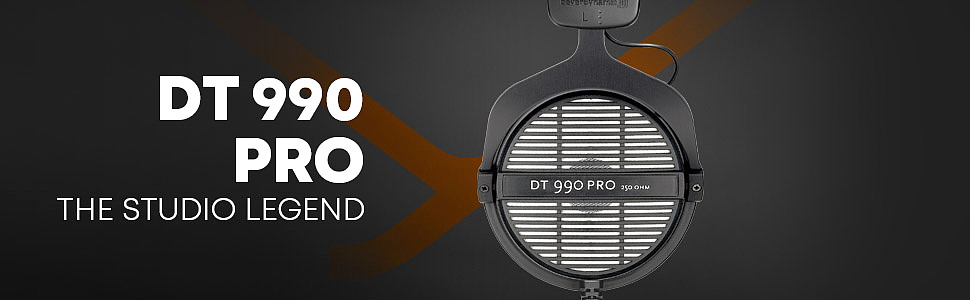
In the world of consumer electronics, efficiency is usually the goal. We want devices that run longer on smaller batteries and produce maximum output from minimal input. However, in the realm of professional audio engineering, this logic is often inverted. High-fidelity reproduction frequently demands inefficiency, or more accurately, high electrical resistance. This brings us to the often-misunderstood specification of dt 990 pro 250 ohm headphones: impedance. Why would engineers deliberately design a headphone that is “harder” to drive? The answer lies not in volume, but in control, mass, and the physics of transient response.
The Mass-Control Paradox
To understand high impedance, one must look at the microscopic component at the heart of a dynamic driver: the voice coil. This is a coil of wire attached to the diaphragm, suspended within a magnetic field. When an electrical signal passes through it, the coil becomes an electromagnet, pushing and pulling against the permanent magnet to move the diaphragm and create sound.
The Beyerdynamic DT 990 Pro 250 ohm illustrates a crucial engineering trade-off. To achieve an impedance of 250 ohms, the voice coil is wound with extremely thin copper wire. Thinner wire has higher electrical resistance (impedance), but crucially, it also has significantly less mass than the thicker wire used in low-impedance (e.g., 32 ohm) models.
This reduction in mass is the secret weapon. According to Newton’s Second Law (F=ma), a lighter object requires less force to accelerate and, more importantly, less force to stop. In audio terms, this translates to “Transient Response”—the ability of the driver to react instantly to the start of a sound (like a snare hit) and stop instantly when the sound ends. A lighter, high-impedance voice coil suffers less from inertia, resulting in a sound that is perceptually “faster” and more detailed, with less blurring between rapid notes.
Electrical Damping and Amplifier Interaction
The interaction between the headphone and the amplifier is governed by the “Damping Factor,” which is the ratio of the headphone’s impedance to the amplifier’s output impedance. High-impedance headphones like the DT 990 Pro naturally allow for a higher damping factor with a wider range of amplifiers.
This electrical damping acts like a brake system for the driver. After a bass note is played, the diaphragm wants to keep moving due to momentum (ringing). High electrical damping generates a counter-electromotive force (back EMF) that resists this extra motion, tightening the bass response. While a 32-ohm headphone depends heavily on the amplifier having a near-zero output impedance to maintain this control, a 250-ohm design is more forgiving of the amplifier’s variance while inherently offering superior electromagnetic control over the diaphragm’s excursion.

The Diffuse-Field Equalization Target
The frequency response of studio headphones is rarely “flat” in the literal sense. Instead, engineers often aim for “Diffuse-Field Equalization.” This tuning attempts to mimic the tonal balance of a flat loudspeaker system heard in a reverberant room.
The DT 990 Pro is famous for its specific interpretation of this curve, often characterized by a lift in the treble frequencies (around 8-10 kHz) and a slight boost in the bass. From a technical standpoint, this “V-shaped” signature acts as an acoustic microscope. The elevated treble allows recording engineers to easily detect hiss, background noise, and vocal sibilance that might be masked on warmer, darker headphones. It transforms the headphone from a device for enjoyment into a tool for error detection, prioritizing the revelation of technical flaws in the recording chain.
Future Horizons: The Limits of Dynamic Drivers
As we look to the future of transducer technology, the dynamic driver continues to evolve, pushed by material sciences like beryllium coatings and biocellulose diaphragms. However, the fundamental physics of the voice coil remains constant. While planar magnetic and electrostatic technologies offer alternative methods to achieve low mass (by eliminating the voice coil entirely), the high-impedance dynamic driver remains the most efficient way to achieve professional-grade transient response in a robust, field-serviceable form factor. The continued relevance of 250-ohm designs in an era of low-voltage mobile devices stands as a testament to the enduring importance of pure physics in audio reproduction.