The Geometry of Flavor: Grinding for Consistency and Extraction in Entry-Level Machines
Update on Jan. 12, 2026, 9:11 a.m.
Coffee brewing is, at its core, a chemical extraction process. Water acts as a solvent, dissolving specific compounds (caffeine, lipids, acids, sugars) from the solid coffee bean. The rate and quality of this extraction are governed by one primary variable: Surface Area.
The job of a coffee grinder is to increase the surface area of the roasted bean in a controlled manner. Ideally, every single particle would be the exact same size, exposing the exact same surface area to the water. This would allow for perfectly uniform extraction.
In reality, grinding creates a chaotic distribution of particle sizes, from boulders to microscopic dust.
The SHARDOR CG835B, an entry-level electric burr grinder, sits at the intersection of affordability and precision. It claims “Uniform Coffee Grounds” via “Metallic Flat Burrs.” But what does uniformity mean in the context of a $40 machine? And how does the geometry of the burr affect the flavor in the cup? This article explores the Particle Size Distribution (PSD), the physics of Flat Burrs, and how to navigate the 16 settings to optimize extraction.
The Physics of the Burr: Flat vs. Blade
To understand the value of the Shardor, we must first look at what it replaces: the Blade Grinder.
A blade grinder is a blender. It spins a metal propellor that smashes beans randomly.
* Stochastic Chaos: Some beans are hit 50 times (becoming dust); some are hit twice (remaining boulders).
* Bimodal Distribution: The result is a mix of dust and chunks. The dust over-extracts instantly (bitter), and the chunks under-extract (sour). The resulting cup is muddy and unbalanced.
The Shardor uses Metallic Flat Burrs. * The Milling Principle: Beans are drawn between two serrated plates. They cannot exit the grinder until they are broken down to a size smaller than the gap between the plates. * Controlled Fracture: This creates a physical constraint on the maximum particle size. While it still produces some fines (dust), the majority of the particles are confined to a specific size range (the “Target Peak”).
This geometric constraint is the foundation of better coffee. It allows the user to control the surface area, and thus the extraction rate.
The Spectrum of Grind: Navigating 16 Settings
The Shardor offers 16 Grind Settings. In the world of coffee, 16 is a finite number, but it covers a vast spectrum of fluid dynamics.
The Coarse End: French Press and Percolation
At the coarse settings (highest numbers), the burrs are furthest apart. The particles resemble sea salt. * Diffusion Kinetics: In immersion brewing (French Press), water sits with the coffee. The extraction is driven by diffusion—compounds moving from high concentration (inside the particle) to low concentration (the water). * Surface Area Requirement: Because the contact time is long (4 minutes), we need less surface area to avoid over-extraction. Coarse particles slow down the diffusion rate. * The “Fines” Problem: If a grinder produces too many fines at coarse settings, these fines will pass through the French Press mesh screen, creating a “muddy” mouthfeel in the cup. This is a common challenge for entry-level flat burrs, which tend to generate more fines than conical burrs.
The Fine End: Espresso and Pressure
At the fine settings (lowest numbers), the burrs are nearly touching. The particles resemble flour. * Flow Resistance: In espresso, the coffee puck must provide resistance to pressurized water (9 bars). The fine particles pack together, creating a tortuous path for the water. * Surface Area Explosion: The massive surface area allows for rapid extraction in just 25 seconds. * The Shardor Limit: While the Shardor can grind fine, it is not a “Stepless” grinder. The jump between Setting 1 and Setting 2 might be too large for dialing in a precise espresso shot on a commercial machine. However, for pressurized portafilters (common in home espresso machines), the “Fine” setting is often sufficient to create the necessary resistance.
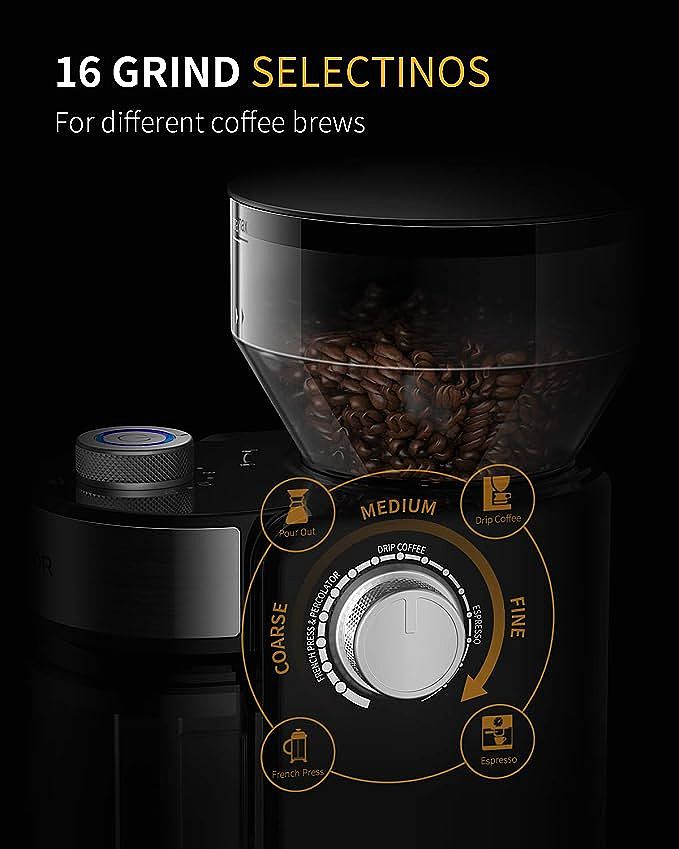
The image above highlights the Grind Dial. This physical interface controls the vertical distance between the burrs. The tactile click of the dial corresponds to a vertical movement of maybe 50-100 microns. This mechanical precision is what separates a “tool” from a “gadget.”
Consistency and Alignment: The Hidden Variables
Why does a $2000 grinder exist if a $40 one uses burrs too? The answer lies in Alignment and Stability. * Axial Runout: If the motor shaft wobbles even slightly, the gap between the burrs changes as they spin. One side might be grinding at 200 microns, the other at 400 microns. This widens the particle distribution curve, reducing clarity. * Chassis Rigidity: Plastic bodies (like the Shardor) can flex under the torque of grinding light-roast (hard) beans. This flex changes the burr gap momentarily.
For the entry-level user, this means the Shardor is optimized for Medium to Dark Roasts. Dark roasts are more brittle and break easily, requiring less torque and causing less chassis flex. They are also more forgiving of wider particle distributions. Light roasts, which require extreme uniformity to extract sweetness without acidity, push the mechanical limits of an entry-level chassis.
The Workflow of Quantity: Dosing by Time
The Shardor features a “2-14 Cups” selector. It is important to understand that this is a Timer, not a scale. * The Flow Rate Variable: The grinder does not know how fast the beans are falling. Hard beans grind slower; soft beans grind faster. * The Calibration: Setting it to “2 Cups” simply runs the motor for (e.g.) 10 seconds. Depending on the bean density and grind size, this might yield 15g or 20g of coffee.
For the serious barista, this introduces a variable. The “Best Practice” is to use a separate digital scale to weigh the output. However, for the casual user (the target demographic), the timer provides “Good Enough” accuracy, removing the friction of weighing every single morning. It trades absolute precision for workflow velocity.
Conclusion: The Gateway to Flavor
The SHARDOR CG835B is a gateway device. It introduces the user to the fundamental concept of Uniformity. By replacing the chaotic chopping of a blade with the systematic milling of a burr, it unlocks the potential of the coffee bean.
It is not a perfect machine—physics dictates that at this price point, alignment and static issues will exist. But it solves the biggest problem in home coffee: the boulders-and-dust extraction. It allows the user to explore the spectrum of extraction, from the slow diffusion of a French Press to the rapid percolation of a drip brewer. It turns coffee making from a lottery into a science.