The Science of Focus: How Noise Cancelling Headphones Re-Engineer Your Brain for the Gym
Update on Oct. 29, 2025, 6:28 p.m.
It’s not about blocking the world out. It’s about creating the perfect space for your mind to perform. Welcome to your first lesson in cognitive architecture.
Let’s be honest. The gym can be a terrible place to focus.
Between the clanking weights, the droning treadmills, and the questionable pop music blasting over the speakers, it’s a full-on sensory assault. You’re there to build your body, but you spend half your mental energy just trying to build a wall against the chaos. We often treat focus as an act of pure willpower, like pushing through one last rep.
But what if I told you that’s the wrong approach? What if the secret to next-level concentration isn’t about trying harder to ignore distractions, but about using technology to intelligently redesign the very environment your brain operates in?
This is your guide to becoming an architect of your own focus. We’re going to dive into the simple physics of how to literally erase sound, explore the hidden “mental budget” your brain uses every second, and see how brilliant engineering can transform a simple pair of headphones into a powerful tool for peak performance.

Lesson 1: The Physics of Vanishing Sound
To control your sonic world, you first need to understand the enemy. Sound isn’t a thing; it’s a ripple of energy—a pressure wave moving through the air with peaks and troughs. For centuries, our only defense was brute force: thick walls, heavy doors, or stuffing cotton in our ears. This is called passive noise isolation. It works, but it’s clumsy.
Active Noise Cancellation (ANC) is different. It’s elegant, precise, and feels like magic. It doesn’t just block a sound wave; it erases it with its perfect opposite.
This principle is called destructive interference, and it’s surprisingly simple.
Think of it like this: Imagine the peak of a sound wave is a +1 and the trough is a -1. Now, what if you could create another sound wave that’s a perfect mirror image—a -1 where the original has a +1? When you play them both at the same time, they cancel each other out. The result is zero. Silence.
This isn’t a new idea, but it wasn’t until recently that technology became fast enough to pull it off in real time. Here’s how it works in your headphones:
- A tiny microphone on the outside of the earcup “listens” to the ambient noise around you (like the hum of the gym’s AC).
- A high-speed processor inside instantly analyzes that soundwave and generates its exact inverse—the “anti-noise.”
- This anti-noise is played through the speaker inside the headphone.
When the original noise and the new anti-noise meet at your eardrum, they annihilate each other. The drone of the treadmill simply vanishes before your brain ever has to deal with it. It’s a stunning feat of physics, but what it does for your mind is even more impressive.

Lesson 2: Your Brain’s Hidden Energy Budget
Your brain isn’t just a passive listener; it’s an active filter. It’s constantly working to separate important signals from irrelevant noise. This is called selective attention, and it’s what lets you hear your friend in a loud restaurant.
But this filtering process isn’t free. It costs mental energy. It taps into a very limited resource.
This is the core idea behind Cognitive Load Theory. Think of your working memory—the part of your brain you use for active thinking, learning, and problem-solving—as having a finite amount of RAM, just like a computer. Every single task, no matter how small, uses up some of this RAM.
Psychologists talk about extraneous cognitive load, which is the mental effort spent on things that are irrelevant to your main goal.
The clatter of weights, the chatter from across the room, the low hum of the ventilation—each of these is a distraction that your brain has to actively spend energy to filter out. Every bit of mental RAM spent on ignoring that noise is RAM that you cannot use for focusing on your muscle contraction, maintaining proper form, or pushing your limits.
You feel this as mental fatigue or a struggle to concentrate. It’s not a failure of willpower; your brain’s RAM is simply full.
This is where ANC becomes more than just a cool feature—it becomes a cognitive performance tool. By erasing ambient noise before it reaches your brain, ANC effectively outsources the job of filtering. It’s a cognitive offloader. It frees up your mental RAM, giving you more resources to dedicate to what actually matters: your workout.
The result isn’t just a quieter environment; it’s an expanded capacity for focus and a faster path to achieving a state of flow.

Case Study: How Science Becomes a Tool
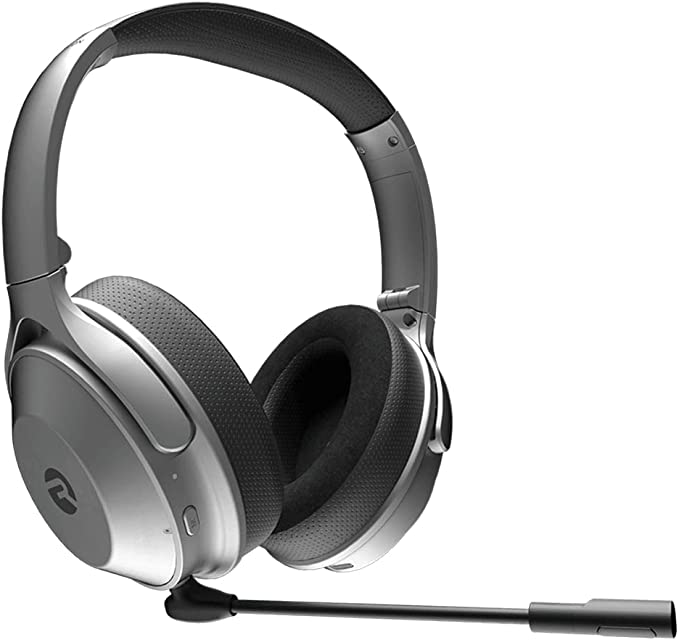
To see how these principles of physics and psychology come to life, let’s look at how they are applied in a product engineered specifically for the demanding gym environment, like the BlueAnt PUMP X headphones. This device serves as a perfect case study in how abstract science is translated into tangible solutions.
- Applied Physics (ANC): The Active Noise Cancellation is a direct application of destructive interference. It’s specifically tuned to combat the constant, low-frequency drones common in gyms, directly reducing the extraneous cognitive load on an athlete.
- Applied Psychoacoustics (X-Mode): When a user activates the “X-Mode” bass boost, they are leveraging the science of psychoacoustics. Our brains are hardwired to associate powerful, low-frequency sounds with energy and motivation. This isn’t just about making music sound “better”; it’s an engineered auditory cue designed to enhance psychological drive and performance.
- Applied Thermodynamics (Cooling Gel Pads): Intense workouts generate heat. The inclusion of interchangeable cooling gel ear pads is a direct application of thermodynamics. The gel has high thermal conductivity, which helps draw heat away from the skin, managing a key physiological stressor and allowing the user to remain in their optimal performance zone for longer.
- Applied Biomechanics (Secure Fit): A common complaint with workout headphones is stability. The strong clamping force of the PUMP X isn’t an oversight; it’s a calculated ergonomic decision based on biomechanics. It ensures the headphones remain stable during explosive, high-impact movements, prioritizing function over all else.
This single product demonstrates how a deep understanding of science can create a system engineered from the ground up to build a superior performance environment for your mind and body.

You Are the Architect
We started with a simple problem: the modern world is too loud. But the solution isn’t just about finding quiet. It’s about understanding that focus is a resource, and like any resource, it can be managed.
Technologies like Active Noise Cancellation are more than just a feature; they represent a new way of interacting with our environment. They are tools for sensory architecture, giving us the power to control our perceived reality. They let us build a sanctuary for deep work and peak performance, whether we’re in the gym, on a plane, or at our desk.
The future of personal achievement lies not just in training our bodies and minds, but in intelligently designing the sensory worlds they inhabit. You are no longer just a passive occupant of your environment. You are its architect. And in the focused silence you create, you can finally hear yourself perform.