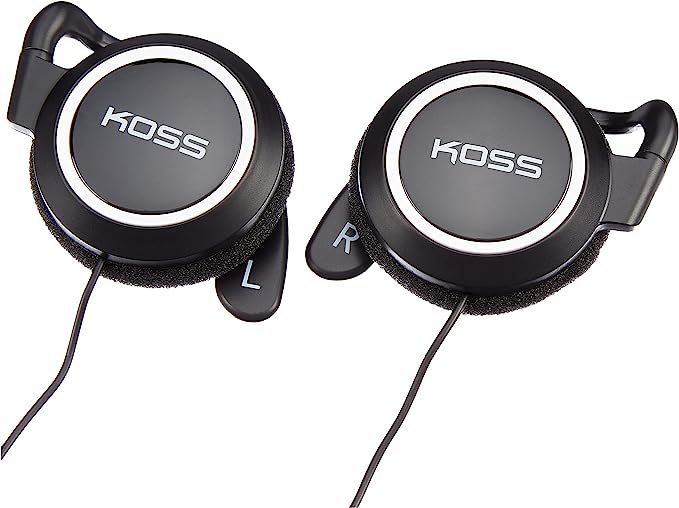
Koss KEB25iW Wired Earbuds – Decent Sound Quality at an Affordable Price
Update on June 28, 2025, 12:39 p.m.
Walk down any electronics aisle, and you’ll face the same gamble: a wall of affordable earbuds, all promising great sound for a fraction of the price of their premium counterparts. It’s a world of hope and frequent disappointment. In this landscape, the Koss KEB25iW presents a fascinating puzzle. On one hand, you have glowing five-star reviews from loyal fans proclaiming, “Koss is Boss.” On the other, you find detailed critiques from discerning listeners calling them “a rare miss by Koss.”
How can a single, sub-$30 product from a legendary American audio pioneer elicit such a passionate and polarized response? This isn’t just a matter of personal taste. The answer lies buried in the laws of physics, the quirks of human hearing, and the art of intentional engineering compromise. Let’s put on our lab coats and dissect the science behind this sonic enigma.
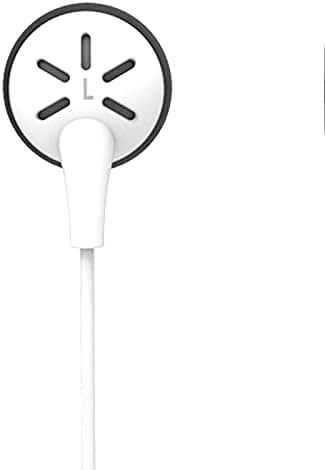
The First Clue: The Science of the Seal
The KEB25iW boasts of being “noise isolating,” a term that requires a crucial distinction. This isn’t the battery-powered magic of Active Noise Cancellation (ANC) that electronically erases the world around you. This is Passive Noise Isolation, and it’s governed by one simple, unyielding principle: a perfect physical seal.
Think of it like trying to soundproof a room. If you leave a window cracked, even a tiny bit, outside noise will flood in. Your ear canal is that room, and the earbud tip is the window. If the tip doesn’t create an airtight seal, two things happen. First, ambient noise gets in, ruining your immersion. But more importantly, a fundamental law of acoustics comes into play: low-frequency sound waves—the bass—need a sealed chamber to build pressure and be fully perceived by your eardrum.
This single principle brilliantly explains the experience of the user who noted, “you need to put a lot of pression in your ear, so you can get a proper sound and insulation.” They weren’t just describing discomfort; they were describing a failed acoustic experiment. Without that seal, the bass literally leaks out into the open air before it can be heard, leaving the music sounding thin, tinny, and lifeless. The included foam tips, which expand to the unique shape of your ear canal, are often the key to unlocking the intended sound by creating a superior seal.

The Sonic Fingerprint: Decoding the V-Shape
Once a proper seal is achieved, we can analyze the earbud’s true character, what acousticians call its frequency response. One reviewer, Matthew Orlandini, provided a perfect sonic fingerprint, describing “brilliantly detailed treble” and “deep and plentiful sub-bass,” but a “mid-range [that] is virtually absent.”
He identified this as an “extreme V-Shape.” Imagine the spectrum of sound as a landscape. A V-shaped signature aggressively carves out this landscape, boosting the deep valleys of bass and the high peaks of treble while scooping out the essential plains of the mid-range where most vocals and core instruments reside.
This is arguably the most popular sound signature in consumer audio, and it functions much like a popular photo filter. It instantly makes the “picture” pop with high contrast and vibrant saturation. It adds punch, sizzle, and an immediate sense of excitement. But it comes at a cost. That scooped-out mid-range can leave vocals sounding distant and rob instruments of their natural warmth and body. This leads to the crucial question: why would talented engineers at a company like Koss intentionally design something so… colored?
The Motive: A Secret of Human Hearing
The answer isn’t a mistake; it’s a clever and calculated piece of psychoacoustics. The engineers weren’t just tuning for a microphone in a lab; they were tuning for the human brain. Our hearing is not a perfectly flat, linear instrument. As landmark research from the 1930s revealed in the Fletcher-Munson curves, our ears are naturally less sensitive to very low and very high frequencies, especially at lower listening volumes.
At a quiet, conversational level, bass and treble frequencies need to be physically louder than mid-range frequencies for us to perceive them as being at the same volume.
The V-shape signature is a direct, intentional compensation for this quirk. By boosting the bass and treble, the KEB25iW is essentially pre-correcting the sound to match the natural curve of our hearing during casual, low-to-moderate volume listening. It’s a sonic trick designed to make the music sound fuller, richer, and more perceptually “balanced” in the exact scenarios—a walk, a bus ride, studying in a library—where these earbuds are most likely to be used. It’s not designed for accuracy; it’s designed for satisfaction.
Examining the Evidence: The Physical Reality
Of course, these earbuds exist in the physical world, a world of manufacturing tolerances and material trade-offs. While the source material lacks official specifications for the driver size or impedance—data crucial for a full technical analysis—the user feedback provides the final clues.
One user reported “terribly unbalanced” sound, with one earbud much louder than the other. This is a classic sign of loose manufacturing tolerances. At this price point, ensuring every tiny dynamic driver (the miniature speaker inside the housing) performs identically is a major challenge. Another user’s report of the cable developing static and the jack becoming loose points to the reality of budget materials. The internal wiring is thin, and the strain relief may not be robust enough for years of daily tugging.
And what of the legendary “laundry survivor”? While a fantastic anecdote, it’s more a testament to luck than design. It highlights the random nature of product durability. The simple, sealed plastic housing might just happen to protect the electronics from a single, sudsy ordeal. Ultimately, the single-button remote and lack of volume controls are not oversights; they are intelligent decisions to strip away complexity and cost, focusing every available cent on the core acoustic performance.
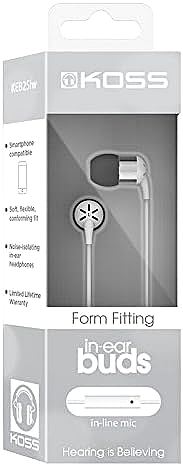
The Verdict: More Than Just Earbuds
So, we return to our puzzle. The Koss KEB25iW is neither a champion nor a failure. It is a brilliant, targeted acoustic solution. The polarized reviews are not a sign of inconsistent quality, but of a fundamental clash between listener expectations and a highly specific engineering goal.
The listener who loves it is likely using it as intended: for casual listening where the V-shaped signature compensates for our natural hearing, creating a lively and engaging experience. The listener who dislikes it is likely a critical audiophile judging it against a standard of flat, neutral accuracy, a standard it was never designed to meet.
The Koss KEB25iW is a lesson etched in plastic and wire. It teaches us that “good” sound is relative, that engineering is an art of compromise, and that sometimes, the most interesting products are not the flawless ones, but the ones that make us ask, “Why?” By understanding the science behind the seal and the secret of the V-shape, you’re now equipped to listen with more than just your ears. You can listen with your brain, decoding the story behind the sound of any audio device you encounter.