Acoustic Resilience: Engineering Audio Devices for Extreme Kinetic Environments
Update on March 4, 2026, 8:06 p.m.
The intersection of human athletic performance and portable microelectronics presents a unique theater of engineering warfare. Devices tasked with delivering high-fidelity audio during rigorous physical activity must survive a relentless barrage of biomechanical shock, highly corrosive biological fluids, and congested radio frequency environments. The design of modern sports-focused acoustic hardware is no longer just about speaker quality; it is an exercise in extreme material science and structural resilience.
By analyzing the specific architectural choices in consumer hardware—such as the STRXBBR Power HBQ Pro-1 wireless earbuds—we can dissect the fundamental physical challenges of maintaining an uninterrupted, high-quality audio stream when the human body is pushed to its metabolic limits.

The Miniature Submarine in Your Ear Canal
To understand the necessity of robust ingress protection, one must first recognize that human sweat is a highly destructive substance. It is not pure water; it is a warm, saline electrolyte solution containing sodium chloride, potassium, urea, and lactic acid. When this fluid breaches the casing of an electronic device and bridges the gap between two charged copper traces on a printed circuit board, it initiates immediate galvanic corrosion. Within hours, the circuitry can be entirely dissolved.
Defending against this requires sealing the device with the rigor of marine engineering. The IPX7 standard is a critical benchmark in this domain. The “7” signifies that the hardware can survive complete submersion in one meter of static water for up to thirty minutes. Achieving this rating requires a multi-layered defense strategy.
Devices like the STRXBBR unit employ a “close-system airtight body.” This involves eliminating traditional mechanical seams wherever possible through ultrasonic welding, which fuses plastic housing halves at a molecular level. Where physical gaps must exist—such as around charging pins or acoustic vents—engineers utilize polymer nano-waterproof materials. Through a process like plasma-enhanced chemical vapor deposition (PECVD), a microscopic hydrophobic (water-repelling) polymer layer is bonded to the internal components. This coating fundamentally alters the surface energy of the hardware. When sweat manages to penetrate the outer shell, it cannot flatten out and seep into the microprocessors via capillary action; instead, it is forced to bead up into tight spheres that harmlessly roll away from critical junctions.
Why Water and Capacitive Touch Are a Disastrous Mix
A prevalent trend in modern industrial design is the eradication of physical buttons in favor of sleek, capacitive touch surfaces. However, when placed in a high-moisture, high-kinetic environment, this aesthetic choice introduces a severe functional failure mode.
Capacitive touch sensors operate by projecting a uniform electrostatic field across a surface. Because the human body is conductive, bringing a finger near the surface distorts this local electrical field, registering as a “tap.” The fatal flaw is that water—specifically the mineral-rich sweat pouring down a runner’s face—is also highly conductive.
When a drop of sweat lands on a capacitive sensor, it violently warps the electrostatic field. The microprocessor becomes confused, unable to distinguish between the user’s finger and a stray bead of moisture. This results in “ghost touches,” where the device wildly skips tracks, pauses music, or hangs up phone calls without human input.
This is precisely why purpose-built athletic equipment frequently reverts to mechanical switches. Implementing physical multi-function and volume rocker buttons guarantees absolute deterministic input. A mechanical switch requires a specific threshold of physical actuation force (measured in grams) to close an internal electrical circuit. Water cannot inadvertently apply this targeted mechanical force. Furthermore, the tactile “click” provides immediate, unmistakable feedback to the user’s somatosensory system, confirming the command has been registered even when wearing gloves, running through heavy rain, or navigating a chaotic gym environment.

What Does a 14.2mm Diameter Actually Move?
The fundamental mechanism of a dynamic speaker driver is relatively straightforward: an alternating electrical current passes through a voice coil suspended in a magnetic field, causing the coil to oscillate. This coil is attached to a diaphragm, which pushes and pulls atmospheric air molecules to create the pressure waves our brains interpret as sound.
However, the physics of low-frequency sound reproduction (bass) dictates a rigid geometric constraint: to produce deep bass, you must displace a large volume of air. In the microscopic confines of an in-ear device, surface area is the most critical variable.
A 14.2mm full-range dynamic driver represents a massive physical footprint relative to the human concha (the bowl of the ear). This expanded surface area allows the diaphragm to move a significantly larger column of air per oscillation compared to standard 6mm or 8mm micro-drivers, yielding the high-amplitude, low-frequency impact necessary to overcome the masking effect of ambient environmental noise during a workout.

Yet, surface area alone is insufficient; the material science of the diaphragm is equally critical. If the diaphragm is too heavy, it suffers from severe inertial lag, resulting in muddy, undefined transient responses. If it is too thin, the massive physical excursion required for bass notes will cause the material to flex and warp, generating harmonic distortion. The use of a TUP (Thermoplastic Polyurethane) composite diaphragm addresses this specific engineering paradox. TUP possesses a high modulus of elasticity combined with low mass. It allows the 14.2mm membrane to act as a perfectly rigid piston during extreme excursions, while remaining lightweight enough to instantly stop and reverse direction when tracing the delicate high-frequency waveforms of a cymbal crash or human speech.
Securing the Wireless Handshake Across Congested Airwaves
Transmitting uncompressed, high-fidelity audio data through the air is an inherently fragile process. The 2.4 GHz Industrial, Scientific, and Medical (ISM) radio band is an invisible warzone, saturated with interference from Wi-Fi routers, microwaves, and dozens of other wearable devices in any given public space.
To prevent data packet loss—which the listener experiences as audio stuttering or complete dropouts—the protocol governing the transmission must be exceptionally robust. The integration of the Bluetooth 5.1 standard represents a significant leap in RF (Radio Frequency) stability.
Bluetooth 5.1 utilizes advanced Frequency Hopping Spread Spectrum (FHSS) algorithms. Instead of broadcasting on a single static channel, the transmitter and receiver agree on a cryptographic sequence, rapidly hopping across 79 distinct frequency channels hundreds of times per second. If one specific frequency is jammed by a passing smartwatch or a gym’s Wi-Fi router, the data packet is simply retransmitted a fraction of a millisecond later on a clean channel.
Furthermore, the 5.1 iteration vastly improves connection initialization through enhanced caching and directed advertising protocols. This allows devices like the STRXBBR earbuds to execute their automatic pairing sequence almost instantaneously upon removal from the charging chassis, bypassing the tedious polling phases required by legacy Bluetooth generations.

When Gravity Pulls During a 10-Kilometer Run
The human gait is a violent, repetitive collision with the earth. During a run, the body experiences vertical impact forces equivalent to two or three times its normal resting weight. For an object resting unsecured inside the ear canal, this repeated gravitational acceleration creates immense dislodging forces.
Standard friction-fit earbuds rely entirely on the compressive force of a silicone tip expanding against the soft tissue of the ear canal. Once sweat is introduced—acting as a highly effective lubricant—the coefficient of friction drops to near zero, and the earbud ejects itself.
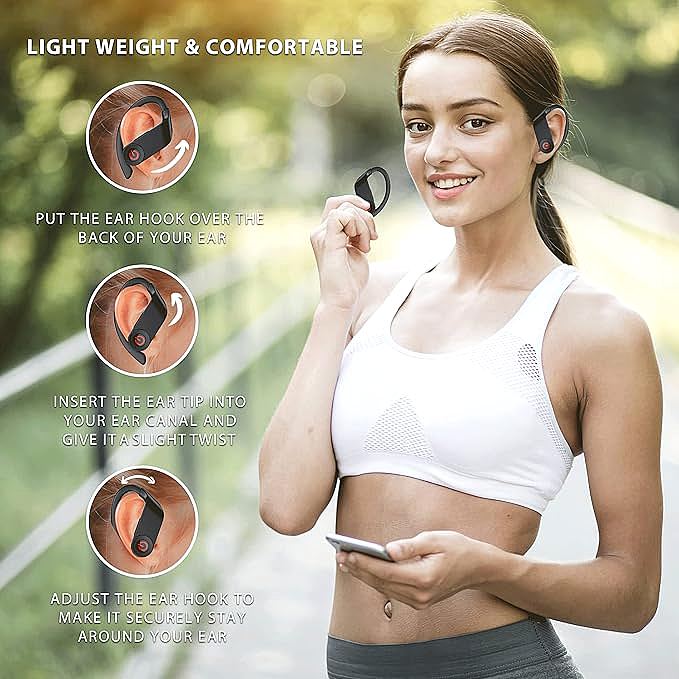
To counteract this biomechanical reality, structural anchoring must be introduced to shift the center of gravity and alter the fulcrum of the device. The application of a flexible, over-ear hook fundamentally changes the physics of the fit. By looping a soft polymer arm over the pinna (the outer ear), the device establishes a superior anchor point that relies on structural blockage rather than mere friction.
When the runner’s foot strikes the pavement and downward gravitational acceleration attempts to pull the 6.7-ounce mass of the chassis out of the ear, the downward force is caught and dispersed across the wide, curved surface of the top of the ear. The flexible nature of the hook ensures this force distribution occurs without causing localized pressure necrosis (pain points), successfully isolating the delicate acoustic seal in the ear canal from the violent kinetic shock of the runner’s body.
Volumetric Constraints vs. Chemical Endurance
The ultimate limiting factor in any portable electronic device is energy storage. Lithium-ion chemistry dictates a strict mathematical relationship between the physical volume of a battery cell and the total amount of electrical current it can discharge.
In a wearable audio device, the internal volume is fiercely contested real estate, fought over by the acoustic chamber, the Bluetooth antenna, the DSP microprocessors, and the battery cell itself. Achieving a continuous playback duration of 10 hours from a device small enough to fit in the ear requires extreme electrical frugality.
This longevity is achieved through a symbiotic relationship with the Bluetooth 5.1 Low Energy (LE) protocol, which aggressively power-gates the radio transmitter, shutting it down for microseconds between data packets to conserve milliamps.
However, chemical limits eventually intervene. The solution is distributed power architecture. By outfitting the storage chassis with a substantial 950mAh lithium-ion reservoir, the system shifts the bulk of its chemical mass out of the user’s ear and into their pocket. The case acts as a localized power grid, continually replenishing the smaller internal cells of the earbuds via localized induction or physical copper pin contacts, extending the total operational envelope to 50 hours. The integration of an LED display bridges the gap between chemical reality and user experience, translating raw voltage data into a digestible metric so the user is never caught with a depleted energy grid.
Beyond the Acoustic Payload
The engineering present in robust, sport-focused acoustic hardware represents a critical stepping stone in the evolution of human-computer integration. By successfully solving the problems of ingress protection, kinetic anchoring, and stable RF transmission, engineers have established a reliable, permanent beachhead within the human ear canal.

The current utilization of this real estate—delivering 14.2mm dynamic driver audio across an IPX7-rated Bluetooth 5.1 link—is merely the first phase. The ear canal is a dark, highly vascularized environment, uniquely suited for high-precision optical sensors. As these protective architectures become standardized, future iterations of athletic audio gear will inevitably shift from passive acoustic receivers to active biometric sensor arrays, utilizing their unshakeable physical grip to monitor core body temperature, blood oxygenation, and precise heart rate variability, seamlessly intertwining acoustic motivation with profound biological telemetry.