Why the Best Thinkers Don't Work in Silence

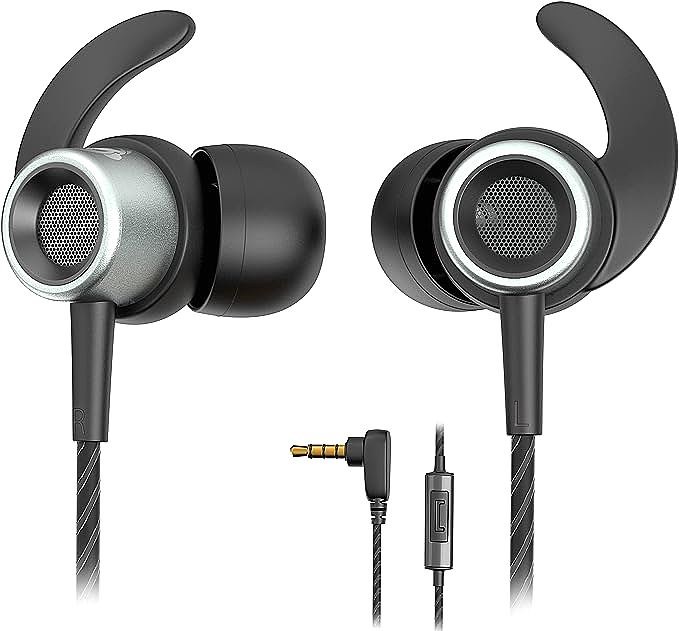
LUDOS SPECTA Wired Earbuds
In 1954, an acoustics engineer discovered something counterintuitive: the most productive people didn't work in the quietest rooms. They worked surrounded by a specific kind of sound—one that masked distraction while actually sharpening thought.
This paradox sits at the heart of everything we understand about human concentration. We assume silence is golden. We chase quiet offices, noise-canceling headphones, and secluded workspaces. But the science of attention tells a different story—one about sound environments, cognitive load, and the unexpected physics of creating mental space in a world designed to interrupt you.
The Paradox of Silence
Silence isn't empty. It's full of invisible threats.
When you sit in a supposedly quiet room, your auditory system remains hyperactive. The brain constantly monitors for threats—even sounds you don't consciously notice. A door closing three offices away. The hvac system's barely perceptible hum. Someone chewing gum two cubicles over. Each of these registered sounds consumes a tiny slice of your cognitive budget, even when you don't realize it.
This is the paradox of silence: true quiet requires more mental effort than you think. Your brain is doing the work of a sentry, scanning for danger in what appears to be nothing.
The solution isn't more silence. It's smarter sound.
How Your Brain Betrays You in Open Spaces
Open offices were supposed to foster collaboration. Instead, they became factories of distraction.
The problem lies in how working memory—the mental scratchpad where you hold and manipulate information—handles auditory input. When background speech enters your awareness, even at low volumes, your brain attempts to process it. Language is particularly invasive because your neural pathways are optimized for speech recognition. Unlike random noise, speech automatically triggers comprehension systems, pulling you into other people's conversations whether you want it or not.
Researchers call this involuntary auditory attention. Your brain doesn't ask permission. It simply hijacks your cognitive resources whenever human speech is detected.
This creates a cruel math for knowledge workers. In a typical open office, you might lose 5-10% of your cognitive capacity to auditory distraction every hour. Over an eight-hour workday, that's nearly an entire work session lost to sounds you didn't choose to hear.
The impact compounds. After each distraction, your brain needs time to rebuild the mental context you had before the interruption. Studies suggest this "recovery time" can take anywhere from 15 to 25 minutes per incident. Three unplanned conversations in a morning could cost you most of a productive day.
The Physics of Sound Barriers
Passive noise isolation works differently than most people assume.
When you place an earbud with a silicone tip into your ear canal, you're not just blocking sound. You're creating an acoustic seal—a physical barrier that reflects sound waves rather than letting them reach your eardrum.
The physics is elegant. Sound travels as pressure waves. When these waves hit the boundary between air and the soft silicone tip, most of their energy reflects back. Only the highest-frequency, sharpest sounds might penetrate this barrier, and even those arrive significantly attenuated.
What makes this remarkable is what the blocked frequencies contain. The sounds most damaging to concentration—human speech, particularly in the 300-3000 Hz range where conversation lives—happen to be exactly the frequencies that a well-sealed ear canal blocks most effectively.
This acoustic seal does something else: it creates what audio engineers call a "mini listening room" for your ear. With external noise suppressed, you can hear subtle details in your audio that would otherwise be masked. A 14mm driver can reproduce a bassline with accuracy because nothing in the environment is competing with it.
The result isn't silence. It's focus—the quiet that comes not from absence of sound, but from the presence of only what you chose to hear.
Why Wired Audio Makes a Difference
The wireless revolution brought convenience. It also brought compromises.
Bluetooth audio requires compression. Music files get smaller so they can travel through the air without wires. This "lossy" compression discards audio data deemed "less audible"—often the subtle room acoustics, the decay of notes, the spatial information that makes music feel live.
For casual listening, this trade-off matters little. But for focused work sessions where you're using audio to create a concentration environment, every lost detail is a missed opportunity to engage your brain with something meaningful rather than distracting.
Wired connections offer something else: absolute reliability. No pairing to fail mid-task. No battery to die during a flow state. No latency between intent and sound. The 3.5mm jack, a technology dating to the 19th century, remains superior for one reason: it's a direct, uncompressed connection between your audio source and your ears.
For the deep worker, this dependability matters. Your concentration environment shouldn't require troubleshooting.
The Deep Work Audio Stack
Creating the ideal sound environment for cognitive work involves understanding what your brain needs.
First, the environment must block intrusive speech. Human voices are the primary distractors in knowledge work settings. Any effective solution must address them specifically.
Second, the replacement audio—if you use audio—should be non-intrusive. Music with lyrics engages language processing, creating internal competition with whatever you're trying to think about. Instrumental music, ambient sounds, and white or pink noise work better because they don't trigger the same comprehension systems.
Third, the volume should be at a level where you're not fighting to hear it. Your brain uses audio to gauge safety; if it must strain to hear your focus audio, it stays alert for threats. The ideal level is loud enough to feel present but quiet enough to feel relaxed.
Finally, physical comfort matters for extended sessions. Earbuds that cause ear fatigue after thirty minutes become obstacles to deep work rather than enablers.
The goal isn't to block the world. It's to build a wall around your mental workspace—a space where external chaos becomes internal calm.
The Engineering Behind the Seal
One example illustrates these principles in practice: earbuds like the LUDOS SPECTA, which use silicone tips to create that acoustic seal we discussed.
With a 14mm driver—a relatively large driver for in-ear monitors—such earbuds can move enough air to reproduce low frequencies accurately. This matters because bass isn't just about music quality; low-frequency sound provides a satisfying "weight" to the audio environment that feels grounding rather than harsh.
The braided cable design addresses a different problem: durability. A wired earbud that lasts through daily use becomes reliable infrastructure for your concentration practice. When you reach for your focus tool, it should work—not tangle, not fray, not require adjustment.
These engineering choices—acoustic sealing, driver size, cable construction—exist to serve one purpose: creating a portable sound environment that supports extended cognitive work.
Designing for Hours, Not Minutes
The difference between a tool you use occasionally and a tool that becomes part of your practice is comfort over time.
Any earbud can provide noise isolation for a short period. The engineering challenge emerges when you ask someone to wear them for three hours of deep focus. That's when pressure points matter. When cable microphonics—the noise generated by a cable brushing against clothing—become annoying. When the weight of the device becomes noticeable.
The best audio setups for deep work disappear. They become invisible infrastructure, present but unremarkable. You stop thinking about them and start thinking about your work.
This is the ergonomic imperative: design for the marathon, not the sprint.
The Ritual of Concentration
What you choose to listen to during deep work becomes conditioned to concentration.
Over time, your brain learns to associate certain audio patterns with focused states. The ambient soundtrack of your best work sessions becomes a cue—a trigger that helps you transition into cognitive mode.
This is why the deep work audio setup matters beyond mere noise blocking. You're not just creating silence. You're constructing a sensory environment that supports a particular quality of attention.
Some prefer instrumental music that provides energy without words. Others find white noise or nature sounds more effective. The specific choice matters less than the consistency and the principles behind it: non-intrusive, comfortable for extended wear, effective at blocking the frequencies that interrupt thought.
The wired earbud, derided as obsolete by the wireless enthusiasts, remains a profound tool for the knowledge worker who takes concentration seriously. Its direct connection, uncompressed audio, and zero-battery-dependency make it infrastructure rather than accessory.
In a world designed for constant interruption, the person who builds a sound environment for deep work gains an extraordinary advantage. The science of sound, the physics of acoustic sealing, and the psychology of attention all point toward the same conclusion: the best thinkers don't just accept their audio environment. They engineer it deliberately.
Your next deep work session deserves the same consideration.
LUDOS SPECTA Wired Earbuds
Related Essays

The Case for "Obsolete" Tech: Why Wired Earbuds Still Win on Latency and Reliability

JAAMIRA JR-EM390 Sports Wired Earbuds: The Ergonomic Science of Staying Put and Sounding Great During Your Most Active Moments
MINDBEAST SPS-HD03 Noise Cancelling Headphones - Great Sound and Value for Money

Sephia SP2040 Earbuds – Enhanced Sound Quality and Comfort

sephia SP3030 Wired Earbuds: Exceptional Noise-Isolating Audio Immersion on a Budget

Skullcandy Ink'd+ In-Ear Earbuds: Understanding Your Sound - Affordable Audio Science Explained

Avantree ME12 Sports Wired Earbuds: Secure Fit & Balanced Sound for Your Workout

Symphonized FBA_nrg3.0gbk Wired Earbuds with Microphone - Noise Isolating Headphones with Wire

Why Your Earbuds Sound Wrong: The Physics Most People Never Learn
