The Invisible Audit: Thermal Diagnostics for Home and Industry
Update on Feb. 1, 2026, 2:20 p.m.
Our buildings and machines speak a language we cannot hear or see: the language of heat. Every electrical circuit, every HVAC duct, and every insulated wall emits a thermal signature that reveals its operating condition. By utilizing thermal imaging technology, maintenance professionals and homeowners can translate this invisible language into actionable data. The ability to perform a “thermal audit” is not just about having the tool; it is about understanding the thermal behavior of structural and mechanical systems.

Electrical Audits: Resistance Equals Heat
The fundamental principle of electrical thermography is simple: resistance generates heat. As components degrade—whether due to corrosion, loose connections, or overloading—their electrical resistance increases. This manifests as a localized temperature rise, or a “hotspot.”
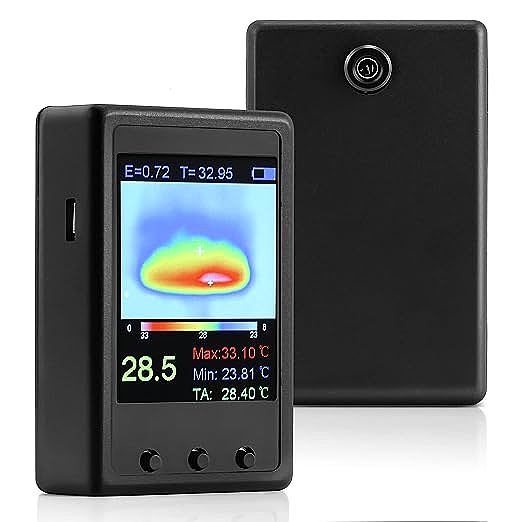
According to the National Fire Protection Association (NFPA), nearly 10% of building fires are related to electrical system failures. A thermal imager like the UNI-T UTi89 Pro allows for safe, non-contact scanning of these systems under load.
* What to Look For: When scanning a breaker panel, look for temperature anomalies rather than absolute values. If one breaker is significantly hotter than its neighbors carrying a similar load, it indicates a fault.
* Delta T: The critical metric is “Delta T” ($Delta T$)—the temperature difference between the component and the ambient air or a similar reference component. A $Delta T$ of even 5°C can indicate a problem requiring investigation.
* Safety: The 80x60 resolution is ideal here because the “hotspot” is usually distinct and bright against the cooler background, easily identifiable even from a safe distance.
HVAC Efficiency: Visualizing Airflow
Heating, Ventilation, and Air Conditioning (HVAC) systems are notoriously difficult to diagnose because air is invisible. Thermal imaging changes this by allowing you to see the effect of the air on solid surfaces.
* Duct Leaks: Uninsulated or leaking ducts will change the temperature of the surrounding ceiling or crawlspace. In cooling mode, a leak will appear as a cold plume spreading across the adjacent insulation or drywall.
* Register Balance: By pointing the imager at supply vents, you can quickly visually verify if all registers are delivering air at roughly the same temperature. A register that appears “fainter” (closer to room temperature) than others may indicate a disconnected duct or a closed damper deep in the system.
* Coil Performance: Scanning the evaporator and condenser coils can reveal blockages. A uniform temperature gradient suggests proper operation, while irregular “bands” of temperature may indicate clogged tubes or uneven refrigerant flow.
Moisture Detection: The Evaporative Signature
Water is the enemy of building integrity, often hiding behind drywall or under floorboards until significant damage is done. Thermal cameras are potent moisture detectors, not because they “see” water, but because they detect the physics of evaporation.
As water evaporates from a surface, it consumes heat energy, creating a localized cooling effect. This evaporative cooling appears as a distinct cold (blue/dark) anomaly on the thermal screen.
* Roof Leaks: During the evening, after the sun has set, dry roof insulation cools down faster than wet insulation (which retains heat). A thermal scan can reveal the warmer, wet patches.
* Plumbing Leaks: Conversely, inside a home, a leak from a hot water pipe will show as a spreading red stain, while a cold water leak or moisture seepage will appear as an amorphous cold shape.
The Importance of Ruggedized Tools
Performing these audits often requires squeezing into crawlspaces, climbing ladders, or working in dusty industrial environments. The durability of the diagnostic tool is as important as its optical performance. The UNI-T UTi89 Pro is engineered with an IP65 rating, meaning it is dust-tight and protected against water jets. Furthermore, its 2-meter drop specification ensures that an accidental slip from a ladder doesn’t end the inspection.
Reliable tools allow inspectors to focus on the data rather than worrying about the device. By systematically scanning for thermal anomalies—whether hot (electrical) or cold (moisture)—users can move from reactive repairs to predictive maintenance, catching issues when they are merely 0.15°C temperature differences, long before they become catastrophic failures.
Start your preventative maintenance routine today. A simple scan can save thousands in repairs.