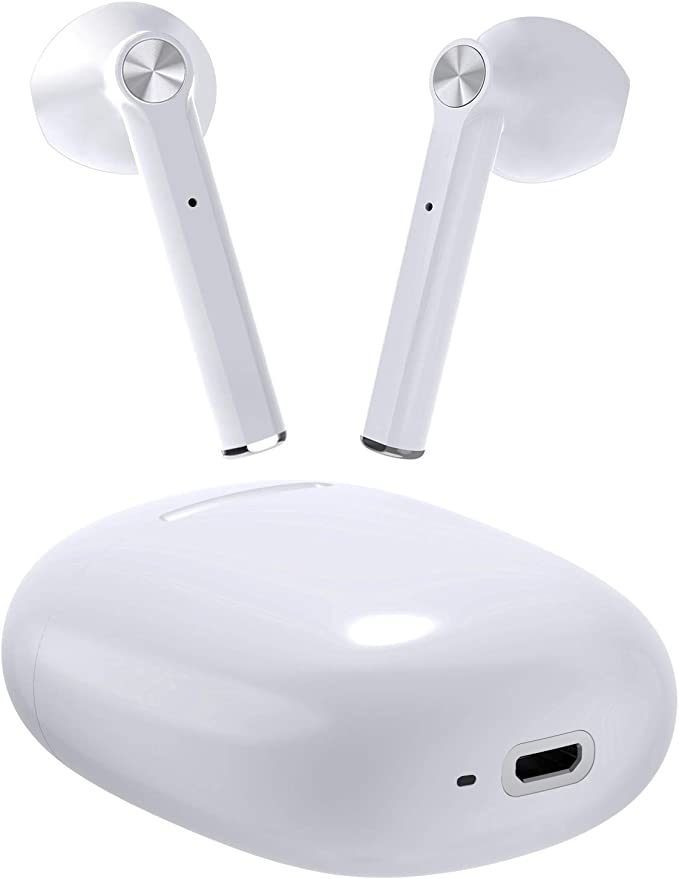
Why Mother-of-Pearl Earbuds Shimmer: The Physics of Structural Coloration
Update on March 10, 2026, 11:06 a.m.
For centuries, humans have been captivated by a material that seems to hold liquid light within its solid form. We’ve seen it inlaid in the thrones of Persian kings, adorning the necks of flappers in the Roaring Twenties, and glistening on the handles of antique silverware. It’s called mother-of-pearl, or nacre. It’s not a gemstone, but the architectural masterpiece of a living creature. And in an age of mass-produced plastic, the idea of placing this timeless, natural jewel in your ear raises a fascinating question: what happens when a material born of the sea, steeped in history, learns to sing the digital anthems of our lives?

The answer lies not in marketing claims, but in materials science—a discipline that has studied nacre for decades, long before it found its way into consumer electronics.
The Brick-and-Mortar Architecture of Nature
To hold a piece of mother-of-pearl is to hold a minor miracle of biomimicry. What looks like a simple iridescent shell is, at the microscopic level, one of nature’s most sophisticated engineered structures.
Scientific research published in Nature Materials reveals that nacre is built like a flawless brick wall. Ninety-five percent of it consists of tiny, hexagonal platelets of aragonite—a form of calcium carbonate (CaCO₃). These platelets act as the “bricks.” The remaining five percent is a flexible biopolymer matrix that serves as the “mortar,” binding the aragonite platelets together.
Why This Architecture Matters:
| Structural Element | Function | Engineering Analogy |
|---|---|---|
| Aragonite platelets | Provide hardness and stiffness | Ceramic tiles in body armor |
| Biopolymer layers | Absorb and dissipate energy | Rubber shock absorbers |
| Layered structure | Forces cracks to navigate around platelets | Maze vs. straight path |
This brick-and-mortar design is so effective at absorbing and dissipating energy that nacre is approximately 3,000 times tougher than pure aragonite crystals. Scientists have studied this structure to design better body armor, fracture-resistant ceramics, and lightweight composite materials for aerospace applications.
The evolutionary context is staggering: mollusks have perfected this architecture over more than 500 million years. What takes modern engineers millions in R&D budgets, nature achieved through patient biological iteration.
Why Mother-of-Pearl Shimmers: Structural Coloration Explained
The shimmering, rainbow luster of mother-of-pearl is not caused by pigments or dyes. It’s physics in action—a phenomenon called structural coloration.
Unlike the colors we see in paint or ink (which absorb certain wavelengths and reflect others), structural coloration creates color through physical interaction with light. The mechanism is the same one that produces the iridescent blues of a Morpho butterfly’s wings, the greens and golds of a peacock’s feathers, and the shifting rainbow on a soap bubble.
How Structural Coloration Works in Nacre:
Step 1: White light (containing all visible wavelengths) hits the surface
Step 2: Light penetrates the layered aragonite structure
Step 3: Each layer reflects some light, transmits the rest
Step 4: Reflected waves interfere with each other
         - Constructive interference: certain wavelengths amplified
         - Destructive interference: certain wavelengths canceled
Step 5: Your eye perceives only the amplified wavelengths as color
Key Variables That Determine Color:
| Variable | Effect | Why It Matters |
|---|---|---|
| Layer thickness | Determines which colors appear | Must match light wavelength (~400-700nm) |
| Viewing angle | Color shifts as you move | Path length changes, different interference |
| Number of layers | Intensity and saturation | More layers = stronger, more vivid effect |
This is why a single piece of mother-of-pearl appears to change color as you rotate it. The physics of thin-film interference means that different wavelengths are amplified at different angles. A shell that looks predominantly white from one angle might flash blue, green, or pink from another.
Why Each Shell Is Unique:
The layer spacing in nacre varies with the mollusk’s life history—ocean temperature, diet, age, and environmental conditions all affect growth patterns. No two shells have identical layer spacing, which means no two shells display identical colors. This biological variation is fundamentally different from manufactured materials, where consistency is the goal.

This uniqueness explains why claims of “360-hour handmade craftsmanship” aren’t merely marketing language—they reflect the genuine care required to work with a material that cannot be mass-produced with identical results. Cutting, polishing, and shaping nacre without destroying its natural optical properties requires skilled human hands and significant time.
Gold in a Vacuum: Physical Vapor Deposition
Complementing the natural shell is a metallic finish applied through a process described as “gold vacuum plating.” In materials science, this points to an advanced technique called Physical Vapor Deposition (PVD).
PVD is not the electroplating process used for costume jewelry. Traditional electroplating relies on chemical baths and electrical current to deposit metal layers—effective, but prone to tarnishing and inconsistent thickness.
How PVD Works:
Step 1: Parts are placed in a high-vacuum chamber
Step 2: Target material (e.g., titanium nitride) is introduced
Step 3: Plasma arc vaporizes the target material
Step 4: Atoms travel through the vacuum to the part surface
Step 5: Atoms bond directly to the surface at a molecular level
PVD vs. Traditional Electroplating:
| Aspect | Electroplating | PVD |
|---|---|---|
| Process | Chemical baths, electrical current | Vacuum chamber, plasma vaporization |
| Coating thickness | 5-20 μm | 0.5-5 μm (thinner but denser) |
| Durability | Good, can tarnish over time | Excellent, highly scratch-resistant |
| Environmental impact | Chemical waste requires treatment | Minimal waste, eco-friendly |
| Common applications | Costume jewelry, decorative items | Luxury watches, aerospace components |
The result of PVD is a coating that is incredibly thin yet immensely durable—resistant to tarnish, abrasion, and corrosion. This is why the luxury watch industry has adopted PVD as a standard for gold-colored timepieces. A PVD-coated watch can withstand daily wear, sweat exposure, and UV radiation without the fading that plagues electroplated alternatives.
Trade-Offs of PVD:
| Advantage | Disadvantage |
|---|---|
| Scratch resistance (800-2000 HV hardness) | Equipment costs $500K-$2M |
| Corrosion resistance (saltwater, sweat) | Process takes 2-4 hours per batch |
| Consistent color (no batch variation) | Cannot be easily repaired |
| Hypoallergenic (no nickel release) | High barrier to entry for manufacturers |
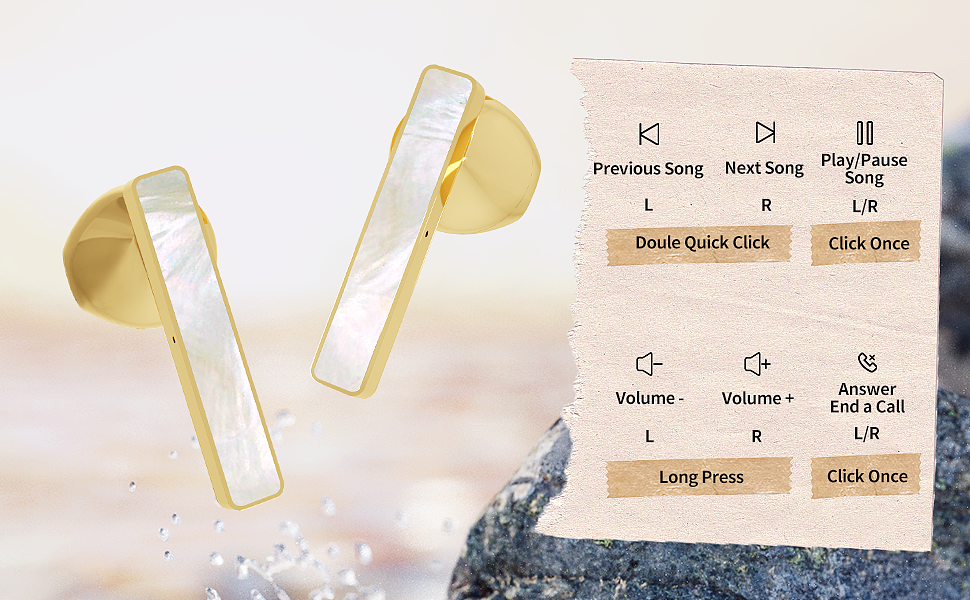
The marriage of natural shell with PVD coating represents a convergence of biological evolution and human engineering—nature’s resilient architecture enhanced by humanity’s most precise manufacturing techniques.
The Acoustics Inside the Jewel
A beautiful object for the ear must also deliver sound that justifies its placement in one of the body’s most sensitive sensory organs. This is where materials science meets acoustics.
Driver Size and Sound Quality:
The housing contains a 13mm dynamic driver. To understand why this matters, consider the physics of sound reproduction.
A speaker driver works like a drum. When an electrical signal passes through the voice coil, it creates a magnetic field that pushes and pulls the driver diaphragm. The diaphragm moves air, creating pressure waves that your ear perceives as sound.
Driver Size Comparison:
| Driver Size | Typical Use | Sound Characteristics |
|---|---|---|
| 6-8mm | Compact, minimalist earbuds | Bright highs, limited bass response |
| 10-12mm | Standard true wireless earbuds | Balanced sound, moderate bass |
| 13mm+ | Larger premium earbuds | Deep bass, full soundstage, more air displacement |
The physics of air displacement explains this difference:
Air Displacement = Diaphragm Area × Excursion Distance

Comparing 13mm vs 6mm drivers:
- Surface area ratio: π(6.5)² / π(3)² ≈ 4.7x more surface area
- A 13mm driver can move approximately 4-5x more air per cycle
- More air displacement = stronger bass frequencies with less distortion
Analogy: A large drum can produce deep, resonant bass that a small tambourine simply cannot match. The 13mm driver is the difference between a bass drum and a snare—it’s about physical capability, not just tuning preference.
Bluetooth 5.3 and LE Audio:
The wireless signal arrives via Bluetooth 5.3, which according to the Bluetooth Special Interest Group (SIG), introduces full support for LE Audio (Low Energy Audio). This standard uses a highly efficient codec called LC3, which can deliver higher-quality audio while consuming significantly less power than traditional SBC or AAC codecs.
The practical benefit: more efficient data transmission means less battery drain, contributing to the claimed six-hour continuous playtime from the earbuds themselves.
Environmental Noise Cancellation (ENC) for Calls:
When making calls, the earbuds employ Environmental Noise Cancellation (ENC). This technology uses outward-facing microphones to sample ambient noise—street traffic, café chatter—and creates a digital filter to reduce that noise from your voice transmission.
ENC vs. ANC: Critical Distinction:
| Technology | Purpose | Who Benefits |
|---|---|---|
| ENC (Environmental Noise Cancellation) | Makes YOUR voice clearer to the listener | The person on the other end of the call |
| ANC (Active Noise Cancellation) | Makes the world quieter for YOU | The wearer/listener |
This distinction matters because user feedback reflects the design trade-off. Reviews indicate that while music playback quality receives praise, call quality receives mixed assessments—some users report sounding “far away” or “breaking up” during calls. This is a common pattern in earbuds that prioritize aesthetics and music playback over dedicated communication performance.
Battery Mathematics and Durability Reality
The claimed 100-hour total playtime requires context to understand what this number represents.
How Manufacturers Calculate “100 Hours”:
Earbud battery: 6 hours per charge (at 50% volume, moderate codec)
Charging case capacity: ~300-400mAh = ~15-16 full recharges
Total: 6hrs × 16 + 6hrs = ~100 hours
Real-World Variables That Reduce Battery Life:
| Factor | Typical Impact | Why |
|---|---|---|
| Volume level | -20% at 80% volume | Higher amplitude requires more power |
| Audio codec | -10% for aptX/AAC vs. SBC | More complex decoding = more processing |
| Call usage | -30% during calls | Microphone + transmission power |
| Temperature | -20% in freezing conditions | Li-ion chemistry less efficient in cold |
Realistic Expectation: 100 hours claimed → approximately 70-80 hours in real-world mixed usage.
IP55 Rating: What It Means (and Doesn’t Mean):
The IP55 rating is defined by the International Electrotechnical Commission’s (IEC) 60529 standard. This code is not a vague promise but a specific measure of resilience.
IP55 Breakdown:
| Digit | Rating | Protection Level |
|---|---|---|
| First (5) | Dust protected | Limited ingress (no harmful deposit) |
| Second (5) | Water jets | Low-pressure water from any direction |
What IP55 CAN Handle:
- ✅ Sweat during workouts
- ✅ Rain exposure
- ✅ Accidental splashes
- ✅ Dust in gym bags or pockets
What IP55 CANNOT Handle:
- ❌ Submersion in water (that’s IPX7 or IPX8)
- ❌ High-pressure water jets
- ❌ Saltwater immersion (corrosive to metals)
- ❌ Direct shower spray (steam can penetrate seals)
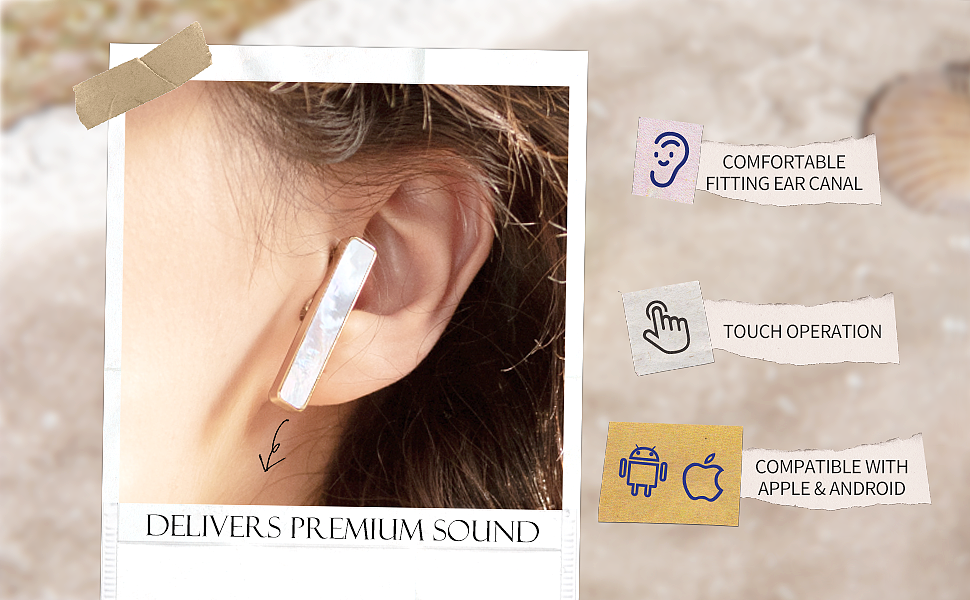
Critical Context: IP55 is “splash-resistant,” not “waterproof.” It’s suitable for workouts and rain, but not swimming or submersion. This distinction matters for consumers who might confuse IP55 with the higher IPX7 rating found in some competitors.
The Honest Trade-Off: Fashion Meets Function
The integration of natural materials into consumer electronics represents a deliberate design choice—one that involves genuine engineering trade-offs.
What You Gain:
| Benefit | Why It Matters |
|---|---|
| Unique aesthetics | Each pair is visually distinct due to biological variation |
| Lightweight strength | Nacre’s brick-mortar structure provides durability at low weight |
| Hypoallergenic surface | Natural calcium carbonate is biocompatible (ISO 10993) |
| Conversation value | Distinctive materials invite questions and appreciation |
| Premium presentation | Jewelry-style packaging enhances gift-giving experience |
What You Trade Off:
| Trade-Off | Why It Exists |
|---|---|
| Call quality | Microphone placement prioritizes aesthetics over optimal positioning |
| Cost | Natural materials + PVD coating +手工 craftsmanship = higher BOM cost |
| Weight | Shell + metal housing heavier than all-plastic alternatives |
| Repairability | Natural materials cannot be easily replaced if damaged |
| Consistency | Biological variation means no two units are identical |
The Call Quality Reality:
User reviews reveal a consistent pattern: music playback receives praise (“amazing sound quality,” “immersive”), while call quality receives qualified assessments (“people tell me I sound far away,” “not for lots of calls”). This is not a defect—it’s the expected outcome of prioritizing aesthetic integration over communication-optimized microphone placement.
For users whose primary use case is music and podcast listening, this trade-off is irrelevant. For frequent business callers, it’s a legitimate consideration that should factor into the purchase decision.
The Takeaway: A Living Material Learns to Sing
The journey of a fragment of nacre—from the ocean depths to an artisan’s hands to a vacuum chamber where it bonds with titanium nitride atoms—is a remarkable intersection of biology, physics, and engineering.
Mother-of-pearl earbuds are not merely a fashion statement. They represent a materials science achievement: harnessing 500 million years of evolutionary refinement and combining it with human manufacturing precision. The shimmering rainbow you see is not a coating or a dye—it’s light itself, captured and manipulated by a structure that predates human engineering by hundreds of millions of years.
For Buyers:
| If you prioritize… | Consider this category |
|---|---|
| Unique aesthetics + conversation value | Natural material earbuds excel |
| Music/podcast listening | 13mm drivers deliver satisfying sound |
| Gift-giving | Premium presentation adds emotional value |
| Frequent business calls | Consider communication-optimized alternatives |
| Swimming/water sports | Look for IPX7+ rated options |
| Budget-conscious purchase | Plastic alternatives offer better value |
The honest assessment: natural material earbuds are not for everyone. They are for listeners who value the story behind their technology, who appreciate that their earbuds are literally one-of-a-kind, and who understand that fashion-forward design sometimes involves functional trade-offs.
Technology does not have to be a cold, plastic monolith. It can be personal, historical, and in its own way, alive—a living jewel that has finally found its voice. But that voice comes with the honest admission that it sings more beautifully for music than for phone calls.
Both positions are defensible. The informed choice starts with understanding what you’re actually buying: not just earbuds, but a piece of evolutionary history that learned to play your playlist.