Hybrid Theory: The Physics of Dynamic and Balanced Armature Drivers in Modern IEMs
Update on Jan. 10, 2026, 5:20 p.m.
The world of high-fidelity (Hi-Fi) audio has long been guarded by a high barrier to entry. For decades, terms like “soundstage,” “imaging,” and “separation” were the exclusive vocabulary of those willing to spend hundreds, if not thousands, of dollars on gear. However, a quiet revolution has been taking place in the manufacturing hubs of the audio industry. Advanced acoustic technology, once reserved for flagship models, has trickled down to the entry-level market.
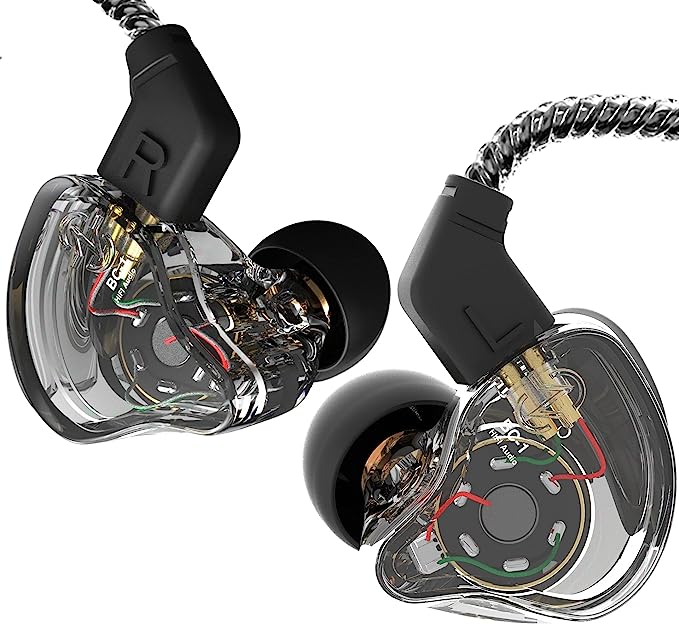
The YINYOO CCZ Melody stands as a prime example of this democratization. Retailing for around $20, it boasts a Hybrid Driver configuration—a feature that was practically unheard of in budget earphones just a few years ago. But what exactly is a “Hybrid Driver,” and why does it matter? To understand the significance, we must look beyond the marketing buzzwords and delve into the fundamental physics of how we turn electrical signals into sound.
This article explores the two distinct technologies powering modern In-Ear Monitors (IEMs): the Dynamic Driver (DD) and the Balanced Armature (BA). We will examine how they work, why they sound different, and how combining them creates a sum greater than its parts.
The Workhorse: The Dynamic Driver (DD)
The Dynamic Driver is the oldest and most common type of transducer. If you’ve ever seen a loudspeaker with a vibrating cone, you’ve seen a dynamic driver. Its operation is based on the principle of electromagnetic induction.
The Mechanics of Air Movement
A coil of wire (voice coil) is attached to a diaphragm (usually made of plastic, bio-cellulose, or metal). This coil is suspended within the magnetic field of a permanent magnet. When an audio signal (electricity) flows through the coil, it creates a fluctuating magnetic field that pushes and pulls against the permanent magnet. This moves the diaphragm back and forth, displacing air and creating sound waves.
The superpower of the Dynamic Driver is Air Displacement. Because the diaphragm has a relatively large surface area (10mm in the case of the CCZ Melody) and a long “throw” (range of motion), it can move a significant volume of air. This is crucial for reproducing Low Frequencies (Bass). Bass waves are long and require substantial energy to be felt. The DD provides that visceral “thump” and “rumble” that forms the rhythmic foundation of music. It gives the sound its body, warmth, and texture.
The Specialist: The Balanced Armature (BA)
The Balanced Armature driver operates on a completely different principle. Originally developed for hearing aids, BAs are microscopic in size and incredibly efficient.
The Mechanics of Precision
Inside a BA driver, there is no voice coil moving a large cone. Instead, a tiny armature (a metal reed) is balanced between two magnets. A coil is wrapped around this armature. When electricity flows, the armature pivots, moving a tiny drive pin connected to a microscopic diaphragm.
The superpower of the Balanced Armature is Speed and Transient Response. Because the moving parts have almost zero mass, they can start and stop vibrating instantaneously. This makes them exceptional at reproducing High Frequencies (Treble). High notes—the shimmer of a cymbal, the breath in a vocalist’s voice, the snap of a snare drum—require rapid-fire vibrations (up to 20,000 times per second). A heavy Dynamic Driver often struggles to move this fast without blurring the sound (distortion). The BA handles these details with surgical precision, revealing layers of music that a standard earbud would simply smear over.
The Hybrid Synergy: The Best of Both Worlds
For years, engineers had to choose. Use a Dynamic Driver for great bass but sacrifice treble detail? or use a Balanced Armature for great detail but accept tinny, weak bass?
The Hybrid Driver Architecture of the CCZ Melody solves this by using both. * 10mm Dynamic Driver: Dedicated to the Lows and Mids. It provides the punch, the warmth, and the natural timbre of drums and bass guitars. * Balanced Armature: Dedicated to the Highs. It sits closer to the ear nozzle, firing high-frequency details directly into the ear canal for maximum clarity.
The Crossover Network
Merging these two drivers isn’t as simple as wiring them together. Without control, they would overlap in the middle frequencies, causing “muddy” sound and phase cancellation. This is where the Electronic Crossover comes in.
The crossover is a circuit that acts like a traffic cop. It splits the incoming audio signal. It sends the low-frequency energy to the Dynamic Driver and the high-frequency energy to the Balanced Armature. A well-tuned crossover ensures a seamless transition between the two. When you listen to a track on the CCZ Melody, you shouldn’t hear “two drivers”; you should hear a single, cohesive image where deep bass and sparkling treble coexist without fighting each other.
The Pipeline: 4N OFC Cable Physics
Finally, the signal must reach these drivers intact. The CCZ Melody utilizes a 4N OFC (Oxygen-Free Copper) cable. In metallurgy, “4N” stands for “Four Nines” (99.99% purity).
Why does purity matter? Impurities in copper (like oxygen or iron) act as microscopic roadblocks to the electrical signal, creating resistance. While the audible difference is often debated, physically, high-purity copper ensures the least possible resistance and signal loss.
Moreover, the Detachable 2-Pin Design is a professional feature borrowed from stage monitors. Cables are the most fragile part of any headphone. By making the cable replaceable, the lifespan of the IEM is theoretically infinite. If the cable breaks, you replace the wire ($10-$15), not the entire earphone. This modularity is a core tenet of sustainable, professional audio gear.
Conclusion: The Physics of Value
The YINYOO CCZ Melody is not just a “good deal.” It is a lesson in applied physics. By leveraging the specific mechanical advantages of Dynamic Drivers for air movement and Balanced Armatures for speed, it achieves a level of fidelity that was physically impossible for single-driver budget earphones of the past.
It represents a maturity in the audio market, where high-end engineering principles—hybrid architecture, crossovers, and modular cabling—have become accessible tools for the everyday listener. It proves that you don’t need magic to get great sound; you just need the right combination of magnets, coils, and diaphragms.