Extracting Signal from the Gale: Audio and Energy in Open-Air Environments
Update on March 6, 2026, 10:22 a.m.
In the controlled environment of a recording studio, capturing pristine audio is a matter of isolation and acoustic treatment. However, when audio hardware moves into the kinetic, unpredictable theater of the outdoors—strapped to the head of a runner or cyclist—isolation is violently stripped away. Wind rushes across the hardware, traffic produces chaotic low-frequency rumbles, and the human body itself introduces heavy mechanical shockwaves with every footfall. In these scenarios, the design philosophy of audio hardware must shift from passive capture to aggressive, algorithmic extraction. The engineering challenge is no longer just playing music; it is separating vital communication from an ocean of aerodynamic and acoustic interference.
Why Does Wind Turbulence Destroy Audio Transmission?
To understand the complexity of outdoor voice capture, one must first recognize that wind noise is rarely an acoustic phenomenon in the traditional sense; it is a severe mechanical failure mode. When a runner moves through the air, or when a gust hits a headset, the air does not merely carry sound waves. Instead, kinetic air masses collide directly with the microphone’s diaphragm.
According to the principles of fluid dynamics, as air flows over the small ported openings of a microphone housing, it creates microscopic vortices and rapid fluctuations in static pressure, governed by Bernoulli’s principle. These pressure differentials physically push and pull the highly sensitive microphone diaphragm far beyond its intended operating range. To the digital signal processor (DSP), this chaotic mechanical buffeting is translated into massive, clipping low-frequency voltage spikes. It manifests as a deafening “rumble” that entirely overpowers the comparatively weak pressure waves generated by human vocal cords.
Traditional single-microphone setups fail completely in this environment. A single diaphragm possesses no spatial awareness; it cannot mathematically distinguish between the mechanical impact of wind and the acoustic wave of a spoken word. Overcoming this requires abandoning the idea of a single acoustic sensor and moving toward spatial arrays.
The Acoustic Sieve in Your Ear
The solution to localized environmental chaos lies in a technology known as Environmental Noise Cancellation (ENC), operating via acoustic beamforming. Unlike systems designed to silence the world for the listener, ENC is strictly outbound—it acts as a microscopic sieve, filtering the audio sent to the person on the other end of a phone call.
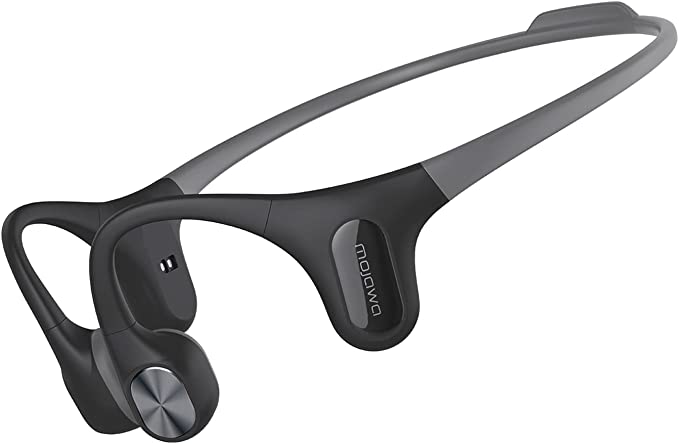
This requires a minimum of two spatially separated microphones, a configuration utilized in devices like the ESSONIO open ear headphones. The architecture relies on differential distance to create a mathematical map of the acoustic space.
-
The Primary Voice Sensor: Positioned as close to the mouth’s acoustic vector as possible. It captures the user’s speech, but inevitably, it also captures a massive amount of the surrounding environmental noise. We can express this mathematically as:
$Signal_1 = Voice + Noise$ -
The Environmental Reference Sensor: Positioned further back on the chassis, specifically engineered to be off-axis from the mouth. Its primary function is to capture a clean sample of the ambient acoustic chaos, with as little voice bleed as possible.
$Signal_2 = Noise’$
With these two distinct data streams, the onboard Digital Signal Processor initiates a high-speed mathematical operation. By analyzing the microsecond delay between a sound wave hitting $Signal_2$ and then $Signal_1$, the DSP can map the origin of the sound. Because the reference microphone provides a real-time template of the environmental noise, the processor can invert the phase of $Signal_2$ and overlay it onto $Signal_1$.
The theoretical output relies on destructive interference:
$Output \approx (Voice + Noise) - Noise’ = Voice$

However, simple phase inversion is insufficient for complex urban environments. Advanced headsets incorporate dedicated, independent ENC acceleration chips to perform Spectral Subtraction. Human speech possesses a very distinct harmonic structure consisting of a fundamental frequency and mathematically related overtones called formants. An independent ENC chip constantly runs Fourier transforms on the incoming audio, identifying frequencies that do not match the geometric model of human vocal cords, and aggressively clamping them down. This is how a voice remains intelligible even when the speaker is surrounded by the erratic broadband noise of a busy intersection.
Algorithmic Subtraction vs. Physical Barriers
A common failure in consumer understanding is conflating ENC with Active Noise Cancellation (ANC). While both rely on phase inversion, their physical requirements and targets are diametrically opposed.
ANC is an inward-facing technology. To effectively cancel low-frequency rumble for the listener, ANC requires a strictly controlled, sealed acoustic chamber. Silicone or memory foam tips must create an airtight seal inside the ear canal. The internal microphone measures the noise that breaches this barrier, and the speaker driver fires an exact anti-phase wave to destructively interfere with it just millimeters from the eardrum. If the physical seal is broken, the predictable acoustics of the ear canal are compromised, and the ANC algorithms fail, sometimes even amplifying the noise through feedback loops.
Open ear headphones deliberately obliterate this physical barrier. By suspending the audio driver outside the ear canal, they allow full acoustic transparency with the environment. Because there is no sealed cavity, ANC is mathematically and physically impossible. Therefore, for an open-air device, the engineering priority shifts entirely to the outgoing signal. ENC becomes the primary defensive layer. The hardware accepts that the listener will hear the wind, but the algorithms ensure the person on the other end of the radio link only hears the voice.
Moving Beyond the Constant Broadcast
No matter how sophisticated the localized audio processing is, the entire system is useless if the data cannot be transmitted to the host device efficiently. The evolution of the Bluetooth protocol represents a decades-long struggle against latency, bandwidth limitations, and battery consumption.
Early Bluetooth iterations (like 4.0 and earlier) operated on a paradigm of constant, serialized broadcasting. To stream stereo audio, the phone had to establish a heavy, continuous link to a primary earbud, which then bounced a secondary stream to the other earbud. This architecture was prone to cross-body interference (as radio waves struggle to pass through the dense water mass of the human skull) and required the radio transceivers to remain constantly powered on, bleeding energy.
The adoption of Bluetooth 5.2 fundamentally restructured this telemetry. The critical breakthrough is the implementation of Isochronous Channels (ISOC), which forms the backbone of LE (Low Energy) Audio.
Instead of a constant, serialized stream, Bluetooth 5.2 utilizes time-synchronized parallel transmission. The host device sends independent, microscopic packets of data to both the left and right receivers simultaneously. This eliminates the need for the earbuds to communicate with each other, drastically reducing the required transmission power.
Furthermore, Bluetooth 5.2 optimizes the “duty cycle.” By compressing the audio data and transmitting it in incredibly fast, dense bursts, the radio transceiver can literally power down and “sleep” in the microsecond intervals between packets. The user hears continuous music, but the hardware is actually cycling between active and dormant states hundreds of times per second. Additionally, the Enhanced Attribute Protocol (EATT) allows for parallel command execution. When a user taps the side of the ESSONIO headset to skip a track or answer a call, that command does not have to wait in a queue behind the audio data stream; it executes instantly, drastically dropping the perceived latency of the hardware interface.
When the Battery Must Outlast the Marathon
Power management in wearable acoustics is an exercise in extreme compromise. A device must be light enough to wear during high-impact sports, which severely limits the physical size and chemical capacity of the lithium-ion cells it can carry. Yet, open-ear acoustic architectures are notoriously power-hungry.
When an audio driver is sealed inside an ear canal, it only needs to move a tiny volume of air to generate high Sound Pressure Levels (SPL) at the eardrum. Conversely, an open-ear transducer is fighting the inverse-square law of sound propagation in free space. The acoustic energy dissipates exponentially as it travels the few millimeters from the speaker grill to the ear canal. To achieve an acceptable volume, the driver must move significantly more air, which requires drawing exponentially more electrical current from the battery.
Achieving claims like 13 hours of continuous playback—and a total of 50 hours utilizing a charging case—requires systemic efficiency across multiple layers.
1. Transducer Thermodynamics: High-gauss neodymium magnets and ultra-low-mass voice coils are utilized to ensure that the maximum amount of electrical energy is converted into kinetic acoustic movement, minimizing energy lost as waste heat.
2. Quiescent Current Optimization: The most impressive metric is often not the active playtime, but the standby endurance. A 90-day standby time indicates that the System-on-Chip (SoC) possesses aggressive deep-sleep states. When the headset is inactive, the power management integrated circuit (PMIC) systematically shuts down the voltage gates to the DSP, the amplifiers, and the radio, reducing the parasitic drain (quiescent current) to mere microamps.

Securing the Kinetic Environment
Acoustics and digital protocols represent only half the engineering equation for sports wearables; the other half is brutal mechanical durability and biomechanical stability.
Human locomotion, particularly running, generates severe ground reaction forces. With every foot strike, a shockwave travels up the skeletal structure, manifesting as rapid, high-G vertical accelerations at the skull. Traditional in-ear monitors rely entirely on the static friction between a silicone tip and the epithelial tissue of the ear canal to remain in place. When the user perspires, the sweat acts as a highly effective lubricant, dropping the coefficient of friction and causing the heavy earbud to violently dislodge during these accelerations.
The open-ear, hanging chassis design bypasses friction entirely by shifting the load-bearing mechanics to the pinna (the external cartilage of the ear). By hooking over the ear, the center of gravity is distributed across a wider structural base, utilizing gravity and geometric tension rather than frictional wedging to maintain stability.
Material science further secures the hardware against the environment. The integration of light space cotton serves a dual purpose: it provides a compliant mechanical buffer against the skin to prevent chafing during repetitive movement, and it utilizes capillary action to wick sweat away from the sensitive electronic enclosures.
To achieve an IPX5 rating, the hardware must withstand low-pressure water jets from any direction. This requires abandoning basic snap-fit plastics. The internal acoustic chambers must be isolated using hydrophobic acoustic meshes. These meshes feature microscopic pores that allow air molecules (sound) to pass through, but the pores are smaller than the surface tension of a water droplet, creating a physical barrier against sweat and rain. The addition of active photon emitters—such as green night running lights integrated into the chassis—pushes the device beyond pure audio playback into the realm of active situational safety equipment.
To Hear Better, Stop Sealing the Ear
For the last two decades, consumer audio has been obsessed with isolation—building thicker ear pads and stronger ANC algorithms to wall the user off from the outside world. However, this approach runs counter to the evolutionary biology of human hearing.
The auditory system did not evolve to listen to isolated, two-channel stereo mixes in a vacuum. It evolved as a 360-degree early warning radar system, constantly mapping the environment for spatial anomalies, approaching vehicles, and social cues. Plugging the ear canal triggers a disorienting physiological phenomenon known as the occlusion effect. When the canal is sealed, the low-frequency bone-conducted sounds of the user’s own footsteps, chewing, and heavy breathing become trapped and artificially amplified, muddying the acoustic experience during physical exertion.
Open-ear architectures reject occlusion. By leaving the ear canal entirely unobstructed, they respect the biological necessity of environmental awareness. The audio is not meant to replace reality; it is engineered to overlay a digital audio stream seamlessly on top of the physical world. As DSP capabilities increase and battery chemistries shrink, the trajectory of outdoor audio is clear. The goal is no longer isolation, but synthesis—allowing the user to consume high-fidelity telemetry, maintain crystal-clear communications through gale-force winds, and still hear the quiet approach of a bicycle bell on a damp morning trail.